



Qualitative Research Method in Sociology
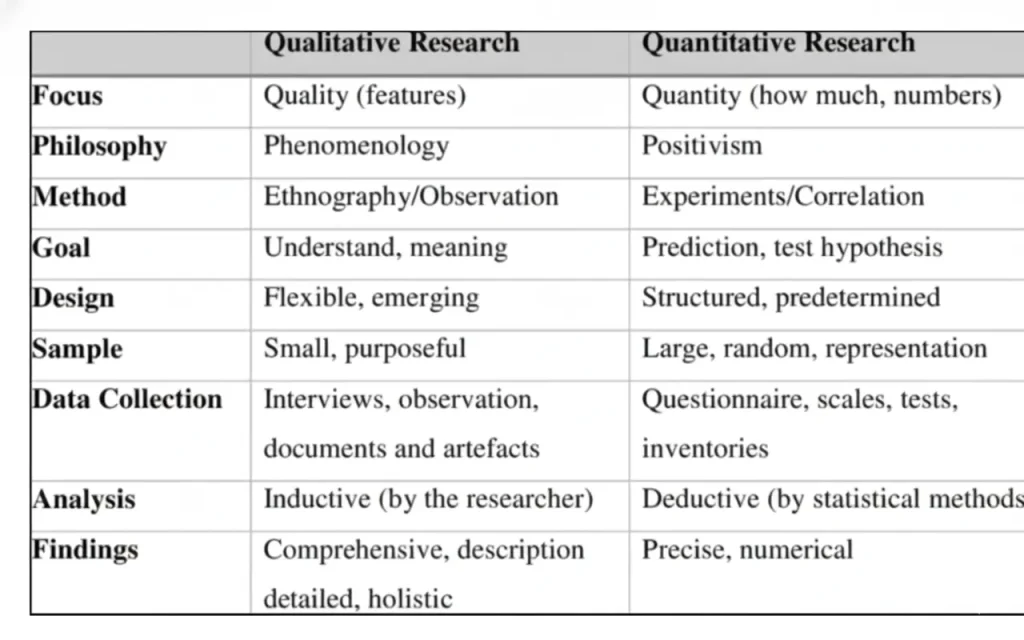
Qualitative research refers to an approach to social research that focuses on non-quantitative analysis and is concerned with understanding qualitative phenomena, that is, phenomena related to meanings, experiences, values, beliefs, and interpretations. Unlike quantitative research, which emphasizes measurement and numerical analysis, qualitative research seeks to explore the depth, complexity, and contextual nature of social reality.
In sociology, qualitative research plays a vital role in understanding how individuals and groups construct meaning, interpret social situations, and experience social processes in everyday life. It is particularly useful when the objective of research is to explore why people behave in certain ways rather than how many behave in that way.

Theoretical Orientation of Qualitative Research
Qualitative research is rooted in interpretivist, phenomenological, and constructivist traditions. These perspectives challenge positivism by arguing that social reality is not external and objective but socially constructed through interaction.
Qualitative researchers emphasize:
- The value-laden nature of inquiry
- The intimate relationship between researcher and subject
- The influence of social, cultural, and situational contexts on knowledge production
As Max Weber argued, sociology should aim at Verstehen—an interpretative understanding of social action from the actor’s point of view.
Nature of Qualitative Research
Qualitative research fundamentally refers to an approach that seeks to describe and analyze human culture and behavior from the perspective of those being studied. It focuses on understanding social reality as lived and experienced by individuals.
For instance, if a researcher wants to investigate the reasons behind human behavior, qualitative techniques such as:
- Word association tests
- Sentence completion tests
- Story completion tests
- Other projective techniques
are preferred, as they allow respondents to express underlying meanings, emotions, and motivations.
Compared to quantitative data, qualitative data are often considered richer, deeper, and more insightful, as they provide a nuanced picture of people’s attitudes, beliefs, and lived experiences.
Methods and Techniques of Qualitative Research
Some commonly used qualitative research methods include:
- Biographical and Life History Studies
- Ethnography
- Participant and Non-participant Observation
- Focus Group Discussions
- Content Analysis
- Case Studies
These methods enable an in-depth understanding of social phenomena within their natural settings.
Key Elements of Qualitative Research
A qualitative research study is broadly defined by three interconnected elements: Research Design, Data Collection, and Data Analysis.
Research Design in Qualitative Research
Naturalistic Design
Qualitative research is conducted in natural, real-life settings where social phenomena occur organically. The researcher observes events as they unfold without artificial manipulation.
Emergent Design
Qualitative research designs are flexible and evolving. As understanding deepens, researchers adapt their strategies, questions, or focus areas. Rigid designs are avoided to allow new insights to emerge.
Purposeful Sampling
Cases are selected deliberately because they are information-rich and capable of providing deep insights into the phenomenon under study.
Data Collection in Qualitative Research
Rich and Detailed Data
Data are derived from in-depth observations, interviews, case studies, documents, and material culture. The aim is to capture complexity rather than frequency.
Personal Experience and Engagement
The researcher has direct and sustained contact with participants and settings. Personal interaction becomes a critical component of inquiry.
Empathic Neutrality
Researchers strive for empathetic understanding without judgment. This involves openness, sensitivity, respect, and cultural awareness while maintaining analytical neutrality.
Dynamic Systems Perspective
Qualitative research emphasizes process over static outcomes, recognizing that social life is continuously changing and evolving.
Data Analysis in Qualitative Research
Unique Case Orientation
Each case is treated as unique and context-specific rather than as a unit for statistical aggregation.
Inductive Analysis
Rather than testing predefined hypotheses, qualitative researchers immerse themselves in data to identify patterns, themes, and relationships inductively.
This bottom-up approach allows theory to emerge from empirical reality rather than being imposed beforehand.
Characteristics of Qualitative Research
- The natural setting is the direct source of data.
- The researcher is the key instrument of data collection and interpretation.
- Data are primarily in the form of words, narratives, images, and symbols, not numbers.
- Focus is on process as well as outcome.
- Emphasis on how people make sense of their lives and social world.
- Analysis is inductive and interpretive.
- Meaning is derived from interaction, context, and culture.
Advantages of Qualitative Research
1. Flexibility
Qualitative research allows researchers to adapt questions, methods, and focus as the study progresses.
2. Depth and Authenticity
Smaller sample sizes enable in-depth exploration, leading to high levels of accuracy, authenticity, and contextual understanding.
3. Open-ended Responses
Participants can respond in their own words, generating data that are:
- Unanticipated by the researcher
- Rich and explanatory
- Culturally meaningful
4. Holistic Understanding
Qualitative research provides a comprehensive view of social phenomena by integrating cultural, emotional, and situational dimensions.
5. Participant Perspective
Through immersion and interaction, researchers gain insight into the worldview of participants, aligning with Weber’s concept of Verstehen.
6. Innovation and Theory Building
Qualitative methods are particularly effective for generating new concepts, categories, and theories.
7. Responsiveness to Change
Researchers can respond to unexpected developments during fieldwork, allowing the study to evolve organically.
Disadvantages of Qualitative Research
1. Subjectivity
Findings may vary depending on the researcher’s background, values, and interpretive lens.
2. Time-Consuming
Extended fieldwork, transcription, and analysis make qualitative research labor-intensive.
3. Lack of Statistical Representation
Results cannot be statistically generalized to large populations.
4. Complexity of Analysis
Interpreting qualitative data requires skill, reflexivity, and experience.
5. Researcher Dependency
Data must be recognized and interpreted by the researcher, increasing dependence on individual judgment.
6. Limited Replicability
Due to context-specific nature, studies are difficult to replicate exactly.
7. High Skill Requirement
Effective qualitative research demands high levels of interpersonal, observational, and analytical competence.
The qualitative research method occupies a central position in sociology by enabling an in-depth understanding of social life from the perspective of social actors themselves. It challenges positivist assumptions by emphasizing meaning, context, and subjectivity. While qualitative research lacks statistical generalizability, its strength lies in its ability to capture the richness and complexity of social reality. In contemporary sociology, qualitative methods are increasingly combined with quantitative approaches in mixed-methods research, ensuring both analytical depth and empirical breadth. Thus, qualitative research remains indispensable for a holistic and human-centered understanding of society.
Important Keywords
Qualitative Phenomena, Interpretivist Tradition, Phenomenology, Social Construction of Reality, Verstehen (Weber), Naturalistic Inquiry, Emergent Research Design, Purposeful Sampling, In-depth Understanding, Inductive Analysis, Researcher as Instrument, Contextual and Cultural, Meaning, Holistic Perspective, Subjectivity and Reflexivity, Mixed-Methods Approach


UPSC Current Affairs – July 24th
Stay connected via Google News Follow us for the latest travel updates and guides. July11th Current Affairs <a href=”https://primusias.com”>Home</a> /
UPSC Current Affairs – July 18th
Stay connected via Google News Follow us for the latest travel updates and guides. July18th Current Affairs <a href=”https://primusias.com”>Home</a> /
UPSC Current Affairs – July 17th –
Stay connected via Google News Follow us for the latest travel updates and guides. July17th Current Affairs <a href=”https://primusias.com”>Home</a> /
UPSC Current Affairs – July 16
Stay connected via Google News Follow us for the latest travel updates and guides. July 16th Current Affairs <a href=”https://primusias.com”>Home</a>
UPSC Current Affairs – July 15th
Stay connected via Google News Follow us for the latest travel updates and guides. July15th Current Affairs <a href=”https://primusias.com”>Home</a> /
UPSC Current Affairs – July 14th
Stay connected via Google News Follow us for the latest travel updates and guides. July14th Current Affairs <a href=”https://primusias.com”>Home</a> /
UPSC Current Affairs – July 13th
Stay connected via Google News Follow us for the latest travel updates and guides. July13th Current Affairs <a href=”https://primusias.com”>Home</a> /
UPSC Current Affairs – July 11th
Stay connected via Google News Follow us for the latest travel updates and guides. July11th Current Affairs <a href=”https://primusias.com”>Home</a> /
UPSC Current Affairs – July 10th
Stay connected via Google News Follow us for the latest travel updates and guides. July10th Current Affairs <a href=”https://primusias.com”>Home</a> /
UPSC Current Affairs – July 9th
Stay connected via Google News Follow us for the latest travel updates and guides. July 9th Current Affairs <a href=”https://primusias.com”>Home</a>
Related
Discover more from Primus Civil Services Academy
Subscribe to get the latest posts sent to your email.