



Census as a Quantitative Method
The census is one of the most comprehensive quantitative tools used in social science research and public administration. It provides an official and systematic account of a country’s population by collecting data on demographic, social, economic, and cultural characteristics. Conducted at regular intervals, the census forms the backbone of evidence-based governance, planning, and policy formulation.
Meaning of Census
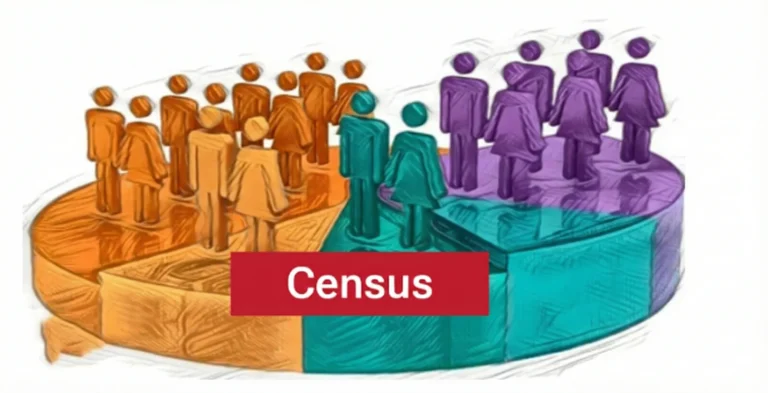
A census is defined as the total process of collecting, compiling, analysing, evaluating, publishing, and disseminating statistical data relating to the population and its characteristics at a specific point in time. Unlike sample surveys, a census aims at complete enumeration, covering every individual in the population.
Example: The Census of India, conducted once every ten years, is one of the largest administrative exercises in the world.
Scope and Nature of Census Data
The census collects detailed information on multiple dimensions of population life:
- Population distribution – Urban and rural concentration of people.
Example: Data showing increasing urbanisation in metropolitan cities like Delhi and Bengaluru. - Socio-economic characteristics – Occupation, education, and employment patterns.
Example: Workforce participation rates across states. - Vital statistics – Birth rate, death rate, fertility rate, and migration.
Example: Migration data revealing rural-to-urban movement. - Cultural and social aspects – Language, religion, caste, and Scheduled Tribes.
Example: Linguistic diversity and tribal population distribution in India.
- Population distribution – Urban and rural concentration of people.
Advantages of Census
- Comprehensive Population Coverage: Since every individual is enumerated, census data provides a complete and accurate demographic picture of the country.
Example: Identification of population density across districts. - Understanding Urban–Rural Distribution: Census data helps analyse patterns of urbanisation and rural depopulation, aiding city planning and rural development policies.
Example: Planning infrastructure under Smart Cities Mission. - Vital Source of Socio-Economic Information: Census acts as a repository of crucial information such as literacy rate, fertility rate, mortality rate, and migration trends.
Example: Literacy data guiding educational reforms and schemes like Samagra Shiksha. - Policy Formulation and Resource Allocation: Governments rely on census data for delimitation of constituencies, reservation policies, and allocation of funds.
Example: Distribution of central grants to states. - Foundation for Further Research: Census data provides a benchmark for sample surveys and academic research.
Example: NSSO surveys use census data as a sampling frame.
- Comprehensive Population Coverage: Since every individual is enumerated, census data provides a complete and accurate demographic picture of the country.
Disadvantages of Census
- Highly Expensive and Resource-Intensive
Conducting a census requires massive financial investment, manpower, and administrative machinery.
Example: The Census of India involves millions of enumerators. - Higher Possibility of Errors
Errors may arise due to misreporting, misunderstanding of questions, or logistical challenges.
Example: Underreporting of migration or income. - Inadequate Training of Enumerators
Insufficiently trained enumerators may lead to data inconsistencies and inaccuracies.
Example: Incorrect classification of occupation or education levels. - Data Security and Privacy Concerns
Census data may not always be securely protected, raising concerns about confidentiality and misuse. - False or Inaccurate Information by Respondents
Beneficiaries may provide false information due to fear, stigma, or lack of awareness.
Example: Underreporting of age or misstatement of religion/caste. - Risk of Data Abuse
There are concerns regarding potential misuse or manipulation of data by officials or authorities.
- Highly Expensive and Resource-Intensive
The census remains an indispensable instrument for understanding the structure and dynamics of a population. Despite challenges such as high cost, logistical difficulties, and data accuracy concerns, its role in governance, planning, and social research is unparalleled. With technological advancements and better training mechanisms, the census can continue to serve as a robust foundation for inclusive and informed policy-making.
Important Keywords
Census, Complete Enumeration, Demographic Data, Urbanisation, Vital Statistics, Population Distribution, Socio-economic Characteristics, Policy Planning


Carbon Border Adjustment Mechanism (CBAM)
Stay connected via Google News Follow us for the latest travel updates and guides. Home / Carbon Border Adujustment Mechanism
ಬಾರಿಸು ಕನ್ನಡ ಡಿಂಡಿಮವ
Stay connected via Google News Follow us for the latest travel updates and guides. Home / ‘ಬಾರಿಸು ಕನ್ನಡ ಡಿಂಡಿಮವ’ ದೇಶದ
UPSC CSAT Average PYQ with Solutions
Stay connected via Google News Follow us for the latest travel updates and guides. UPSC CSAT Average PYQ with Solutions
Hypothesis in Sociological Research
Stay connected via Google News Follow us for the latest travel updates and guides. Home / Hypothesis in Sociological Research
Sampling Errors in Sociological Research
Stay connected via Google News Follow us for the latest travel updates and guides. Home / Sampling Errors in Sociological
Sampling in Sociology
Stay connected via Google News Follow us for the latest travel updates and guides. Home / Sampling in Sociology Sampling
Variables in Sociological Research
Stay connected via Google News Follow us for the latest travel updates and guides. Home / Variables in Sociological Research
Nomothetic and Idiographic Methods in Sociology
Stay connected via Google News Follow us for the latest travel updates and guides. Home / Nomothetic and Idiographic Methods
Focus Group Discussion (FGD) in Sociology
Stay connected via Google News Follow us for the latest travel updates and guides. Home / Focus Group Discussion (FGD)
Biographical Studies in Sociology
Stay connected via Google News Follow us for the latest travel updates and guides. Home / Biographical Studies in Sociology