



Participant and Non-Participant Observation
Participant Observation
Meaning and Nature of Participant Observation
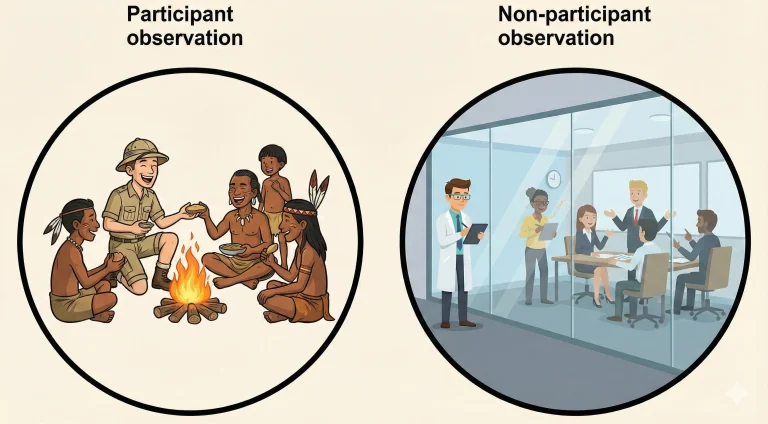
Participant observation is a qualitative research method in which the researcher becomes part of the group or community being studied, actively participating in social life while simultaneously observing it. This method enables the researcher to gain an insider’s perspective on norms, values, beliefs, power relations, and everyday practices. By sharing the lived experiences of the group, the sociologist understands social reality as perceived by the actors themselves.
Examples:
- M.N. Srinivas used participant observation to study Sanskritisation in Mysore villages by living among rural communities and observing caste mobility.
- Andre Beteille examined caste, class, and inequality in Tanjore village through close engagement with everyday village life.
- M.N. Srinivas used participant observation to study Sanskritisation in Mysore villages by living among rural communities and observing caste mobility.
Participant observation usually involves long-term immersion, allowing the researcher to capture context, meanings, informal interactions, and unspoken norms that shape social behaviour.
Process of Participant Observation
- Entry and Rapport Building: The researcher gradually gains acceptance within the group.
Example: Living in a village before beginning formal observation. - Participation in Daily Life: The researcher takes part in routine activities.
Example: Participating in festivals or agricultural work. - Systematic Observation: Social interactions, hierarchies, and rituals are closely observed.
Example: Observing caste-based seating during village meetings. - Recording and Supplementation: Detailed field notes are maintained and supplemented with informal interviews.
Example: Recording daily observations in ethnographic diaries.
- Entry and Rapport Building: The researcher gradually gains acceptance within the group.
Advantages of Participant Observation
- Reveals real priorities and lived experiences
Example: Understanding tribal livelihood concerns beyond government records. - Ethically sensitive and culturally respectful
Example: Respecting local customs while studying religious rituals. - Utilises indigenous knowledge systems
Example: Learning traditional healing practices from community elders. - Reduces artificiality of behaviour
Example: Over time, villagers behave naturally around the researcher. - Provides holistic and contextual understanding
Example: Linking caste practices with economy, politics, and kinship.
- Reveals real priorities and lived experiences
Limitations of Participant Observation
- Loss of objectivity due to emotional involvement
Example: Researcher sympathising with a marginalised group’s struggles. - Researcher influence on group behaviour
Example: Presence affecting decision-making in community meetings. - Subjective interpretation of data
Example: Interpreting rituals based on personal beliefs. - Limited scope of observation
Example: Inability to access private family discussions. - Highly time-consuming and demanding
Example: Years spent in fieldwork for village studies.
- Loss of objectivity due to emotional involvement
Non-Participant Observation
Meaning and Nature
Non-participant observation is a qualitative research method in which the researcher remains detached and does not take part in the activities of the group being studied. The observer records behaviour as an external spectator, maintaining distance to ensure neutrality.
Example: Observing shoppers’ purchasing behaviour in a mall without interaction.
This method prioritises objectivity and control, though it limits access to deeper meanings behind actions.
Advantages of Non-Participant Observation
- Greater objectivity through detachment
Example: Observing classroom discipline without emotional involvement. - Minimal researcher influence
Example: Recording traffic behaviour through CCTV footage. - Suitable for public behaviour and large groups
Example: Studying crowd behaviour during public protests. - Clear ethical boundaries
Example: Observing public events without personal intrusion. - Less time-intensive
Example: Short-term observation of consumer behaviour in retail spaces.
- Greater objectivity through detachment
Limitations of Non-Participant Observation
- Observer presence may alter behaviour
Example: Students becoming conscious when observed in classrooms. - Limited understanding of motives and meanings
Example: Inability to know why shoppers prefer certain brands. - Absence of rapport
Example: Lack of trust preventing access to informal explanations. - Undefined observer role causing discomfort
Example: Suspicion towards a silent observer in small communities.
- Observer presence may alter behaviour
Observational research occupies a central position in sociological methodology by enabling the direct study of social behaviour in natural settings. Participant observation provides depth, context, and insider understanding, while non-participant observation offers greater objectivity, detachment, and efficiency. Each method has distinct advantages and limitations, and their suitability depends on the research objective, ethical considerations, and practical constraints. When applied carefully and ethically, observational methods generate insights into social processes that cannot be captured through surveys or interviews alone.


Carbon Border Adjustment Mechanism (CBAM)
Stay connected via Google News Follow us for the latest travel updates and guides. Home / Carbon Border Adujustment Mechanism
ಬಾರಿಸು ಕನ್ನಡ ಡಿಂಡಿಮವ
Stay connected via Google News Follow us for the latest travel updates and guides. Home / ‘ಬಾರಿಸು ಕನ್ನಡ ಡಿಂಡಿಮವ’ ದೇಶದ
UPSC CSAT Average PYQ with Solutions
Stay connected via Google News Follow us for the latest travel updates and guides. UPSC CSAT Average PYQ with Solutions
Hypothesis in Sociological Research
Stay connected via Google News Follow us for the latest travel updates and guides. Home / Hypothesis in Sociological Research
Sampling Errors in Sociological Research
Stay connected via Google News Follow us for the latest travel updates and guides. Home / Sampling Errors in Sociological
Sampling in Sociology
Stay connected via Google News Follow us for the latest travel updates and guides. Home / Sampling in Sociology Sampling
Variables in Sociological Research
Stay connected via Google News Follow us for the latest travel updates and guides. Home / Variables in Sociological Research
Nomothetic and Idiographic Methods in Sociology
Stay connected via Google News Follow us for the latest travel updates and guides. Home / Nomothetic and Idiographic Methods
Focus Group Discussion (FGD) in Sociology
Stay connected via Google News Follow us for the latest travel updates and guides. Home / Focus Group Discussion (FGD)
Biographical Studies in Sociology
Stay connected via Google News Follow us for the latest travel updates and guides. Home / Biographical Studies in Sociology