



Sampling in Sociology
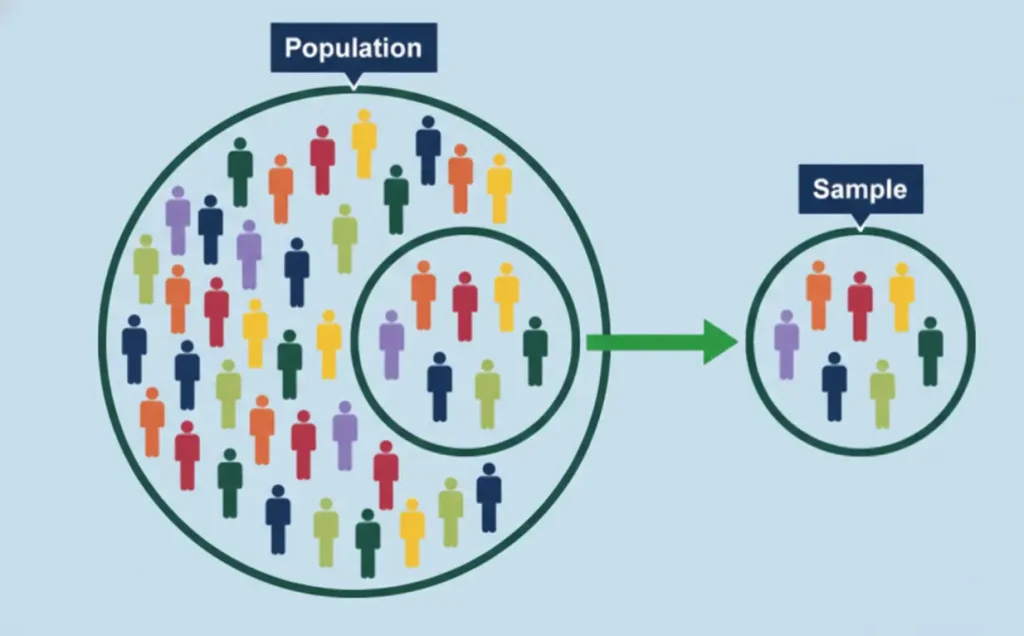
Sampling is one of the most essential procedures in sociological research because studying an entire population is often impossible due to limitations of time, money, manpower, and accessibility. For example, if a sociologist wants to study unemployment, poverty, caste discrimination, political behaviour, or health awareness in a state or country, surveying every individual would be impractical. Therefore, researchers select a smaller group from the larger population, called a sample, which represents the universe. The process of choosing this portion is known as sampling. A well-designed sampling strategy ensures that the research findings remain accurate, representative, and reliable, enabling sociologists to draw conclusions about society as a whole.
Meaning and Nature of Sampling
- Impractical to survey everyone: Sociologists often research very large groups, making complete surveys difficult.
Example: Studying “digital divide in India” cannot involve every household; hence sampling is used. - Sample and sampling: A sample is a selected portion of elements from a larger population. Sampling is the process of selecting these elements.
Example: Selecting 400 households from a population of 40,000 households in a district for studying sanitation practices. - Sampling plan: A sampling plan defines:
- How elements will be chosen
- How many will be chosen
- Example: A plan may involve choosing 5 villages randomly and then selecting 20 households per village.
- Statistical meaning: Sampling is a statistical process where a predetermined number of observations are taken from a larger population.
Example: Election surveys take a sample of voters to predict overall voting behaviour.
- Impractical to survey everyone: Sociologists often research very large groups, making complete surveys difficult.
Types of Sampling
A) Probability Sampling
Meaning
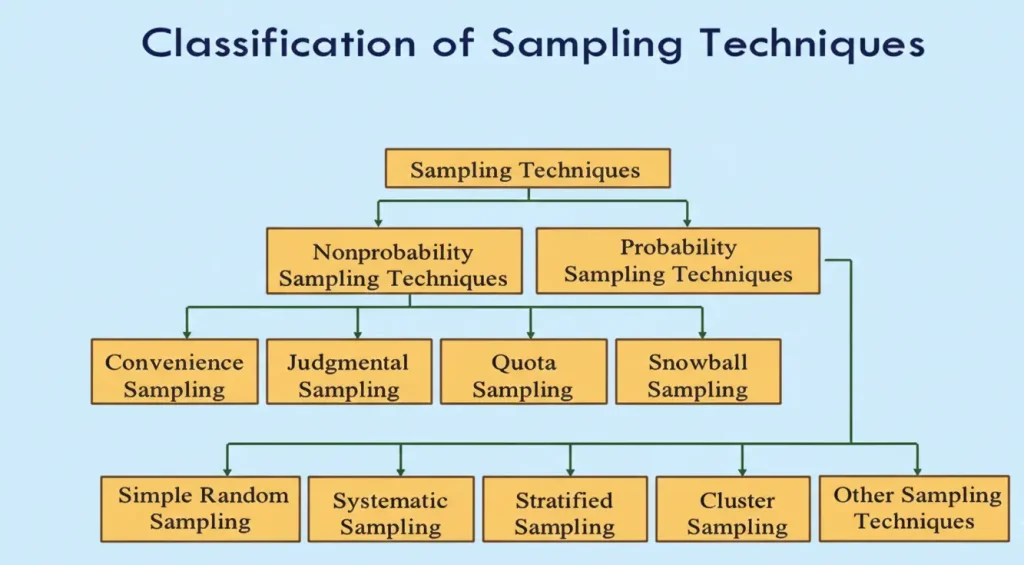
Probability sampling is a method where every unit has an equal probability of selection.
It ensures high representativeness.
Example: If a village has 1000 households, each household must have an equal chance to be selected.
Conditions for Probability Sampling (Black and Champion)
According to Black and Champion, probability sampling requires:
Complete list of subjects (sampling frame)
Example: School roll register, voter list, census household list.Universe size must be known
Example: Total number of students in a college is known.Sample size must be specified
Example: Researcher decides “sample size = 200 respondents.”Each element must have equal chance: Prevents selection bias.
Example: Not selecting only easily accessible households near the road.
Types of Probability Sampling
1) Lottery / Simple Random Sampling
Highest randomness
Each sample unit has equal chance.
Done using random number table or lottery.
Example: Picking names from a bowl of chits.
2) Systematic Random Sampling
Samples chosen at fixed intervals (every nth unit).
Not purely random but systematic.
Example: Choosing every 10th person from 1000 people when sample size needed is 100.
3) Stratified Sampling
Population divided into homogeneous groups (strata).
Samples selected from each stratum separately.
Useful when population is heterogeneous.
Example: Dividing population into strata like SC/ST/OBC/General and selecting respondents proportionally.
4) Cluster Sampling
Multi-stage sampling suited for wide geographic areas.
Randomly select clusters first, then sample within clusters.
Example: Selecting: State level → District level → Block level → Village level
Advantages of Probability Sampling
Easy, quick, straightforward
Example: Randomly selecting 50 students from attendance register.Sampling error can be calculated: Reduces selection bias.
Example: Opinion polls show margin of error.Saves time and effort
Example: Studying 500 households instead of 50,000.Easy to administer: Especially systematic sampling.
Example: Survey every 5th passenger in a metro station.Higher precision and representation
Example: Stratified sampling ensures representation of all castes/classes.Most applicable for heterogeneous populations: Stratified sampling works best.
Example: Study of income inequality across social groups.Cluster sampling provides flexibility: Covers large areas efficiently.
Example: National-level surveys (NFHS) use cluster sampling.
Disadvantages of Probability Sampling
May still lead to bias: If the sampling frame is incomplete.
Example: Migrants missing from voter lists.Complex to organize and analyse: Needs trained investigators.
Example: Large-scale rural surveys require field teams.Difficult to identify proper strata:
Example: Defining strata of “middle class” is difficult due to informal income.High sampling error in cluster sampling: Clusters may not represent entire population diversity.
Example: Selecting only coastal clusters may ignore inland realities.Least representative (poorly-designed cluster sampling
Example: Selecting only easily accessible clusters excludes remote tribal areas.
B) Non-Probability Sampling
Meaning
Non-probability sampling does not use probability rules.
Does not claim representativeness.
Used mostly for qualitative exploratory analysis.
Sampling error cannot be calculated, hence generalisation is weak.
Example: Studying experiences of acid attack survivors through selected cases.
Types of Non-Probability Sampling
1) Convenience / Accidental Sampling
Select respondents who are easy to access.
Example: Studying students by visiting the nearest school/college.
2) Purposive Sampling
The researcher selects a sample deliberately for a specific purpose.
Sample characteristics pre-defined.
Example: If research is on unemployment → target is the working-age population.
3) Quota Sampling
Fix quota for representation of a group, but selection within quota is non-random.
Similar to stratified sampling but without random selection.
Example: Fix quota: 50 males + 50 females, but selecting whoever is available.
4) Snowball Sampling
Based on referral.
Useful for hidden populations.
Example: Studying drug users or sex workers where no sampling frame exists.
Advantages of Non-Probability Sampling
Time effective
Example: Quick field-based study on protest participants.Easy to collect sample
Example: Surveying shopkeepers in one market.Focused on particular group: Particularly in convenience sampling.
Example: Studying issues faced by hostel students.Cost effective
Example: Small-scale exploratory study.Selects only relevant individuals: Purposive sampling.
Example: Only selecting dropouts when studying school dropout reasons.Best when no sampling frame exists: Snowball sampling.
Example: Refugees, illegal migrants, underground workers.
Disadvantages of Non-Probability Sampling
Biased and unrepresentative
Example: Convenience sampling from the city ignores rural realities.Cumbersome when sample is large
Example: Snowball sampling becomes difficult when referrals expand.Accuracy cannot be estimated: No random selection.
Example: Findings cannot give statistical confidence levels.No guarantee of representation
Example: Quota fixed but selection biased toward outspoken participants.Distorted view: Misrepresents population.
Example: Selecting only NGO beneficiaries shows only one side of poverty.Not truly random: Everyone doesn’t have an equal chance
Example: Only people present in public spaces are sampled.
Way Forward
- Use mixed sampling designs: Probability sampling for representativeness + purposive sampling for depth.
Example: Survey 1000 households randomly, then do purposive interviews with 50 women workers. - Strengthen sampling frames: Update population lists for better accuracy.
Example: Include migrants and informal workers in updated registers. - Apply stratification carefully: Use meaningful strata like caste, class, gender, rural-urban.
Example: Study of education should stratify by government/private schools. - Invest in training field investigators: Reduce investigator bias, improve data quality.
Example: Standardised instructions for household interviews. - Use technology: Random number generators, GIS mapping, digital survey tools.
Example: GIS helps select remote clusters, reducing accessibility bias.
- Use mixed sampling designs: Probability sampling for representativeness + purposive sampling for depth.
Sampling is indispensable for sociological research because it allows the study of large populations through manageable and meaningful subsets. Probability sampling strengthens scientific validity by ensuring randomness and representativeness, while non-probability sampling provides flexibility and depth, especially in exploratory qualitative research. However, challenges such as bias, sampling errors, and representational distortions remain. By improving sampling frames, combining methods, using technology, and ensuring proper training, sociologists can design better sampling strategies that lead to more reliable and socially relevant research outcomes.
Important Keywords
Sampling, sample, sampling plan, population/universe, sampling frame, probability sampling, non-probability sampling, simple random sampling, systematic sampling, stratified sampling, cluster sampling, purposive sampling, convenience sampling, snowball sampling, sampling error


UPSC Current Affairs – March 16
Stay connected via Google News Follow us for the latest travel updates and guides. March 16th Current Affairs <a href=”https://primusias.com”>Home</a>
Carbon Border Adjustment Mechanism (CBAM)
Stay connected via Google News Follow us for the latest travel updates and guides. Home / Carbon Border Adujustment Mechanism
ಬಾರಿಸು ಕನ್ನಡ ಡಿಂಡಿಮವ
Stay connected via Google News Follow us for the latest travel updates and guides. Home / ‘ಬಾರಿಸು ಕನ್ನಡ ಡಿಂಡಿಮವ’ ದೇಶದ
UPSC CSAT Average PYQ with Solutions
Stay connected via Google News Follow us for the latest travel updates and guides. UPSC CSAT Average PYQ with Solutions
Hypothesis in Sociological Research
Stay connected via Google News Follow us for the latest travel updates and guides. Home / Hypothesis in Sociological Research
Sampling Errors in Sociological Research
Stay connected via Google News Follow us for the latest travel updates and guides. Home / Sampling Errors in Sociological
Sampling in Sociology
Stay connected via Google News Follow us for the latest travel updates and guides. Home / Sampling in Sociology Sampling
Variables in Sociological Research
Stay connected via Google News Follow us for the latest travel updates and guides. Home / Variables in Sociological Research
Nomothetic and Idiographic Methods in Sociology
Stay connected via Google News Follow us for the latest travel updates and guides. Home / Nomothetic and Idiographic Methods
Focus Group Discussion (FGD) in Sociology
Stay connected via Google News Follow us for the latest travel updates and guides. Home / Focus Group Discussion (FGD)
Related
Discover more from Primus Civil Services Academy
Subscribe to get the latest posts sent to your email.