

September 12th Current Affairs
Table of Contents
UPSC Current Affairs – September 11th
Stay connected via Google News Follow us for the latest travel updates and guides. September 11th Current Affairs <a href=”https://primusias.com”>Home</a>
UPSC Current Affairs – September 10th
Stay connected via Google News Follow us for the latest travel updates and guides. September 9th Current Affairs <a href=”https://primusias.com”>Home</a>
UPSC Current Affairs – September 9th
Stay connected via Google News Follow us for the latest travel updates and guides. September 9th Current Affairs <a href=”https://primusias.com”>Home</a>
UPSC Current Affairs – September 8th
Stay connected via Google News Follow us for the latest travel updates and guides. September 8th Current Affairs <a href=”https://primusias.com”>Home</a>
UPSC Current Affairs – September 7th
Stay connected via Google News Follow us for the latest travel updates and guides. September 7th Current Affairs <a href=”https://primusias.com”>Home</a>
UPSC Current Affairs – September 4th
Stay connected via Google News Follow us for the latest travel updates and guides. September 4th Current Affairs <a href=”https://primusias.com”>Home</a>
UPSC Current Affairs – September 3rd
Stay connected via Google News Follow us for the latest travel updates and guides. September 3rd Current Affairs <a href=”https://primusias.com”>Home</a>
UPSC Current Affairs – September 2nd
Stay connected via Google News Follow us for the latest travel updates and guides. September 2nd Current Affairs <a href=”https://primusias.com”>Home</a>
UPSC Current Affairs – September 1st
Stay connected via Google News Follow us for the latest travel updates and guides. September 1st Current Affairs <a href=”https://primusias.com”>Home</a>
UPSC Current Affairs – August 31st
Stay connected via Google News Follow us for the latest travel updates and guides. August 31st Current Affairs <a href=”https://primusias.com”>Home</a>
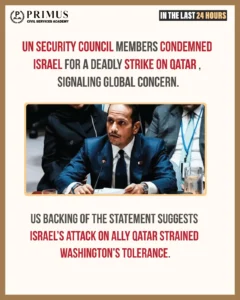
UN Security Council members condemn Israel over deadly strike on Qatar
Relevance to UPSC
- GS Paper II – International Relations / Foreign Policy: Examines India’s and the world’s role in UN diplomacy, the norms of sovereignty, mediation, and de-escalation in volatile regions.
- GS Paper II – International Law / UN Charter: Touches on the principles of territorial integrity and sovereignty, legality of cross-border strikes, and obligations under international humanitarian law.
- GS Paper III – Security Issues & Strategic Studies: Raises questions about state behaviour in conflicts, use of force in foreign territories, and responses of global actors.
More About the News
- All 15 members of the UN Security Council, including the US, condemned Israel’s strike in Doha targeting Hamas leaders, calling for de-escalation and upholding Qatar’s sovereignty.
- The attack killed five Hamas members and one Qatari security official; some Hamas leadership survived.
- US diplomats stated that bombing a sovereign mediator (Qatar) undermines peace efforts, and suggested the strike was a serious misstep in Israel-US relations.
United Nations Security Council (UNSC)
The United Nations Security Council (UNSC) is the primary organ of the UN tasked with maintaining international peace and security. Since its creation in 1945, it has been both a guarantor of global stability and a subject of sharp criticism, given its structure and decision-making dynamics.
Evolution of UNSC
- Established in 1945 after the Second World War under the UN Charter, replacing the League of Nations’ ineffective collective security framework.
- First meeting held in London, 1946; permanent HQ at New York, USA.
- Over time, the Council expanded non-permanent members from 6 to 10 (1965 reform) to improve representation.
Laws / Provisions Guiding It
- Guided by the UN Charter (Chapter V–VII, Articles 24–51).
- Article 24 → UNSC bears primary responsibility for peace and security.
- Article 25 → Members agree to accept and carry out UNSC decisions.
- Chapter VII → Authorizes enforcement measures including sanctions and military action.
- Veto power → Held by five permanent members (P5).
Membership and Chairmanship
- Permanent Members (P5) → US, UK, France, Russia, China.
- Non-permanent Members (10) → Elected by UNGA for 2-year terms, with geographical balance.
- Chairmanship (Presidency) → Rotates monthly among members in English alphabetical order.
How UNSC Works
- Resolutions require 9/15 votes and no veto from any P5 member.
- Decisions are binding on all UN members.
- Operates through subsidiary bodies (Sanctions Committees, Peacekeeping mandates).
- Works closely with the Secretary-General and other UN agencies.
Features of UNSC
- Binding Decisions → UNSC resolutions are enforceable under international law. E.g., sanctions on North Korea.
- Veto Power → P5 can block any substantive resolution. E.g., Russia vetoing Ukraine-related resolutions.
- Peacekeeping Mandate → Authorizes peacekeeping missions worldwide. E.g., UNMISS in South Sudan.
- Collective Security → Ensures coordinated global response. E.g., Gulf War 1991, UNSC-authorized coalition.
- Crisis Response → Can convene urgently at any time. E.g., UNSC emergency session after 9/11 attacks.
Advantages of Having UNSC
- Maintains Global Peace → Acts against aggression. E.g., UNSC sanctions on Iraq (1990).
- Legitimacy → Provides global legitimacy to interventions. E.g., NATO in Afghanistan, 2001.
- Platform for Dialogue → Reduces chances of unilateral actions. E.g., negotiations on Iran nuclear issue.
- Humanitarian Role → Protects civilians in conflicts. E.g., UNSC resolutions on Syria aid access.
- Prevention of Global War → Balanced power among P5 avoids world war. E.g., Cold War era restraint.
Disadvantages of Having UNSC
- Veto Paralysis → One P5 member can block consensus. E.g., China blocking Masood Azhar listing (2019).
- Outdated Membership → No representation for rising powers. E.g., India, Brazil excluded from P5.
- Selective Intervention → Acts only where P5 interests align. E.g., quick action in Kuwait vs. inaction in Rwanda genocide.
- Dominance of P5 → Over-centralized decision-making. E.g., US unilateral influence on Middle East issues.
- Ineffectiveness in Civil Wars → Limited success in intra-state conflicts. E.g., prolonged Syrian conflict.
Impacts Created by UNSC
- Global Stability → Prevented another world war. E.g., nuclear restraint during Cuban Missile Crisis.
- Peacekeeping → Deployment of blue helmets across continents. E.g., UN Peacekeeping in Congo.
- Sanctions Regimes → Economic isolation of aggressors. E.g., sanctions on Iran and North Korea.
- Human Rights Advocacy → Condemnation of apartheid South Africa.
- Influence on Global Order → Shapes geopolitics. E.g., UNSC resolutions on Ukraine influencing Russia-West relations.
Challenges / Criticism
- Lack of Representation → No permanent seat for India, Africa, Latin America.
- Veto Abuse → Misuse for national interests. E.g., Russia vetoing Ukraine issues.
- Double Standards → Selective enforcement. E.g., inaction on Palestine vs. action on Iraq.
- Limited Accountability → No checks on P5 decisions.
- Peacekeeping Criticism → Allegations of misconduct and limited success. E.g., failures in Rwanda genocide.
Counter-Organisations / Platforms
- G4 (India, Japan, Germany, Brazil) → Demand UNSC reform.
- Uniting for Consensus (Coffee Club) → Oppose expansion of permanent members.
- G77, NAM, AU (Ezulwini Consensus) → Push for equitable representation.
- BRICS, SCO → Alternative multilateral forums to counterbalance Western dominance.
Measures Taken
- 1965 Reform → Non-permanent seats expanded from 6 to 10.
- High-Level Panels & Reports → On UNSC reforms (2005 onwards).
- India’s Push → Actively advocating for permanent seat with G4 and African Union support.
Way Forward
- Expand both permanent and non-permanent membership for inclusivity.
- Reform veto system (limit or gradual abolition).
- Enhance transparency in decision-making.
- Strengthen cooperation with regional organizations (AU, ASEAN).
- Prioritize conflict prevention and humanitarian action over P5 politics.
The UNSC remains a cornerstone of global peace architecture but suffers from structural inequities and political deadlocks. Its future relevance depends on adapting to new geopolitical realities, ensuring inclusivity, and reforming its decision-making process to reflect the multipolar world order.
Prelims MCQ
Q. Which of the following statements about the UN Security Council is/are correct? 1. The UNSC has 15 members, of which 5 are permanent. 2. A UNSC resolution requires at least 9 affirmative votes and no veto from permanent members. 3. The Presidency of the UNSC is decided through annual elections by the General Assembly.
A. 1 and 2 only
B. 1 only
C. 2 and 3 only
D. 1, 2 and 3
Mains Question
Q. “The United Nations Security Council, while central to maintaining global peace, faces a crisis of legitimacy and effectiveness in today’s multipolar world.” Critically analyze with examples, and suggest measures for reform.
ISRO inks pact with HAL for transfer of small satellite launch vehicle technology
Relevance to UPSC
GS Paper III
- Science & Technology, Defence, Security → Space Tech & Strategic Capability
- Economy → Industrial Growth & Technology Transfer
- Infrastructure & Growth → Space Infrastructure & Start-ups Ecosystem
More About the News
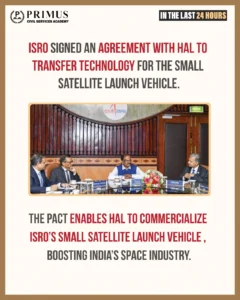
- ISRO signed a Technology Transfer Agreement with HAL (Hindustan Aeronautics Limited), along with NSIL and IN-SPACe, for the Small Satellite Launch Vehicle (SSLV) technology.
- Under the deal, HAL will take about 24 months to absorb the SSLV tech, with ISRO providing training, technical support. After that, HAL will be able to independently design, build, integrate, launch, and support SSLVs.
- SSLV is an all-solid, three-stage launch vehicle capable of putting up to 500 kg payloads into Low Earth Orbit; can be launched from Sriharikota or the upcoming Kulasekarapattinam site for polar launches.
Space Industry in India
India’s space industry has evolved from a state-led research programme into a fast-growing ecosystem combining government agencies, public-sector companies and an expanding private sector. It now supports strategic, commercial and developmental needs — from launch services and earth observation to navigation and telecom — and is poised for further commercialization and global partnerships.
Evolution
- 1960s: Institutional beginnings — INCOSPAR (1962) and formation of ISRO (1969).
- 1970s–1990s: Development of domestic launch vehicles (SLV, ASLV, PSLV) and satellite programmes (IRS, INSAT).
- 2000s: Operational maturity — reliable PSLV launches, GSLV development and application-oriented missions.
- 2010s–2020s: Reforms for commercialization — creation of NSIL, Antrix, and policy shifts enabling private sector participation.
- 2020s onwards: Regulatory & policy push (Indian Space Policy 2023), IN-SPACe as a regulator, and rapid private startup growth.
Key Trends
- Rapid commercialization and private sector entry (startups for launch, small satellites, services).
- Miniaturisation: growth of small satellites, rideshares and small-sat constellations.
- Cost-efficient launch focus (SSLV, reusable technologies) and increased launch cadence.
- Global partnerships and export of space services (satellite data, launch services).
- Policy & regulatory reforms to enable private investment and licensing (IN-SPACe, NSIL).
Statutory & Policy Framework
- Indian Space Policy 2023, DoS governance rules, IN-SPACe charter, NSIL commercial mandate, and sectoral regulations (licensing, liability, safety).
Bodies, Organisations & Ministries
- Department of Space (DoS) — administrative authority (reports to PM).
- Indian Space Research Organisation (ISRO) — R&D and mission execution.
- IN-SPACe (Indian National Space Promotion & Authorisation Centre) — regulator/promoter for private sector.
- NewSpace India Limited (NSIL) — commercial arm for marketing/industry transfer.
- Antrix Corporation, IIST, ISRO centres (VSSC, URSC, SAC, SDSC-SHAR), private firms and startups.
Features of India’s Space Industry
- Strong government leadership and institutional continuity (DoS + ISRO).
- Emphasis on cost-effectiveness and mission pragmatism (PSLV/SSLV models).
- Growing public–private partnerships (NSIL, IN-SPACe enablement).
- Diverse application portfolio: remote sensing, communications, navigation.
- Increasing regulatory clarity and commercialization push (Indian Space Policy 2023).
Benefits of Having a Robust Space Industry
- Strategic Autonomy — indigenous launch and satellite capability supports defence and surveillance e.g., Indian remote-sensing satellites used for border monitoring.
- Economic Growth & Exports — space services and launch contracts generate revenue e.g., commercial launches and satellite data exports
- Socio-economic Applications — weather forecasting, agriculture mapping and disaster management e.g., INSAT/IRS used in cyclone warning and crop assessment.
- Technological Spillovers — advanced materials, electronics, propulsion innovations feed other industries e.g., spin-offs in avionics, sensors
- Human Capital & Research — training and institutions (IIST, ISRO centres) build high-skilled workforce and R&D ecosystem.
Impacts of the Space Industry
- National Development — improved telemedicine, education via satellite connectivity in remote areas e.g., satellite TV/tele-education programmes
- Disaster Resilience — quicker response through satellite imagery for floods and earthquakes e.g., post-disaster damage assessment
- Global Standing — missions (e.g., lunar/planetary probes) enhance India’s geopolitical influence and soft power.
- Private Sector Growth — new space startups and suppliers, job creation, and a domestic supply chain e.g., small-sat integrators
- Research & Innovation — collaborative science missions increase knowledge and technology exports.
Challenges Faced
- Regulatory & Policy Uncertainty (historically) — slow initial framework for private players; recently being addressed by IN-SPACe.
- Limited Manufacturing Base — many critical components depend on a few suppliers; scaling up for commercial demand is challenging.
- Funding & Commercial Viability — high capex for launch infrastructure and long gestation for returns, deterring private financiers.
- Technology Gaps vs. Global Leaders — challenges in reusable launch tech and human spaceflight ecosystem compared to US/China.
- Space Debris & Regulatory Compliance — rising satellites create orbital congestion and long-term sustainability risks.
Measures Taken by Government & ISRO
- Creation of IN-SPACe (regulator/promoter) and NSIL (commercial arm) to open the sector.
- Indian Space Policy 2023 — sets licensing, safety, and promotion rules.
- Technology transfer and public-sector partnerships (ToTs, e.g., SSLV tech transfer initiatives).
- Strengthening launch infrastructure (new SSLV launch complex at Kulasekarapattinam, higher launch cadence).
- Support for startups: incubation, procurement preferences, and enabling access to ISRO facilities.
Best Practices
- Public–Private Partnership & Reusability (USA – NASA & SpaceX): Contracting private players reduced costs, enabled reusability, and fostered innovation; India can replicate in reusable launch & human spaceflight.
- Regional & Collaborative Model (Europe – ESA): Resource pooling and joint missions lowered costs and advanced R&D; India can adopt regional collaborations via SAARC/BIMSTEC.
Way Forward
- Foster domestic supply chains and manufacturing hubs for components and propulsion systems.
- Encourage venture capital and export financing for space startups.
- Invest in reusability and sustainable launch technologies.
- Strengthen international partnerships for joint missions and technology exchange.
- Develop robust space-traffic management and debris mitigation policies.
India’s space industry stands at a strategic inflection point — moving from government-led achievements to a mixed ecosystem where private enterprise can scale. With recent policy reforms and institutional mechanisms, India can leverage cost competitiveness, skilled human capital and growing demand for space services to emerge as a global hub. Success will depend on sustaining regulatory clarity, building domestic supply chains, and balancing commercialization with national security imperatives.
Comparison with Other Major Space Industries
Field / Strength | India (ISRO + ecosystem) | USA (NASA + commercial) | China (CNSA + industry) | Europe (ESA + industry) |
Launch capability | Reliable, low-cost (PSLV); SSLV emerging. | Broad (Falcon, Vulcan, SLS); strong private players (SpaceX). | Rapid expansion, government-led launch cadence. | Strong launch and shared capability via Arianespace. |
Cost competitiveness | Very cost-effective launches and missions. | Competitive with scale and reusability. | State-funded low-cost launches. | High reliability, higher costs. |
Commercialisation | Rapidly growing; NSIL/IN-SPACe enabling. | Mature private sector — launches, satellites, services. | Large domestic market, growing commercial players. | Strong industrial base, focus on satellites/services. |
Human spaceflight | Emerging (Gaganyaan roadmap). | Mature human spaceflight and commercial crew. | Active human programme and long-term plans. | Limited direct human launch capability; partners with Russia/USA. |
R&D & science missions | Strong planetary, lunar, and application missions. | Extensive deep-space and science missions. | Ambitious lunar and planetary missions. | Strong Earth observation, collaborative science. |
Prelims MCQ
Q. Which of the following statements are correct about India’s current space governance architecture? 1. The Department of Space reports directly to the Prime Minister and oversees ISRO. 2. IN-SPACe is the commercial arm responsible for marketing ISRO products internationally. 3. NewSpace India Limited (NSIL) is intended to act as a commercialisation arm for the Indian space programme.
A. 1 and 2 only
B. 2 and 3 only
C. 1 and 3 only
D. 1, 2 and 3
Mains Question
Q. “Assess the evolution of India’s space industry since independence. In light of recent policy reforms (IN-SPACe, NSIL, Indian Space Policy 2023), evaluate the challenges and opportunities for India to become a global space-services hub. Suggest institutional and policy measures to accelerate commercialization while safeguarding strategic interests.”
‘Match should go on’: Supreme Court refuses urgent listing of plea against India-Pakistan Asia Cup match
Relevance to UPSC
- GS Paper 2 – Polity & Governance / Fundamental Rights → PILs & Judicial Restraint
- GS Paper 3 – Internal Security / Law & Order → Terrorism, national dignity, public sentiment
More About the News
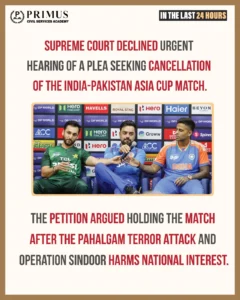
- A group of four law students filed a PIL seeking cancellation of the India-Pakistan Asia Cup match scheduled for September 14, citing the Pahalgam terror attack and “Operation Sindoor” as recent events that make the match inappropriate.
- The Supreme Court, in a bench of Justices J.K. Maheshwari and Vijay Bishnoi, refused to urgently list the plea, asking “What is the urgency? It’s a match, let it be.”
- The plea argued that playing cricket with Pakistan so soon after terror incidents undermines national dignity and sacrifices of citizens and armed forces, and hurts public sentiment.
India - Pakistan Relations
India and Pakistan, born from the Partition of 1947, share deep historical, cultural, and geographical linkages but also a legacy of conflict, mistrust, and wars. Their bilateral ties remain one of South Asia’s most complex and volatile, shaping regional security and global diplomacy.
Evolution of India–Pakistan Relations
- 1947–48: Partition, Kashmir conflict, first war.
- 1965: Second war over Kashmir.
- 1971: Bangladesh Liberation War; Shimla Agreement signed.
- 1980s–90s: Proxy wars, militancy, Kargil conflict (1999).
- 2000s: Composite Dialogue, people-to-people contacts, setbacks post-Mumbai attacks (2008).
- 2010s–2020s: Cross-border strikes, Pulwama–Balakot (2019), Article 370 abrogation (2019), trade suspension, selective dialogue on humanitarian/trade issues.
Common Memberships in Global Groupings
- United Nations (UN)
- World Trade Organization (WTO)
- Shanghai Cooperation Organisation (SCO)
- South Asian Association for Regional Cooperation (SAARC)
- G77 and NAM (Non-Aligned Movement)
Strengths in Relations
- Cultural & Civilizational Links – Shared languages, food, music; cross-border popularity of films (e.g., Bollywood in Pakistan).
- People-to-People Ties – Track-II diplomacy, Kartarpur Corridor for Sikh pilgrims.
- Economic Potential – Formal trade (till 2019) crossed $2 billion annually; informal trade continues via Dubai.
- Shared Environmental Concerns – Indus Waters Treaty (1960) survived wars and tensions.
- Regional Stability Need – Both nuclear powers; backchannel talks to prevent escalation after Pulwama (2019).
Weaknesses in Relations
- Kashmir Dispute – Core issue; Article 370 abrogation worsened tensions.
- Cross-Border Terrorism – 26/11 Mumbai attacks, Pathankot (2016), Pulwama (2019).
- Trust Deficit – Peace talks often derailed by terrorist incidents.
- Suspended Trade – Post-2019, official trade frozen; economic integration stalled.
- Diplomatic Isolation Efforts – India pushing FATF pressure on Pakistan for terror financing.
Challenges in Relations
- Terror Infrastructure – Pakistan-based groups like LeT, JeM.
- Military Escalations – Ceasefire violations along LoC (e.g., 2016–2018).
- China Factor – Pakistan–China nexus through CPEC.
- Political Volatility – Civil–military imbalance in Pakistan policymaking.
- Regional Integration Deadlock – SAARC stalled due to Indo–Pak rivalry.
How Challenges Are Being Countered
- Military Response: Surgical Strikes (2016), Balakot Airstrikes (2019), Operation Sindhoor (2025).
- Diplomatic Pressure: FATF, UN terror listings.
- Backchannel Talks: UAE-brokered ceasefire renewal (2021).
- Humanitarian Steps: Kartarpur Corridor for Sikh pilgrims.
- Strategic Partnerships: India strengthening ties with US, Quad, Gulf to counterbalance.
Initiatives Taken Together
- Indus Waters Treaty (1960) – long-standing water-sharing mechanism.
- Kartarpur Corridor (2019) – facilitating Sikh religious travel.
- SAARC regional initiatives (health, disaster response).
- Humanitarian prisoner exchanges.
- Ceasefire agreements (e.g., 2003, renewed 2021).
Way Forward
- Institutionalised Dialogue despite differences.
- Counter-terrorism cooperation under UN/SCO framework.
- Reviving economic ties through selective trade.
- Regional connectivity (energy, infrastructure) via SCO/SAARC.
- Encouraging civil society, student, and cultural exchanges.
India–Pakistan relations remain strained but not beyond repair. With historical grievances and security concerns dominating, sustained dialogue, trust-building, and regional cooperation can pave the way for stability in South Asia’s future.
Prelims MCQ
Q. Which of the following are common memberships shared by both India and Pakistan?
1. SCO
2. BRICS
3. SAARC
4. NAM
A. 1, 3, and 4 only
B. 1 and 2 only
C. 2, 3, and 4 only
D. 1, 2, 3, and 4
Both India and Pakistan are members of SCO, SAARC, and NAM. BRICS includes India but not Pakistan.
Mains Question
Q. “India–Pakistan relations oscillate between dialogue and distrust. Critically analyse the evolution, challenges, and future prospects of bilateral ties in the context of regional and global geopolitics.”
Government to conduct two key economic surveys on household finances from July 2026
Relevance to UPSC
- GS Paper III – Economy / Statistics / Poverty & Inequality: Critical data on debt, asset ownership, income distribution and agricultural households’ finances help in crafting welfare, taxation, and subsidy policies.
- GS Paper III – Agriculture & Rural Development: Situation Assessment Survey of Agricultural Households will highlight farm household debt, investments, and livelihood pressures.
More about the News
- The Union government plans to conduct two key surveys from July 2026 to June 2027: the All-India Debt & Investment Survey (AIDIS) and the Situation Assessment Survey of Agricultural Households.
- AIDIS will capture data on household indebtedness and asset ownership in both rural and urban areas.
- The Agricultural Survey will assess financial conditions, debt burdens, and investment patterns of farm households, informing policy on farm distress and rural credit.
Household Finances
Household finances—covering income, savings, debt, and investments—form the backbone of India’s economic stability. They determine consumption patterns, financial inclusion, and resilience to shocks. Tracking these trends is crucial for designing welfare schemes, credit policies, and long-term growth strategies.
Key Trends Observed
- Rising household indebtedness in rural areas, especially among agricultural households.
- Urban households diversifying into mutual funds, equities, and insurance.
- Persistent low penetration of formal financial institutions in rural belts despite Jan Dhan expansion.
- Shift from physical assets (gold, land) to financial assets in middle-class families.
- Post-COVID increase in precautionary savings but uneven recovery across socio-economic groups.
Advantages of Household Finance
- Evidence-Based Policymaking – AIDIS data guides targeted credit schemes like PM-KISAN and farm loan waivers.
- Financial Inclusion Monitoring – Helps track outreach of Jan Dhan Yojana and UPI adoption in rural areas.
- Inequality Measurement – Reveals wealth gaps, aiding design of progressive taxation.
- Risk Management – Identifies vulnerable groups in need of social security (e.g., MGNREGA in drought-hit regions).
- Investment Planning – Guides infrastructure & rural credit planning via NABARD.
Impacts of Household Finances
- Consumption Patterns – Rising middle-class investments boost retail and FMCG sectors.
- Agricultural Productivity – Access to loans enables mechanisation and higher yields.
- Economic Growth – Household savings fund national investment (e.g., banks’ deposits for credit creation).
- Poverty Reduction – Debt relief and targeted subsidies reduce vulnerability in agrarian families.
- Global Competitiveness – Stable household savings ratio improves India’s credit ratings and investor confidence.
Challenges Faced
- High Informal Debt – Rural poor depend on moneylenders despite microfinance (Vidarbha farmer debt crisis).
- Financial Illiteracy – Low awareness of insurance/ pensions despite Atal Pension Yojana.
- Urban–Rural Divide – Credit access better in cities than in tribal belts.
- Gender Gap – Women’s asset ownership and financial participation remain minimal.
- Data Gaps – Household surveys infrequent; last AIDIS (2019) delayed policy updates.
Government Initiatives
- PM Jan Dhan Yojana (PMJDY) – Bank account access.
- PM-KISAN – Direct income support to farmers.
- Pradhan Mantri Mudra Yojana (PMMY) – Loans for small entrepreneurs.
- Financial Literacy Centres (FLCs) by RBI/NABARD.
- Digital push – UPI, Aadhaar-enabled payment systems.
Best Practices
Global:
- USA – Household Finance and Consumption Survey (HFCS): Regular detailed tracking of wealth distribution.
- UK – Financial Conduct Authority (FCA) model: Strong consumer protection & financial literacy campaigns.
Indian:
- Self-Help Groups (SHGs): Women-led microfinance networks like Kudumbashree in Kerala.
- Indus Watershed Financial Inclusion Model (NABARD): Linking rural households to formal credit.
Way Forward
- Increase frequency and granularity of surveys.
- Strengthen rural credit institutions and cooperative banking.
- Promote financial literacy through school curricula and digital apps.
- Narrow gender and urban–rural gaps via targeted schemes.
- Link survey outcomes directly with budget allocations for welfare.
Household finance is the micro-engine of India’s macroeconomic growth. Strengthening inclusion, ensuring resilience against shocks, and enhancing financial literacy will transform households into powerful drivers of sustainable development in the future.
Prelims MCQ
Q. Which of the following best reflects the significance of household finance surveys like AIDIS in India?
1. They provide insights into income distribution and debt levels.
2. They help design policies for financial inclusion and welfare.
3. They measure corporate sector investment flows.
?
A. 1 and 2 only
B. 2 and 3 only
C. 1 and 3 only
D. 1, 2 and 3
Household surveys measure debt, income, and assets for policy support; they do not track corporate investments, which are covered separately.
Mains Question
Q. “Household finances in India reflect both the strengths and vulnerabilities of the economy. Analyse key trends, challenges, and the way forward for inclusive financial resilience.”
Scientists develop designer clownfish
Relevance to UPSC
- GS Paper III – Science & Technology / Biodiversity & Environment: The development reflects advances in aquaculture genetic research, selective breeding, and ornamental fish trade sustainability.
- GS Paper III – Economy / Agriculture & Rural Development: Opportunities for livelihood generation in coastal, tribal communities via ornamental aquaculture and reduced dependence on wild-caught stock.
More about the News
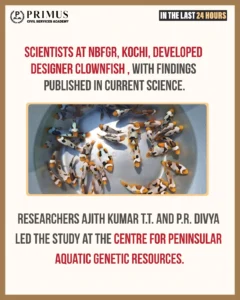
- ICAR-NBFGR has for the first time developed a “designer clownfish” (F4 hybrid generation) by crossbreeding Amphiprion percula (male) and Amphiprion ocellaris (female), yielding distinct colour-pattern variants.
- The experiment took ~6-7 years, and molecular analysis shows the designer fish are genetically closer to A. percula, with visible, market-appealing pattern variations.
- The project includes community aquaculture with tribal communities (in Pichavaram, Pulicat, Tamil Nadu) to farm these fish under sustainable practices and supply the aquarium trade.
Genetic Engineering
Genetic engineering refers to the deliberate modification of an organism’s DNA using biotechnology tools. It has revolutionized agriculture, healthcare, and industry by enabling precision in traits, disease resistance, and bio-product development. However, it also raises ethical, environmental, and socio-economic concerns.
Evolution of Genetic Engineering
- 1970s: Recombinant DNA technology (Cohen & Boyer, 1973).
- 1980s–1990s: First genetically engineered crops (Bt cotton), insulin from recombinant DNA.
- 2000s: Human Genome Project completion; transgenic animals.
- 2010s: CRISPR–Cas9 gene editing breakthrough.
- 2020s: Gene drives, synthetic biology, designer organisms, and precision medicine.
Key Trends
- CRISPR-based gene editing for healthcare and agriculture.
- Increasing role in precision medicine and personalised therapy.
- Synthetic biology for bio-fuels, lab-grown meat, biodegradable plastics.
- GM crops for climate resilience (drought-tolerant rice, pest-resistant cotton).
- Ethical and regulatory debates around human germline editing.
Features of Genetic Engineering
- Involves direct manipulation of DNA using molecular tools.
- Allows targeted and precise alterations compared to traditional breeding.
- It can be applied across plants, animals, and microbes.
- Enables transgenic organisms (cross-species genetic transfer).
- Facilitates both therapeutic and industrial uses.
Advantages of Genetic Engineering
- Agricultural Productivity – Bt cotton in India reduced pest damage.
- Medical Breakthroughs – Recombinant insulin for diabetics.
- Environmental Benefits – GM microbes for oil spill cleanup.
- Nutritional Enhancement – Golden Rice enriched with Vitamin A.
- Industrial Efficiency – Genetically engineered yeast for bioethanol production.
Disadvantages of Genetic Engineering
- Ethical Concerns – Designer babies, germline editing debates.
- Environmental Risks – GM crops may affect biodiversity (e.g., Monarch butterflies & Bt maize debate).
- Resistance Development – Pests developing resistance to Bt cotton.
- Equity Issues – Patents on GM seeds raising farmer dependency (Monsanto case in India).
- Unintended Health Risks – Allergic reactions from GM foods.
Impacts of Genetic Engineering
- Healthcare – CRISPR trials for sickle cell anemia show promise.
- Food Security – GM crops address hunger in drought-prone regions.
- Economy – Biotech contributes significantly to India’s pharma exports.
- Environment – Gene drives proposed to control malaria mosquitoes.
- Society – Ethical debates reshape global laws (e.g., EU strict GM crop laws).
Challenges Faced
- Regulatory Ambiguity – India’s GMO rules often delayed approvals (Bt brinjal).
- Public Perception – Opposition to GM crops due to safety concerns.
- Intellectual Property Rights – Farmers’ seed sovereignty vs biotech patents.
- Bio-safety Concerns – Gene flow from GM crops to wild relatives.
- Global Divide – Some nations adopt GM crops, others ban them.
Government Initiatives Taken
- Genetic Engineering Appraisal Committee (GEAC) under MoEFCC.
- Biotechnology Industry Research Assistance Council (BIRAC).
- National Biotechnology Development Strategy (2015–20).
- Department of Biotechnology (DBT) funding genome editing research.
- ICAR trials of GM mustard, drought-tolerant rice.
Best Practices
Global:
- US FDA & USDA clear regulatory pathways for GM crops/therapies.
- China’s CRISPR innovation in agriculture (high-yield rice, disease-resistant pigs).
Indian:
- Bt Cotton adoption – India became the largest cotton producer.
- Biotech Parks (Tamil Nadu, Hyderabad) for translational research & startups.
Way Forward
- Strengthen transparent regulation balancing innovation & biosafety.
- Promote indigenous research to reduce foreign seed dependency.
- Expand public awareness and literacy on genetic engineering.
- Encourage global collaborations on ethics & safety norms.
- Integrate gene editing into sustainable agriculture & healthcare goals.
Genetic engineering is both a transformative tool and a contentious technology. With responsible innovation, ethical safeguards, and inclusive policies, India can leverage it for food security, healthcare breakthroughs, and sustainable growth in the future.
Methods of Genetic Engineering
Method | Description | Example |
Recombinant DNA Technology (rDNA) | Combining DNA from different organisms to create new genetic combinations | Production of recombinant insulin in bacteria |
Gene Cloning | Isolating and making multiple copies of a gene | Cloning the human growth hormone gene for therapeutic use |
CRISPR–Cas9 Gene Editing | Precise editing of target DNA sequences using CRISPR guide RNA and Cas9 enzyme | Correcting sickle cell anemia mutation in human stem cells |
Gene Silencing / RNA Interference (RNAi) | Suppressing expression of specific genes to control unwanted traits | Pest-resistant crops by silencing insect-target genes |
Transgenesis / Transgenic Organisms | Introducing a foreign gene into an organism’s genome | Bt cotton containing Bacillus thuringiensis toxin gene |
Microinjection | Directly injecting DNA into the nucleus of an animal or plant cell | Genetically modified mice for research |
Electroporation | Using electric pulses to introduce DNA into cells | Introducing plasmids into bacterial cells in laboratories |
Biolistics / Gene Gun Method | Shooting DNA-coated microscopic particles into plant cells | Developing herbicide-resistant rice varieties |
Prelims MCQ
Q.Which of the following is/are correct about Genetic Engineering in India?
1. The Genetic Engineering Appraisal Committee (GEAC) functions under the Ministry of Environment, Forest & Climate Change.
2. Bt cotton is the only GM crop commercially approved in India.
3. CRISPR–Cas9 is an example of a gene editing technology.
A. 1 and 2 only
B. 2 and 3 only
C. 1 and 3 only
D. 1, 2 and 3
GEAC is under MoEFCC, Bt cotton is the sole approved GM crop in India, and CRISPR–Cas9 is a gene-editing tool.
Mains Question
Q. “Genetic engineering presents both opportunities and risks for India’s agriculture, health, and environment. Critically analyse.”
Related
Discover more from Primus Civil Services Academy
Subscribe to get the latest posts sent to your email.