

October 29th Current Affairs
Table of Contents
UPSC Current Affairs – September 18th
Stay connected via Google News Follow us for the latest travel updates and guides. September 18th Current Affairs <a href=”https://primusias.com”>Home</a>
UPSC Current Affairs – September 17th
Stay connected via Google News Follow us for the latest travel updates and guides. September 17th Current Affairs <a href=”https://primusias.com”>Home</a>
UPSC Current Affairs – September 16th
Stay connected via Google News Follow us for the latest travel updates and guides. September 16th Current Affairs <a href=”https://primusias.com”>Home</a>
UPSC Current Affairs – September 11th
Stay connected via Google News Follow us for the latest travel updates and guides. September 11th Current Affairs <a href=”https://primusias.com”>Home</a>
UPSC Current Affairs – September 10th
Stay connected via Google News Follow us for the latest travel updates and guides. September 9th Current Affairs <a href=”https://primusias.com”>Home</a>
UPSC Current Affairs – September 9th
Stay connected via Google News Follow us for the latest travel updates and guides. September 9th Current Affairs <a href=”https://primusias.com”>Home</a>
UPSC Current Affairs – September 8th
Stay connected via Google News Follow us for the latest travel updates and guides. September 8th Current Affairs <a href=”https://primusias.com”>Home</a>
UPSC Current Affairs – September 7th
Stay connected via Google News Follow us for the latest travel updates and guides. September 7th Current Affairs <a href=”https://primusias.com”>Home</a>
UPSC Current Affairs – September 4th
Stay connected via Google News Follow us for the latest travel updates and guides. September 4th Current Affairs <a href=”https://primusias.com”>Home</a>
UPSC Current Affairs – September 3rd
Stay connected via Google News Follow us for the latest travel updates and guides. September 3rd Current Affairs <a href=”https://primusias.com”>Home</a>
Interstellar Comet 3I/ATLAS to make closest approach to Sun this week: Could it be a Black Swan event?

Relevance to UPSC
GS Paper I: Geography
- Relates to astronomical geography understanding celestial phenomena and their interaction with the Earth’s environment.
- Enhances conceptual clarity on solar system dynamics, interstellar objects and cosmic events influencing planetary systems.
- Can be linked to the broader theme of origin and evolution of the Earth and universe, part of physical geography.
GS Paper III: Science & Technology and Space Events
- Falls under developments and applications of science and technology impacting everyday life and global scientific progress.
- Offers insight into space research, planetary defense, and international space cooperation.
- Ties into environmental studies, especially understanding cosmic dust, meteor impacts, and space debris hazards relevant to Earth’s safety.
- Has a security dimension via tracking near-Earth objects to prevent future collision threats.
More About the News
- The interstellar object 3I/ATLAS (i.e., “3 I/ATLAS”), originating from outside our Solar System is set to make its closest approach to the Sun around 29–30 October 2025.
- It is expected to pass at about 1.4 astronomical units (approx 210 million km) from the Sun, giving scientists a rare opportunity to observe how such an alien comet behaves under solar heating.
- Scientists say it poses no threat to Earth, but it may flare up as it nears the Sun, showing increased tail/coma activity and could offer insights into the composition and origin of objects from beyond our Solar System.
What is “3I/ATLAS”?
Space objects such as comets, asteroids, meteoroids, meteors, and meteorites are vital celestial bodies that help scientists understand the formation, evolution, and dynamics of our solar system.
About 3I/ATLAS
- 3I/ATLAS is an interstellar comet, believed to be among the oldest known celestial objects, possibly predating the Solar System by over 3 billion years.
- Identified as interstellar due to its hyperbolic orbit and high velocity (around 57–68 km/s relative to the Sun).
- Its trajectory points toward the constellation Sagittarius, indicating an origin beyond our Solar System, likely from the Milky Way’s thick disk.
- The comet’s orbit is hyperbolic, meaning it will pass through the Solar System once and exit permanently after its solar encounter.
- Closest approach to Earth: 270 million km.
- Closest approach to the Sun: 210 million km (expected around October 29–30, 2025), slightly within Mars’ orbit.
Physical Characteristics and Observations
- Confirmed as an active comet, exhibiting a coma a cloud of gas and dust surrounding its nucleus.
- As it moves closer to the Sun, it is expected to develop a distinct tail formed by solar heating of volatile materials.
- Displays a reddish hue, with a spectral slope (~1.3% per 100 nm) indicating the presence of complex organics or water ice.
- The nucleus is estimated to be 10–30 km wide, significantly larger than 1I/ʻOumuamua (2017) and 2I/Borisov (2019).
- Its composition and rotation period are currently under study through ground-based telescopic observations.
About Comets
- Comets are icy celestial bodies made of frozen gases (water, methane, ammonia, carbon dioxide) mixed with rocky and metallic dust.
- They typically have elongated elliptical orbits, in contrast to the nearly circular orbits of planets.
- Short-period comets originate from the Kuiper Belt, while long-period comets come from the distant Oort Cloud (5,000–100,000 AU from the Sun).
- As they approach the Sun, sublimation of ice forms a coma and tail, making comets visible from Earth.
- Halley’s Comet, the most famous example, returns every 76 years, last observed in 1986.
Asteroid
- An asteroid is a rocky or metallic object that orbits the Sun.
- Sizes vary widely from a few centimeters to nearly a thousand kilometers across.
Meteoroid
- Meteoroids are small fragments of asteroids or comets, usually less than 1 meter in size.
- They move freely through space before possibly entering a planet’s atmosphere.
Meteor
- A meteor is a meteoroid entering Earth’s atmosphere, which burns up due to friction.
- This creates a bright streak of light in the sky, often called a “shooting star.”
Meteorite
- A meteorite is the remaining fragment of a meteor that survives atmospheric entry.
- It lands on Earth’s surface, providing material evidence from outer space.
Challenges Posed by Space Objects
- Risk of Collision with Earth: Large asteroids or comets can cause catastrophic impacts leading to mass extinctions or regional devastation.
Example: The Chicxulub impact (Mexico, ~66 million years ago) is linked to the extinction of dinosaurs. - Threat to Satellites and Space Infrastructure: Micrometeoroids and space debris can damage communication and navigation satellites.
Example: The International Space Station (ISS) often performs orbital adjustments to avoid debris and micrometeoroids. - Limited Early Detection and Tracking: Many near-Earth objects (NEOs) remain undetected due to their small size or dark composition.
Example: The Chelyabinsk meteor (2013) entered Earth’s atmosphere undetected, injuring over 1,000 people in Russia. - Technological and Financial Constraints in Mitigation: Developing and launching deflection or interception missions require high-end technology and huge investments.
Example: NASA’s DART mission (2022) successfully altered the orbit of asteroid Dimorphos, but at significant cost. - Scientific Uncertainty and Composition Challenges: The varied makeup of space objects (rocky, metallic, or icy) makes predicting impact behavior and response effectiveness difficult.
Example: The ʻOumuamua (2017) object’s unusual acceleration puzzled scientists, highlighting limited understanding of interstellar bodies.
- Risk of Collision with Earth: Large asteroids or comets can cause catastrophic impacts leading to mass extinctions or regional devastation.
Advancing space missions and asteroid-deflection technologies will deepen our knowledge of these objects, enhancing planetary defense and expanding humanity’s capacity for sustainable exploration beyond Earth.
Prelims MCQ
Q. Consider the following pairs: Objects in Space: Description
1. Cepheids: Giant clouds of dust and gas in space
2. Nebulae: Stars which brighten and dim periodically
3. Pulsars: Neutron stars that are formed when massive stars run out of fuel and collapse
How many of the above pairs are correctly matched? (PYQ 2023)
A. Only one
B. Only two
C. Only three
D. None
Cepheids – Incorrect: These are variable stars that brighten and dim periodically, not clouds of gas and dust. Nebulae – Incorrect: These are giant clouds of gas and dust in space, not variable stars. Pulsars – Correct: These are rapidly rotating neutron stars formed when massive stars collapse after exhausting their nuclear fuel.
Mains Question
Q. Launched on 25th December, 2021, James Webb Space Telescope has been much in the news since then. What are its unique features which make it superior to its predecessor Space Telescopes? What are the key goals of this mission? What potential benefits does it hold for the human race? (PYQ 2022)
Delhi rain after cloud seeding fails: Experts reveal why govt’s Rs 3.2 crore experiment fell flat, what it means for pollution and weather
Relevance to UPSC
GS Paper I: Geography
- Involves study of weather and climate systems, especially atmospheric processes influencing rainfall formation.
- Demonstrates how human intervention in atmospheric phenomena (like cloud seeding) interacts with natural meteorological conditions.
- Highlights urban climatology microclimate modification attempts in heavily polluted metropolitan regions like Delhi.
GS Paper III: Environment, Science & Technology & Disaster Management
- Falls under technological interventions for environmental improvement, especially air pollution mitigation strategies.
- Raises questions on effectiveness and sustainability of artificial rain as a pollution-control method.
- Connects to climate modification technologies, geoengineering, and innovation in environmental governance.
- Has implications for public spending efficiency and scientific validation in government projects addressing urban environmental crises
More About the News
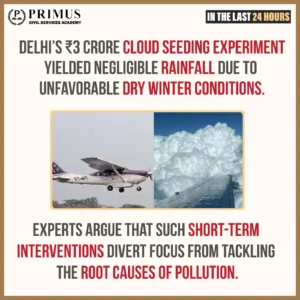
- The Delhi government spent about ₹3.2 crore on cloud-seeding trials with IIT Kanpur to artificially induce rain and curb winter smog in the capital, but the attempt failed to produce significant rainfall.
- Experts attribute the failure mainly to low ambient moisture and lack of suitable rain-bearing clouds, making the seeding ineffective under current atmospheric conditions.
- They caution that cloud seeding is a temporary and cosmetic fix for air-pollution and does not address root causes like vehicle emissions, industry, crop-burning, thus raising questions on cost-effectiveness and long-term strategy.
Cloud Seeding
Cloud seeding represents a promising yet debated weather modification technique aimed at artificially enhancing rainfall or snowfall. While it offers potential for drought relief and pollution reduction, its effectiveness and environmental safety remain under scrutiny.
About Cloud Seeding
- Definition: A scientific method to enhance precipitation (rain or snow) from existing clouds.
- Mechanism: Involves dispersing particles like silver iodide, potassium iodide, sodium chloride, or dry ice into clouds via aircraft.
- These particles act as condensation or ice nuclei, allowing supercooled droplets to freeze and grow, eventually falling as rain or snow.
- It cannot create clouds, working only on existing moisture-rich formations.
Cloud Seeding in India and Worldwide
- India’s Ministry of Earth Sciences (MoES) conducted CAIPEEX experiments (2009–2019) showing up to 46% increase in rainfall under favourable conditions.
- Indian states like Maharashtra, Karnataka, Andhra Pradesh, and Tamil Nadu have used it for drought mitigation.
- China applies large-scale seeding for weather control (e.g., 2008 Beijing Olympics).
- UAE and Saudi Arabia use it regularly to address water scarcity in arid regions.
Applications of Cloud Seeding
- Boosting rainfall in drought-prone or arid zones.
- Reducing air pollution by removing airborne pollutants (e.g., experiments in Delhi).
- Dispersing fog near airports and highways to improve visibility.
- Suppressing hailstorms and modifying weather to benefit agriculture.
Limitations of Cloud Seeding for Pollution Control
- Absence of Rain-bearing Clouds: Works only with existing clouds; post-monsoon months (Oct–Dec) have dry, stable air with weak vertical motion.
- Dependence on Western Disturbances: Rain in North India during this period mainly arises from Western Disturbances, which are infrequent and unpredictable, complicating planning.
- Short-term Effect on Pollution: Even if successful, rainfall offers temporary relief, as pollutants resurface once emissions continue.
- Environmental Concerns: Chemicals like silver iodide may accumulate in soil and water, with unclear long-term ecological impacts.
- Accountability and Resource Misallocation:
- Unclear responsibility during floods or weather anomalies post-seeding.
- Lack of region-specific data and high costs can divert funds from proven air-quality solutions.
- Absence of Rain-bearing Clouds: Works only with existing clouds; post-monsoon months (Oct–Dec) have dry, stable air with weak vertical motion.
Cloud seeding holds future promise for climate adaptation and water management, but sustained progress demands robust scientific validation, environmental safeguards, and integration with sustainable atmospheric and pollution control strategies.
Prelims MCQ
Q. In the context of which of the following do some scientists suggest the use of cirrus cloud thinning technique and the injection of sulphate aerosol into the stratosphere? (PYQ 2019)
A. Creating artificial rains in some regions
B. Reducing the frequency and intensity of tropical cyclones
C. Reducing the adverse effects of solar wind on the Earth
D. Reducing the global warming
Mains Question
Q. Discuss in detail the photochemical smog emphasizing its formation, effects and mitigation. Explain the 1999 Gothenburg Protocol. (PYQ 2022)
Digital arrest is one of the most dreaded threats to citizens: President Murmu

Relevance to UPSC
GS Paper III: Science & Technology, Internal Security
- Falls under cybersecurity and technology misuse, showing how criminals exploit digital infrastructure for extortion and impersonation.
- Demonstrates the intersection of technology, crime, and internal security, calling for robust digital forensics, data protection, and public awareness systems.
- Links to AI and emerging tech risks, as deepfakes and online impersonation expand digital vulnerabilities.
GS Paper IV: Ethics, Integrity & Aptitude
- Raises issues of ethical policing ensuring technology serves citizens rather than instills fear.
- Involves responsibility and integrity of law enforcement in maintaining public trust amid digital transformation.
- Reflects on ethical use of technology, digital empathy and the duty of governance to protect vulnerable citizens from exploitation.
More About the News
- President Droupadi Murmu cautioned that “digital arrest” scams, where fraudsters impersonate police to freeze bank accounts and extort money online, have emerged as one of the most serious threats to citizens.
- She highlighted that technology has transformed policing, with criminals exploiting digital tools like video calls and fake identities, urging law-enforcement to stay technologically ahead.
- Murmu stressed that as India’s digital economy and AI adoption grow, policing must embrace innovation while remaining citizen-centric and service-oriented not fear-driven.
Digital Arrest
Digital arrest scams represent a dangerous evolution in cybercrime, exploiting public trust in law enforcement through psychological manipulation, impersonation, and advanced digital technologies to extort money and steal personal data.
What is Digital Arrest?
- A cyber scam where fraudsters impersonate police or government officials (e.g., CBI, ED, TRAI) to falsely accuse victims of crimes.
- Victims are intimidated through video calls or fake legal documents and coerced into paying money under threat of arrest or asset seizure.
Modus Operandi
- Caller ID spoofing to mimic government agencies.
- Fake legal documents and interrogation videos to create fear.
- Victims are isolated, threatened, and extorted via untraceable digital payments.
- Personal data theft is common for identity fraud or financial exploitation.
Rising Digital Arrest Cases in India
- MHA alert (March 2024): Warned of cybercriminals impersonating CBI, Police, and RBI.
- Financial losses: ₹120.30 crore lost (Jan–Apr 2024) as per I4C.
- Cybercrime surge: From 10,395 cases (2020) to 17,470 (2022) as per NCRB.
Reasons for the Surge
- Increased digital transactions and cashless economy.
- Low digital literacy and lack of cyber awareness.
- AI-based fraud tools (deepfakes, synthetic voices, spoofed IDs).
- Cross-border operations from Myanmar, Laos, and Cambodia with weak enforcement.
Key Concerns
- Severe Financial Losses: Victims coerced into paying through crypto, gift cards, or wire transfers.
- Emotional Trauma: Continuous threats and fake interrogations cause distress.
- Identity Theft: Stolen personal details used for fraudulent banking or loans.
- AI-driven Deception: Deepfakes make scams more realistic and difficult to detect.
- Jurisdictional Hurdles: Cross-border cyber networks hinder prosecution.
Government Initiatives
- Indian Cyber Crime Coordination Centre (I4C): Coordinates with banks, telecoms, and fintechs to block frauds.
- Spoofed Call Blocking Mechanism: Filters fake international calls disguised as local numbers.
- Samanvaya Platform: Tracks inter-state cybercrime linkages.
- CERT-In Guidelines: Public advisories on verifying official calls and avoiding suspicious links.
- Microsoft Partnership: Over 1,000 fraudulent Skype IDs blocked used in digital arrest scams.
Way Forward
- Stay Vigilant: Verify caller identity and contact official helplines before responding.
- Prompt Reporting: Report via helpline 1930 or cybercrime.gov.in for immediate action.
- Digital Awareness: Include cyber safety education in schools and public campaigns.
- Strengthen Cyber Defenses: Regular security updates, strong passwords, and antivirus use.
- Global Cooperation: Build international partnerships to trace and prosecute cybercriminals abroad.
Digital arrest scams highlight the darker side of rapid digitization. Strengthening cybersecurity frameworks, public awareness, and global law enforcement collaboration is crucial to protect citizens in an increasingly digital future.
Prelims MCQ
Q. In India, under cyber insurance for individuals, which of the following benefits are generally covered, in addition to payment for the loss of funds and other benefits? (PYQ 2020)
1. Cost of restoration of the computer system in case of malware disrupting access to one’s computer.
2. Cost of a new computer if some miscreant wilfully damages it, if proved so.
3. Cost of hiring a specialized consultant to minimize the loss in case of cyber extortion.
4. Cost of defence in the Court of Law if any third party files a suit.
Select the correct answer using the code given below:
A. 1, 2 and 4 only
B. 1, 3 and 4 only
C. 2 and 3 only
D. 1, 2, 3 and 4
Cyber insurance covers costs related to system restoration after malware attacks. It includes expenses for consultants to manage or reduce cyber extortion losses. It also covers legal defence costs if a third party files a suit for damages.
Mains Question
Q. What are the different elements of cyber security ? Keeping in view the challenges in cyber security, examine the extent to which India has successfully developed a comprehensive National Cyber Security Strategy. (PYQ 2022)
Indian Navy hosts 7th Indo-Pacific Regional Dialogue on promoting holistic maritime security and growth
Relevance to UPSC
GS Paper II: International Relations & Governance
- Highlights India’s strategic engagement in the Indo-Pacific, promoting cooperation, peace, and rules-based maritime order.
- Reflects India’s diplomatic outreach and multilateralism through platforms fostering regional dialogue and collaboration.
- Showcases India’s vision of MAHASAGAR (Mutual and Holistic Advancement for Security and Growth Across Regions), aligning with the broader Indo-Pacific strategy.
GS Paper III: Infrastructure, Economic Development & Security
- Emphasizes maritime security and regional stability, including non-traditional threats like piracy, climate change, and cyber risks.
- Relates to capacity-building, technological advancement, and blue economy development in maritime governance.
- Links to infrastructure and economic cooperation through secure sea lanes vital for trade and economic growth.
More about the News
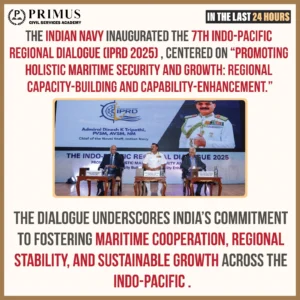
- The Indian Navy hosted the 7th Indo-Pacific Regional Dialogue (IPRD-2025) in New Delhi under the theme “Promoting Holistic Maritime Security and Growth: Regional Capacity-Building and Capability-Enhancement.”
- The dialogue brought together leaders, policymakers, and maritime experts to discuss issues like great power rivalry, non-state maritime threats, climate-related risks, and cyber vulnerabilities.
- It aims to develop collaborative frameworks for regional capacity-building and advance India’s MAHASAGAR vision for secure and sustainable maritime growth across the Indo-Pacific.
7th Indo-Pacific Regional Dialogue (IPRD-2025)
The Indo‑Pacific Regional Dialogue (IPRD) is a premier annual strategic conference hosted by the Indian Navy and its knowledge partner, the National Maritime Foundation. It serves as a high-level forum for deliberation on maritime security, regional cooperation and future-oriented geopolitics in the Indo-Pacific region.
What is IPRD?
- An apex-level international conference convened annually by the Indian Navy, focusing on the Indo-Pacific as a maritime and strategic entity.
- Knowledge-partnered by NMF, it integrates policymakers, defence leaders, maritime experts and academics to engage on holistic maritime security challenges.
- It aligns with India’s maritime vision, including the Indo‑Pacific Oceans Initiative (IPOI) and the SAGAR (Security and Growth for All in the Region) doctrine.
Objectives
- Provide a platform to review India’s opportunities and challenges in the Indo-Pacific region.
- Promote dialogue on maritime security, connectivity, trade, resources, capacity-building and science/technology cooperation.
- Foster inclusive regional collaboration for peace, stability and sustainable maritime growth under rules-based order.
Need for IPRD
- The Indo-Pacific has emerged as a geopolitical and economic centre of gravity, with rising maritime competition, resource contestation and non-traditional threats.
- Ensuring safe and open sea lanes of communication (SLOCs), protecting marine resources and supporting littoral states require multilateral coordination.
- Rapid technological, environmental and infrastructural shifts in the maritime domain demand a strategic forum for policy-makers and practitioners.
India’s Role
- As the host nation, India sets the agenda, leads by example and emphasises its SAGAR-IPOI vision, reinforcing its maritime diplomacy credentials.
- It uses IPRD to strengthen partnerships, advance maritime cooperation, capacity-building with regional states and promote sustainable development.
- India underscores commitment to a rules-based international maritime order, freedom of navigation and inclusive growth in the Indo-Pacific.
Challenges Faced
- Diverging strategic interests of major powers and regional players create complex dynamics and potential for contestation rather than cooperation.
- The multipronged nature of maritime threats (cyber, climate change, seabed mining, resource depletion) complicates agenda convergence.
- Ensuring implementation of dialogue outcomes into real cooperative action remains a persistent challenge across states and institutions.
Way Forward
- Translate dialogue outcomes into actionable mechanisms, joint exercises, maritime domain awareness sharing and capacity-building initiatives.
- Strengthen public-private partnerships, scientific cooperation and sustainability frameworks to harness blue economy opportunities.
- Foster inclusive engagement of smaller littoral states, island nations and stakeholders to ensure balanced regional growth and resilience.
By continually peering ahead and evolving its format, IPRD can empower India and regional partners to shape a secure, cooperative and sustainable maritime future in the Indo-Pacific that withstands strategic shifts and environmental challenges.
Prelims MCQ
Q.
Consider the following statements:
1. Ballistic missiles are jet-propelled at subsonic speeds throughout their flights, while cruise missiles are rocket powered only in the initial phase of flight.
2. Agni-V is a medium-range supersonic cruise missile, while BrahMos is a solid-fuelled intercontinental ballistic missile.
Which of the statements given above is/are correct? (PYQ 2023)
A. 1 only
B. 2 only
C. Both 1 and 2
D. Neither 1 nor 2
Ballistic missiles are rocket-powered during the initial phase and then follow a ballistic trajectory and not jet-propelled or subsonic. Cruise missiles like BrahMos are jet-powered throughout their flight at low altitudes not rocket-powered only initially. Agni-V is an intercontinental ballistic missile (ICBM), while BrahMos is a supersonic cruise missile, not vice versa.
Mains Question
Q. What do you understand by ‘The String of Pearls’? How does it impact India? Briefly outline the steps taken by India to counter this. (PYQ 2013)
India’s Diaspora diplomacy and the limits of cultural nationalism abroad
Relevance to UPSC
GS Paper I: Society & Human Geography
- Connects to themes of migration, cultural diffusion, and identity formation among Indian diaspora communities.
- Demonstrates how transnational communities influence social cohesion and multicultural dynamics in host nations.
GS Paper II: International Relations
- Highlights India’s diaspora diplomacy as a key tool of soft power and foreign policy outreach.
- Examines how cultural nationalism among diaspora communities affects India’s bilateral relations with host countries.
- Reflects the need for a balanced foreign policy approach, ensuring that cultural assertion abroad does not create diplomatic friction or perceptions of interference.
More about the News
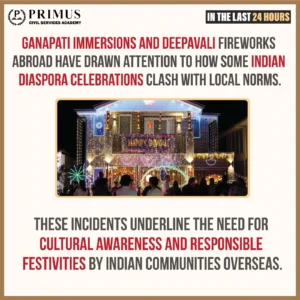
- India’s diaspora diplomacy is expanding, but rising displays of assertive cultural nationalism abroad such as public celebrations and religious events are prompting concerns over their reception in host nations.
- Many Western countries view diaspora activism cautiously, linking it to potential foreign influence, urging India to balance soft power projection with diplomatic sensitivity.
- The shift from territorial to cultural nationalism within diaspora communities underscores the need to balance national pride with respect for host-country laws and multicultural norms.
Cultural Nationalism
Cultural nationalism emphasizes the preservation and pride in a nation’s cultural identity, language, and traditions. In a globalized era, it shapes political consciousness but risks exclusivity without inclusive values.
What is Cultural Nationalism?
- It is a form of nationalism that defines the nation through shared culture, heritage, traditions, language, and religion rather than political or territorial boundaries.
- It seeks to strengthen national identity by reviving indigenous culture and resisting external cultural influences.
- Prominent examples include India’s cultural revival movements, Japan’s Meiji-era identity assertion, and Europe’s Romantic nationalism.
- It often influences politics, education, and foreign policy by promoting unity through shared values and historical consciousness.
Challenges Faced
- Cultural Exclusivism: Can marginalize minority groups and lead to intolerance or cultural hegemony.
- Conflict with Secularism: Risk of blending religion and national identity, undermining pluralism.
- Globalization Pressure: Westernization and consumer culture threaten indigenous traditions.
- Historical Distortions: Cultural nationalism may rely on selective or mythologized versions of history.
- Diplomatic Strain: Aggressive projection of cultural nationalism may alienate neighboring nations or diasporas.
Positive and Negative Effects of Cultural Nationalism
Positive Effects | Negative Effects |
Promotes unity and national pride. | Can lead to exclusion of minorities or dissenting groups. |
Revives traditional arts, language, and heritage. | Risks politicization of culture for ideological agendas. |
Strengthens national resilience against cultural imperialism. | May create internal polarization and communal tension. |
Encourages cultural diplomacy and soft power. | Can hinder modernization and scientific temper. |
Enhances identity in a globalized world. | Often fosters hostility toward foreign influences. |
Way Forward
- Promote Inclusive Nationalism: Balance cultural pride with inclusivity and respect for diversity.
- Strengthen Cultural Education: Encourage awareness of pluralistic heritage rather than narrow identity politics.
- Leverage Soft Power Diplomacy: Use culture as a tool for cooperation and understanding, not dominance.
- Protect Minority Cultures: Recognize and celebrate subcultures as part of the national mosaic.
- Encourage Dialogue: Facilitate intercultural exchange to harmonize tradition with modernity.
Cultural nationalism can empower societies by preserving identity and unity, but its future relevance depends on balancing heritage with inclusivity, tolerance, and adaptability in an interconnected global community.
Prelims MCQ
Q. Which one of the following best defines the term ‘State’?
A. A community of persons permanently occupying a definited territory independent of external control and possessing an organized government.
B. A politically organized people of a definite territory and possessing an authority to govern them, maintain law and order, protect their natural rights and safeguard their means of sustenance.
C. A number of persons who have been living in a definite territory for a very long time with their own culture, tradition and government.
D. A society permanently living in a definite territory with a central authority, an executive responsible to the central authority and an independent judiciary.
A State is defined by four essential elements — population, territory, government, and sovereignty. It must be independent of external control and possess a recognized governing authority.
.Mains Question
Q. Cultural nationalism can serve as both a unifying and divisive force in a pluralistic society like India. Critically analyse this statement in the context of India’s socio-political fabric and its implications for national integration.
Related
Discover more from Primus Civil Services Academy
Subscribe to get the latest posts sent to your email.