

October 30th Current Affairs
Table of Contents
UPSC Current Affairs – September 18th
Stay connected via Google News Follow us for the latest travel updates and guides. September 18th Current Affairs <a href=”https://primusias.com”>Home</a>
UPSC Current Affairs – September 17th
Stay connected via Google News Follow us for the latest travel updates and guides. September 17th Current Affairs <a href=”https://primusias.com”>Home</a>
UPSC Current Affairs – September 16th
Stay connected via Google News Follow us for the latest travel updates and guides. September 16th Current Affairs <a href=”https://primusias.com”>Home</a>
UPSC Current Affairs – September 11th
Stay connected via Google News Follow us for the latest travel updates and guides. September 11th Current Affairs <a href=”https://primusias.com”>Home</a>
UPSC Current Affairs – September 10th
Stay connected via Google News Follow us for the latest travel updates and guides. September 9th Current Affairs <a href=”https://primusias.com”>Home</a>
UPSC Current Affairs – September 9th
Stay connected via Google News Follow us for the latest travel updates and guides. September 9th Current Affairs <a href=”https://primusias.com”>Home</a>
UPSC Current Affairs – September 8th
Stay connected via Google News Follow us for the latest travel updates and guides. September 8th Current Affairs <a href=”https://primusias.com”>Home</a>
UPSC Current Affairs – September 7th
Stay connected via Google News Follow us for the latest travel updates and guides. September 7th Current Affairs <a href=”https://primusias.com”>Home</a>
UPSC Current Affairs – September 4th
Stay connected via Google News Follow us for the latest travel updates and guides. September 4th Current Affairs <a href=”https://primusias.com”>Home</a>
UPSC Current Affairs – September 3rd
Stay connected via Google News Follow us for the latest travel updates and guides. September 3rd Current Affairs <a href=”https://primusias.com”>Home</a>
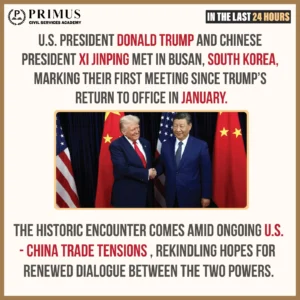
Trump, Xi Jinping shake hands in historic meet in South Korea amid trade war
Relevance to UPSC
GS Paper II: International Relations
- Pertains to India’s and the world’s bilateral, regional, and global groupings and their implications on global politics and economy.
- Highlights US–China relations which is crucial for understanding shifts in the global balance of power and strategic stability.
- Relevant for analyzing impact on India’s foreign policy and trade positioning amid great power competition.
More About the News
- The first in-person meeting in six years between US President Donald Trump and Chinese President Xi Jinping occurred at the APEC Summit in Busan, South Korea.
- The meeting aimed to ease prolonged trade tensions and discuss potential frameworks for a new trade deal.
- The interaction marks a possible thaw in US–China relations, influencing global economic stability and supply chains.
Asia Pacific Economic Cooperation (APEC)
The Asia-Pacific Economic Cooperation (APEC) is a premier regional forum established to promote free trade, sustainable economic growth, and integration across the dynamic economies of the Asia-Pacific region.
Background
- Established in 1989 in Canberra, Australia.
- A response to the growing interdependence among Asia-Pacific economies and the need for an open trade and investment environment.
- Functions as a non-binding, consensus-based forum for promoting economic cooperation and sustainable development.
- Secretariat located in Singapore.
- Works under the principle of “Open Regionalism” – voluntary liberalisation extending benefits to non-members as well.
Members and Observers
- Members (21): Australia, Brunei Darussalam, Canada, Chile, China, Hong Kong (China), Indonesia, Japan, Korea, Malaysia, Mexico, New Zealand, Papua New Guinea, Peru, Philippines, Russia, Singapore, Chinese Taipei (Taiwan), Thailand, United States, Vietnam.
- Observers: ASEAN Secretariat, Pacific Economic Cooperation Council (PECC), Pacific Islands Forum (PIF).
- Members (21): Australia, Brunei Darussalam, Canada, Chile, China, Hong Kong (China), Indonesia, Japan, Korea, Malaysia, Mexico, New Zealand, Papua New Guinea, Peru, Philippines, Russia, Singapore, Chinese Taipei (Taiwan), Thailand, United States, Vietnam.
Objectives
- Trade and Investment Liberalisation: Promote open markets and reduce barriers to trade and investment (e.g., tariff reduction under the Bogor Goals, 1994).
- Business Facilitation: Simplify regulations and procedures to enhance regional trade efficiency (e.g., APEC Business Travel Card).
- Economic and Technical Cooperation (ECOTECH): Bridge development gaps through capacity-building programs (e.g., SME digitalisation training).
- Inclusive and Sustainable Growth: Encourage green, inclusive, and resilient economies (e.g., APEC Green Growth Agenda).
- Regional Integration: Strengthen economic ties and supply chain resilience (e.g., APEC Connectivity Blueprint 2015–2025).
Need for APEC
- Promote Economic Integration: Facilitates supply-chain connectivity among Pacific Rim economies,e.g., digital trade between Japan, Singapore, and the US.
- Ensure Energy Security: Promotes renewable energy partnerships,e.g., APEC Energy Working Group.
- Address Digital Divide: Supports digital inclusion projects across ASEAN and Pacific nations.
- Enhance Disaster Resilience: Collaborative disaster-risk reduction after events like the 2011 Japan tsunami.
- Foster Innovation and SMEs: Encourages MSME participation in cross-border e-commerce platforms.
Challenges Faced by APEC
- Divergent Economic Priorities: Members like the US and China have contrasting trade policies.
- Geopolitical Tensions: US–China rivalry and Taiwan issue hinder consensus-building.
- Non-binding Commitments: Lack of enforceable mechanisms weakens implementation of trade targets.
- Uneven Development: Economic disparity between developed (Japan, US) and developing members (Vietnam).
- Protectionism and Nationalism: Post-pandemic trade protection policies (e.g., US tariffs, supply-chain localization).
Major Initiatives Taken
- Bogor Goals (1994): Free and open trade by 2020.
- APEC Connectivity Blueprint (2015–2025): Enhancing physical, institutional, and people-to-people connectivity.
- Putrajaya Vision 2040: Promotes innovation, digitalization, and sustainability.
- APEC Disaster Risk Reduction Framework: Strengthening regional resilience.
- Women and the Economy Dashboard: Promoting gender-inclusive growth.
India’s Role in APEC
- India is not yet a member, but has been an active aspirant and observer since 2011.
- India’s inclusion is supported by nations like Japan, Australia, and the US.
- Participation in related forums (like East Asia Summit and ASEAN+6) aligns with APEC objectives.
- India’s Act East Policy and Indo-Pacific vision resonate with APEC’s economic goals.
- Inclusion could boost India’s trade integration and digital partnership in the Pacific region.
Way Forward
- Promote Inclusive Digital Transformation: Strengthen e-commerce and innovation ecosystems.
- Enhance Resilience: Build supply-chain cooperation amid global disruptions.
- Bridge Development Gaps: Focus on technology and skill transfer among members.
- Institutional Strengthening: Move towards semi-binding commitments for accountability.
- Integrate India: Expand APEC’s outreach to South Asia for broader Indo-Pacific synergy.
In a rapidly transforming world, APEC’s success depends on inclusive digital integration, sustainability, and cooperation—building an interconnected Indo-Pacific that balances growth, security, and equitable prosperity for all.
Prelims MCQ
Q. Which of the following statements about the Asia-Pacific Economic Cooperation (APEC) are correct?
1. APEC functions as a legally binding trade organization with enforceable commitments.
2. India is a founding member of APEC.
3. APEC works on the principle of “Open Regionalism.”
Its secretariat is located in Singapore.
A. 1 and 2 only
B. 3 and 4 only
C. 2, 3 and 4 only
D. 1, 3 and 4 only
APEC is a non-binding, consensus-based forum (so statement 1 is wrong). India is not a member (so statement 2 is wrong). It is based on Open Regionalism, and its secretariat is in Singapore (so statements 3 and 4 are correct).
Mains Question
Q. Despite its potential to drive inclusive regional growth, APEC faces structural and geopolitical challenges that hinder its effectiveness. Discuss the relevance of APEC for India’s economic and strategic interests in the Indo-Pacific context.
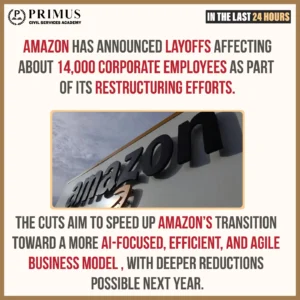
Amazon to lay off 14,000 employees, AI shake-up could push cuts to 30,000 next year: Story in 5 points
Relevance to UPSC
GS Paper III: Economic Development & Employment
- Pertains to the impact of emerging technologies such as Artificial Intelligence (AI) on global and national economies.
- Highlights how automation and AI adoption are reshaping labour markets, corporate structures, and economic policies worldwide.
- Relevant for understanding labour market dynamics, skill transition, and India’s preparedness for technology-driven disruptions in employment and productivity.
More About the News
- Amazon announced it will cut around 14,000 corporate jobs globally, citing a major push towards AI-driven restructuring, and indicated potential for up to 30,000 cuts next year.
- The layoffs affect multiple divisions including devices, HR, operations and cloud, marking one of Amazon’s largest reductions since its pandemic-hiring spree.
- In India, the job cuts will impact approximately 800-1,000 positions as part of the global move, reflecting how multinational shifts reverberate in local economies.
Unemployment
Unemployment refers to the situation where individuals who are capable and willing to work at prevailing wages cannot find suitable employment, reflecting underutilisation of human resources and economic inefficiency.
Types of Unemployment
- Frictional Unemployment: Temporary unemployment during transition between jobs.
Example: A software engineer leaving one company and waiting to join another. - Structural Unemployment: Caused by a mismatch between workers’ skills and job requirements.
Example: Textile workers losing jobs due to automation in factories. - Cyclical Unemployment: Arises due to economic downturns or recessions.
Example: Job losses during the COVID-19 pandemic-induced slowdown. - Seasonal Unemployment: Occurs when demand for labour fluctuates with seasons.
Example: Agricultural labourers remain unemployed after the harvest season. - Disguised Unemployment: More workers are employed than required; productivity per worker is negligible.
Example: Five family members working on a small farm that only needs three. - Technological Unemployment: Job losses due to automation and new technologies.
Example: Bank clerks replaced by ATMs and digital banking. - Educated Unemployment: When educated individuals fail to find jobs matching their qualifications.
Example: Engineering graduates working in non-technical fields or remaining jobless. - Underemployment: Workers employed below their skill level or for fewer hours than desired. Example: A PhD holder working as a data-entry operator.
- Frictional Unemployment: Temporary unemployment during transition between jobs.
Causes of Unemployment
- Slow Economic Growth: Inadequate industrial and infrastructure expansion limits job creation.
Example: India’s jobless growth during the early 2010s despite GDP rise. - Skill Mismatch: Education system not aligned with industry needs.
Example: Shortage of skilled technicians in the renewable energy sector. - Population Pressure: Rapid population growth increases labour force faster than job creation.
Example: Rural youth migrating to cities without adequate opportunities. - Agriculture Dependence: Majority employed in low-productivity farming rather than industrial jobs.
Example: 45% of India’s workforce still dependent on agriculture contributing only ~15% to GDP. - Technological Advancements: Automation and AI reduce demand for manual labour.
Example: Manufacturing plants using robotics replacing assembly-line workers.
- Slow Economic Growth: Inadequate industrial and infrastructure expansion limits job creation.
Impacts of Unemployment
- Economic Slowdown: Reduced income leads to low demand and weak consumption.
Example: Lower household spending during post-pandemic recovery phase. - Social Instability: Joblessness leads to frustration, protests, and social unrest.
Example: Youth agitations over lack of government jobs. - Poverty and Inequality: Unemployment aggravates income disparity and pushes families below poverty line.
Example: Urban informal workers losing jobs during lockdowns. - Brain Drain: Skilled workers migrate abroad for better opportunities.
Example: Indian engineers and doctors moving to the USA and Europe. - Political Consequences: Rising unemployment can cause political dissatisfaction and populist demands.
Example: Employment guarantee schemes gaining political traction.
- Economic Slowdown: Reduced income leads to low demand and weak consumption.
Who Measures Unemployment in India ?
- Primary Agency: National Sample Survey Office (NSSO) under the Ministry of Statistics and Programme Implementation (MoSPI).
- Other Agencies:
- Periodic Labour Force Survey (PLFS) – since 2017.
- Centre for Monitoring Indian Economy (CMIE) – private agency.
- Primary Agency: National Sample Survey Office (NSSO) under the Ministry of Statistics and Programme Implementation (MoSPI).
Methods of Measuring Unemployment in India
- Usual Status (UPS): Measures unemployment over the past 365 days (long-term unemployment).
- Current Weekly Status (CWS): Considers a person unemployed if they had no work for at least one hour during the last 7 days.
- Current Daily Status (CDS): Measures unemployment on a daily basis, providing a more accurate short-term picture.
Challenges in Reducing and Measuring Unemployment
- Informal Sector Dominance: 80–90% of workforce in informal jobs makes tracking unemployment difficult.
Example: Daily-wage workers without formal contracts. - Underreporting of Data: Self-employment often masks true joblessness.
Example: Street vendors counted as employed though underutilised. - Skill Gaps and Education Mismatch: Inadequate technical training limits employability.
Example: Lack of skilled labour in semiconductor manufacturing. - Urban-Rural Disparity: Unequal employment opportunities between regions.
Example: Migration from rural Bihar to Delhi for casual labour. - Lack of Real-Time Data: Delayed surveys hinder timely policy action.
Example: PLFS annual data released months after collection.
- Informal Sector Dominance: 80–90% of workforce in informal jobs makes tracking unemployment difficult.
Government Initiatives to Tackle Unemployment
- Mahatma Gandhi National Rural Employment Guarantee Act (MGNREGA) – Provides 100 days of guaranteed rural employment.
- Skill India Mission (2015) – Enhances employability through vocational training.
- Startup India & Stand-Up India – Promotes entrepreneurship and innovation.
- Make in India – Encourages manufacturing-led job creation.
- PMEGP (Prime Minister’s Employment Generation Programme) – Supports self-employment through micro-enterprises.
- Atmanirbhar Bharat Abhiyan – Focus on self-reliance and MSME revival.
Way Forward
- Promote Labour-Intensive Industries: Focus on textiles, construction, and agro-processing.
- Reform Education System: Integrate vocational and digital skills.
- Enhance MSME Support: Simplify credit and regulatory access.
- Leverage Green Jobs: Invest in renewable energy and sustainability.
- Strengthen Labour Data Systems: Real-time tracking for policy interventions.
Addressing unemployment requires an integrated approach combining skill development, industrial expansion and innovation for creating a future-ready workforce for India’s demographic dividend and sustainable economic growth.
Prelims MCQ
Q. Disguised unemployment generally means (PYQ 2013)
A. large number of people remain unemployed
B. alternative employment is not available
C. marginal productivity of labour is zero
D. productivity of workers is low
Mains Question
Q. Most of the unemployment in India is structural in nature. Examine the methodology adopted to compute unemployment in the country and suggest improvements. (PYQ 2023)
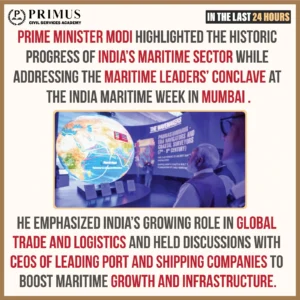
Indian maritime sector has seen historic progress: PM Narendra Modi
Relevance to UPSC
GS Paper III: Science & Technology, Economic Development & Infrastructure
- Pertains to infrastructure, logistics and blue-economy development the article mentions investments in ports, inland waterways and maritime trade.
- Highlights the economic and employment implications of strengthening maritime infrastructure and green hydrogen initiatives at ports.
- Connects to themes of sustainable coastal development, maritime value-chains and job creation in India’s maritime sector.
More About the News
- At the India Maritime Week 2025 in Mumbai, Narendra Modi declared that when global seas are rough the world looks for a “steady lighthouse”, positioning India as that lighthouse in the maritime domain.
- He highlighted India’s rapid maritime sector growth: doubling major-port capacity, reducing vessel turnaround time, boosting inland-waterway cargo growth and modernising laws.
- India pledged prioritising the blue economy and sustainable coastal development over the next 25 years and invited global participation in its maritime-infrastructure expansion.
Logistics System in India
India’s logistics system forms the backbone of its economic growth, integrating transport, warehousing, and digital networks to ensure seamless movement of goods, boost exports, and enhance supply chain competitiveness.
Logistics Sector in India: Status
- Global Standing: India ranked 38th in the World Bank Logistics Performance Index 2023.
- Digital Penetration: The Unified Logistics Interface Platform (ULIP) has processed over 100 million digital transactions (PIB).
- Trade Digitisation: Around 98% of trade transactions are processed via the National Single Window System.
- Port Efficiency: Major Indian ports now have container turnaround times under 24 hours (MoPSW).
Key Drivers of Lowering Logistics Costs
- Digital Integration: GPS-based tracking, app workflows, and transparent digital payments improve coordination and reduce delays.
- ULIP Connectivity: Links 100+ government and private sector systems through APIs for real-time cargo tracking.
- Service Innovation: Rise of asset-light aggregators, Goods Transport Agencies (GTAs), and integrated supply chains to meet diverse industrial needs.
- Tier-2 Expansion: Cities like Bhopal, Coimbatore, and Bhubaneswar emerging as key logistics hubs.
Key Factors Driving Growth
- Government Reforms & Infrastructure: Initiatives like PM Gati Shakti, GST, and freight corridors boost multimodal connectivity and reduce logistics costs.
Example: Dedicated Freight Corridors (DFCs) enhance freight speed and reliability. - E-commerce & Last-Mile Delivery: Rapid growth of e-commerce fuels demand for efficient last-mile logistics in Tier-2 & Tier-3 cities.
Example: Hyperlocal delivery models like Dunzo and Shadowfax. - Digital Transformation & Automation: Use of AI, IoT, GPS, and blockchain improves route optimisation, fleet management, and transparency.
Example: Tech-based route planning reduces fuel consumption and costs. - Growth of Cold Chain Logistics: Rising demand from pharmaceutical and agriculture sectors boosts temperature-controlled logistics.
Example: Government incentives for refrigerated storage and transport networks. - Demand for 3PL & 4PL Services: Firms increasingly outsource logistics to specialised providers for cost efficiency.
Example: Mahindra Logistics and Delhivery offering integrated 3PL/4PL solutions.
- Government Reforms & Infrastructure: Initiatives like PM Gati Shakti, GST, and freight corridors boost multimodal connectivity and reduce logistics costs.
Challenges in the Logistics Sector
- Digital Divide: Small firms lack digital skills and reliable Internet access.
Example: Rural fleet operators still rely on manual paperwork. - Regulatory Complexity: Overlapping state–central laws and inconsistent GST compliance disrupt seamless transport.
Example: Varying state permit rules delay freight movement. - Data Fragmentation: Absence of standardised data formats causes duplication and inefficiency.
Example: Multiple tracking systems used by different ports and logistics firms. - Labour Vulnerability: Gig and contract workers lack job security and social benefits.
Example: Delivery workers face unstable incomes and no insurance coverage. - Cybersecurity Threats: Increasing digitisation exposes the sector to cyberattacks and data leaks.
Example: Breach in logistics payment systems affecting supply chain trust.
- Digital Divide: Small firms lack digital skills and reliable Internet access.
Government Initiatives in the Logistics Sector
- PM Gati Shakti: Unified planning framework for integrated infrastructure and reduced logistics costs.
- National Logistics Policy (NLP): Targets reducing logistics costs to 8% of GDP through digital reforms.
- Dedicated Freight Corridors (DFCs): 1,724 km of high-speed rail corridors to improve freight efficiency.
- Multi-Modal Logistics Parks (MMLPs): 35 planned parks with ₹50,000 crore investment for transport-warehousing synergy.
- Logistics Efficiency Enhancement Programme (LEEP): Boosts freight speed, tracking, and cost efficiency.
- Parivahan Portal & mParivahan App: Digital vehicle registration and tracking for streamlined operations.
- Sagarmala Programme: Promotes port-led development and coastal shipping efficiency.
- Bharatmala Pariyojana: Expands highways and freight corridors to strengthen national connectivity.
Way Forward
- Digital Inclusion: Extend digital infrastructure to small firms and rural logistics players.
- Regulatory Harmonisation: Streamline GST, permits, and licensing for seamless operations.
- Worker Protection: Enforce labour codes and social benefits for gig and contract workers.
- Cybersecurity Resilience: Implement robust data protection and cyber protocols.
- Sustainable Transition: Prioritise low-carbon transport modes and renewable-powered logistics infrastructure.
India’s logistics sector is the backbone of its trade competitiveness. Embracing digital transformation, sustainability, and inclusivity will ensure cost efficiency, global integration, and alignment with India’s net-zero future.
Prelims MCQ
Q. Which of the following statements about India’s logistics sector is/are correct?
1. The PM Gati Shakti initiative aims to integrate multimodal infrastructure and reduce logistics costs.
2. The National Logistics Policy targets bringing logistics costs down to 8% of GDP.
3. The Sagarmala Programme focuses primarily on developing inland waterways for freight transport.
4. The Unified Logistics Interface Platform (ULIP) enables data integration across multiple government systems.
A. 1, 2 and 4 only
B. 1 and 3 only
C. 2 and 3 only
D. 1, 2, 3 and 4
PM Gati Shakti integrates road, rail, port, and air logistics for cost-effective infrastructure planning. National Logistics Policy aims to cut logistics costs to 8% of GDP. Sagarmala focuses on port-led coastal development, not inland waterways.
Mains Question
Q. The Gati-Shakti Yojana needs meticulous coordination between the government and the private sector to achieve the goal of connectivity. Discuss. (PYQ 2022)
President Murmu takes sortie in Rafale fighter jet in Haryana’s Ambala

Relevance to UPSC
GS Paper II: Polity
- President: Role, powers and functions. (President is the supreme commander of the armed forces).
GS Paper III: Defence, Technology & Security
- Highlights advanced military aviation technology and its operational induction in India.
- Touches upon defence infrastructure development and the strategic importance of air-power in India’s security doctrine.
- Connects to themes of modernisation of armed forces, defence diplomacy and indigenous/foreign technology acquisition.
More about the News
- Droupadi Murmu, President of India, undertook a sortie in a Rafale fighter jet at Air Force Station Ambala, becoming the first Indian President to fly in two different IAF fighter aircraft.
- The flight lasted around 30 minutes, covered about 200 km, reached an altitude of around 15,000 ft and a speed of ~700 km/h, underscoring the operational capability of the Rafale fleet.
- The sortie symbolises a boost in India’s aerial combat credibility and sends a signal of confidence in the country’s defence preparedness.
Rafale Fighter Jet
Fighter jets are advanced military aircraft designed for air superiority, precision strikes, and defense operations, integrating cutting-edge avionics, stealth, and weaponry to secure national sovereignty and strategic deterrence capabilities.
Dassault Rafale – Overview
- Generation & Role: 4.5-generation, twin-engine, delta-wing, multirole fighter developed by Dassault Aviation (France).
- Speed & Range: Maximum speed Mach 1.8, combat radius over 1000 km.
- Avionics: Advanced sensors and EW systems for superior situational awareness and survivability.
Aerodynamic Design
- Delta Wing Configuration: Offers high lift-to-drag ratio, low drag, and superior maneuverability.
- Canards: Provide extra lift, allowing short take-offs.
- Relaxed Stability: Enhances agility and control during high-speed maneuvers.
Avionics and Sensors
- RBE2 AESA Radar: Provides long-range detection and multi-target tracking.
- Front Sector Optronics (FSO): Enables passive visual/infrared target tracking.
- SPECTRA EW Suite: Ensures electronic countermeasures, threat detection, and jamming.
- Omnidirectional Warning System: Enhances pilot awareness and self-protection.
Engine and Performance
- Engines: Two SNECMA M88 turbofan engines (50 kN dry thrust, 75 kN with afterburners).
- Supercruise Capability: Enables sustained supersonic flight without afterburners.
- Payload Capacity: 14 hardpoints carrying up to 9500 kg of weapons and fuel.
Rafale Variants
- Rafale C: Single-seat Air Force variant with 75% fleet availability and high reliability.
- Rafale B: Twin-seat variant for training and dual-operation missions.
- Rafale M: Naval variant for carrier-based operations, equipped with reinforced landing gear.
- Rafale N: Specialized nuclear strike variant.
- Rafale R: Reserved for research and technology development.
Rafale Deal with India
- Original MMRCA Tender (2007): Planned for 126 aircraft with full technology transfer.
- 2016 Inter-Governmental Deal: Signed for 36 Rafales (€7.8 billion) — ready-to-fly delivery (2019–2022).
- Cost & Offsets: Included Make in India and technology transfer components.
- India-Specific Enhancements (13): Customized radar, EW systems, helmet sights, and cold-start capability.
- Performance Guarantee: Dassault ensures 75% fleet availability through spares and maintenance support.
India-Specific Customisations
- Helmet Mounted Display: Israeli system for line-of-sight missile targeting.
- EW Suite Enhancements: Israeli jammers and RWRs for survivability.
- Cold Start Capability: Enables operations from high-altitude bases like Leh.
Weapon Integration:- BrahMos & Astra missiles for air dominance and strike missions.
- BrahMos-NG for future integration.
- Communication Upgrades: Integrated with Indian satellites and AWACS systems.
- Refuelling Compatibility: Fully compatible with Indian tanker fleet.
Weapons and Armaments
Air-to-Air:
Meteor: BVR missile (>100 km range), ramjet propulsion, high kill probability.
MICA: Dual IR and EM guidance, range 60–70 km, ideal for close air combat.
Air-to-Ground:
SCALP: Long-range standoff cruise missile (~300 km range).
HAMMER: Modular precision bomb with GPS/INS guidance for low-collateral strikes.
Laser-Guided Bombs: Precision targeting for mobile or time-sensitive assets.
Anti-Ship:
Exocet: Sea-skimming missile (180 km range, 165 kg warhead).
Naval SCALP: Cruise missile variant for engaging naval surface groups.
Significance for India
- Air Superiority: Meteor missile and AESA radar provide an edge in BVR combat.
- Precision Strikes: SCALP and HAMMER enhance deep interdiction and surgical strike ability.
- All-Weather Capability: Integrated targeting pods and FSO enable operations in all conditions.
- Nuclear Deterrence: Capable of carrying nuclear payloads, strengthening India’s triad.
- Strategic Symbol: Demonstrates India’s modernization and growing aerospace partnership with France.
Role in the Indian Air Force (IAF)
- Operational Readiness: High availability and fast turnaround between missions.
- Deployment: Distributed across forward and central air bases for flexible response.
- Mission Versatility: Performs air defence, ground attack, reconnaissance, and nuclear delivery.
- Replacing Legacy Aircraft: Substituting MiG-21s and MiG-27s; supplementing upgraded Mirage-2000s.
- Joint Exercises: Participated in drills with UAE and other friendly forces to demonstrate interoperability.
Concerns
- High Acquisition & Maintenance Cost: Limits wider procurement of other platforms.
- Spare Parts Supply: Continuous flow essential for maintaining high serviceability.
- Training Demands: Requires advanced training for pilots and engineers.
- Integration Challenges: Must align with IAF’s command and logistics systems.
- Technological Upgradation: Needs regular upgrades to prevent obsolescence.
Way Forward
- Indigenous Integration: Seamless integration with Indian weapons (Astra, BrahMos) to enhance autonomy.
- Additional Procurement: Plans to acquire 36 more Rafales and 26 naval variants for the Indian Navy.
- Strategic Deployment: Positioning at forward bases for rapid combat readiness.
- Infrastructure Development: MRO, simulators, and training infrastructure expansion essential.
- India–France Cooperation: Leverage partnership for joint R&D and future aerospace projects.
Future fighter jets will emphasize stealth, artificial intelligence, and indigenous innovation, transforming air combat into a network-centric domain and strengthening self-reliance in aerospace defense for enduring national security.
Prelims MCQ
Q.
Consider the following aircraft:
1. Rafael
2. MiG-29
3. Tejas MK-1
How many of the above are considered fifth generation fighter aircraft? (PYQ 2024)
A. Only one
B. Only two
C. All three
D. None
Rafale, MiG-29, and Tejas Mk-1 are all 4th or 4.5 generation fighter aircraft — not 5th generation. 5th generation fighters (e.g., F-22 Raptor, F-35, Su-57) feature stealth, supercruise, and sensor fusion. Hence, none of the listed aircraft qualify as 5th generation.
Mains Question
Q. How is the S-400 air defence system technically superior to any other system presently available in the world? (PYQ 2021)
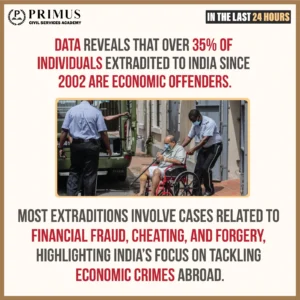
Most people extradited to India are economic offenders: says data
Relevance to UPSC
GS Paper III: Money Laundering
- Pertains to combating economic offences, financial fraud and money-laundering, which affect the economy and financial security.
- Highlights institutional mechanisms, legal frameworks and enforcement challenges in handling fugitives and recovering proceeds of crime.
- Connects to themes such as strengthening regulatory architecture, financial sector integrity and economic deterrence.
More about the News
- A data survey reveals that most individuals extradited to India are charged with economic offences (fraud, forgery, cheating) rather than violent crimes.
- India has issued numerous extradition requests and emphasised bilateral legal cooperation, reflecting a push to bring back high-profile fugitives and recover assets abroad.
- The findings underscore persistent gaps and delays in the extradition process, including legal, human rights and treaty-related issues that hinder swift action.
Money Laundering
Money laundering is the process of converting proceeds of crime into apparently legitimate assets so they can be used without detection. It undermines financial integrity, fuels organised crime and terrorism, and distorts the economy. Effective prevention requires legal frameworks, institutional coordination, and international cooperation.
Stages of Money Laundering
- Placement: Introducing illicit cash into the financial system (e.g., depositing drug-cash into bank accounts).
- Layering: Complex transfers/transactions to obscure source (e.g., multiple transfers, shell companies, trade mis-invoicing).
- Integration: Reintroducing “cleaned” funds into the economy as apparently legitimate assets (e.g., buying property, investments).
Common Methods / Techniques
- Structuring / Smurfing: Splitting large cash deposits into smaller amounts to avoid reporting.
- Use of shell companies & trusts: Layering funds through opaque corporate entities.
- Trade-based money laundering (TBML): Mis-invoicing, over/under-shipment to move value.
- Hawala / informal value transfer systems: Informal cross-border money movement outside formal channels.
- Real estate & luxury assets: Purchasing property, art, vehicles to integrate value.
Legal Framework in India
- Prevention of Money-Laundering Act (PMLA), 2002: Main statute defining offence, attachment/confiscation, penalties, and reporting obligations.
- Rules & sectoral obligations: Banks, NBFCs, financial institutions, intermediaries must do KYC, maintain records and report suspicious transactions to FIU-IND.
- Amendments & allied laws: PMLA has been amended and interacts with IPC, NDPS Act, Prevention of Corruption Act for predicate offences.
Global Legal Framework
- FATF Recommendations: Global AML/CFT standards that states adopt in law/regulation (e.g., customer due diligence, beneficial ownership, international cooperation).
- UN conventions & agencies: UNODC, Egmont Group and INTERPOL provide instruments, operational guidance and cooperation mechanisms.
Various Enforcement Agencies Involved (India)
- Enforcement Directorate (ED): Investigates PMLA offences, attachment & prosecution.
- Financial Intelligence Unit — India (FIU-IND): Central agency for receiving, analysing and disseminating suspicious transaction reports.
- Reserve Bank of India (RBI): Regulates banks/NBFCs, issues AML guidelines, monitors compliance.
- SEBI / IRDA / GST & Income-tax authorities / Customs / Police / CBI: Sectoral regulators and investigative agencies that detect predicate offences or sectoral non-compliance.
- Ministry of Finance (Department of Revenue) steers national AML policy and international cooperation.
Social & Economical Impacts
- Erosion of public trust in financial institutions: e.g., repeated bank fraud/laundering cases erode depositor confidence and willingness to use formal banking.
- Distortion of markets & unfair competition: e.g., businesses funded by laundered proceeds undercut honest firms (real-estate or construction bubbles).
- Revenue loss & fiscal stress: e.g., tax evasion and round-tripping reduce government receipts and investment in public services.
- Financing of organised crime or terrorism: e.g., laundering channels used to move funds for narcotics or terror networks, threatening national security.
- Social inequality & corruption reinforcement: e.g., proceeds used to buy political influence or property, entrenching elite capture and social grievances.
Challenges in Curbing Money Laundering
- Complex cross-border flows & secrecy jurisdictions: e.g., funds routed via tax havens or shell companies make tracing ownership hard.
- Evolving technology & crypto/virtual assets: e.g., anonymous crypto mixers and decentralised exchanges enabling rapid layering.
- Weak beneficial-ownership transparency: e.g., nominee directors and opaque trusts hide real owners of corporate vehicles.
- Resource & capacity constraints in enforcement: e.g., overstretched FIU/ED with high transaction volumes and limited forensic tools.
- Coordination & legal gaps across agencies & jurisdictions: e.g., delays in MLATs, differing evidentiary standards impede swift asset recovery.
Government initiatives
- Strengthening FIU-IND & reporting regime: Mandatory STR/CTR reporting, e-filing and risk-based supervision.
- PMLA enforcement & asset attachment: Aggressive use of PMLA provisions by ED for attachment and prosecution.
- Beneficial-ownership & KYC reforms: Tighter KYC, PAN/Aadhaar seeding for transparency in financial transactions.
- International cooperation: Participation in FATF mutual evaluations and global initiatives (Egmont/FATF/UNODC cooperation).
- Regulatory guidance for new channels: Advisory/regulatory steps for virtual assets, payment banks, and NBFCs to plug AML gaps.
Best Practices
- UK / Companies House reforms: Stronger UBO registers and corporate transparency measures to prevent hiding of ownership.
- FATF-Mutual Evaluation & Peer Pressure: Countries implementing FATF recommendations to raise standards and secure access to global finance.
Way Forward
- Strengthen beneficial-ownership registries & corporate transparency (mandatory, verified UBO data).
- Upgrade techno-forensics & AML analytics in FIU/ED; regulate VASPs (Virtual Asset Service Providers).
- Faster, standardized international cooperation (MLAT reforms / automated info-sharing).
- Risk-based supervision & capacity building for frontline regulators (RBI/SEBI/IRDA).
- Public awareness, whistleblower protections & stronger penalties for facilitators (lawyers, accountants).
Combating money laundering will require resilient domestic institutions, cutting-edge analytics, and seamless international cooperation to keep pace with adaptive criminals. Transparency in ownership, tighter regulation of new financial technologies, and faster cross-border legal processes are essential. Strengthened AML/CFT frameworks will protect economic integrity and foster trust in the formal financial system.
Prelims MCQ
Q.Under the Prevention of Money-Laundering Act (PMLA), 2002, which of the following is NOT primarily a function of the Financial Intelligence Unit — India (FIU-IND)?
A. Receiving and analyzing Suspicious Transaction Reports (STRs) from reporting entities.
B. Coordinating with foreign FIUs for an exchange of financial intelligence.
C. Conducting criminal prosecutions under PMLA in Courts.
D. Disseminating financial intelligence to the law enforcement agencies.
FIU-IND Role: Receives, analyses, and disseminates financial intelligence from Suspicious Transaction Reports (STRs) and Cash Transaction Reports (CTRs). International Cooperation: Coordinates with foreign Financial Intelligence Units (FIUs) for sharing intelligence and enhancing AML/CFT measures. Limitation: Does not conduct criminal prosecutions; enforcement and prosecution under PMLA are handled by agencies like the Enforcement Directorate (ED).
.Mains Question
Q. Discuss how emerging technologies and globalisation contribute to money laundering. Elaborate measures to tackle the problem of money laundering both at national and international levels. (PYQ 2021)
Related
Discover more from Primus Civil Services Academy
Subscribe to get the latest posts sent to your email.