

November 19th Current Affairs
Table of Contents
Carbon Border Adjustment Mechanism (CBAM)
Stay connected via Google News Follow us for the latest travel updates and guides. Home / Carbon Border Adujustment Mechanism
ಬಾರಿಸು ಕನ್ನಡ ಡಿಂಡಿಮವ
Stay connected via Google News Follow us for the latest travel updates and guides. Home / ‘ಬಾರಿಸು ಕನ್ನಡ ಡಿಂಡಿಮವ’ ದೇಶದ
UPSC CSAT Average PYQ with Solutions
Stay connected via Google News Follow us for the latest travel updates and guides. UPSC CSAT Average PYQ with Solutions
Hypothesis in Sociological Research
Stay connected via Google News Follow us for the latest travel updates and guides. Home / Hypothesis in Sociological Research
Sampling Errors in Sociological Research
Stay connected via Google News Follow us for the latest travel updates and guides. Home / Sampling Errors in Sociological
Sampling in Sociology
Stay connected via Google News Follow us for the latest travel updates and guides. Home / Sampling in Sociology Sampling
Variables in Sociological Research
Stay connected via Google News Follow us for the latest travel updates and guides. Home / Variables in Sociological Research
Nomothetic and Idiographic Methods in Sociology
Stay connected via Google News Follow us for the latest travel updates and guides. Home / Nomothetic and Idiographic Methods
Focus Group Discussion (FGD) in Sociology
Stay connected via Google News Follow us for the latest travel updates and guides. Home / Focus Group Discussion (FGD)
Biographical Studies in Sociology
Stay connected via Google News Follow us for the latest travel updates and guides. Home / Biographical Studies in Sociology
Google launches more powerful Gemini 3 model for reasoning and vibe coding

Relevance to UPSC
GS Paper III: Science & Technology
- The advancement of AI models like Gemini 3 is clearly a key scientific-technological development; also relevant to national security (AI in defence/cyber), industry (AI ecosystem), economy (productivity, jobs).
GS Paper IV: Ethics & Aptitude
- Raises ethical questions around AI autonomy, agency, accountability, bias, fairness important for the ethics section though more peripheral.
More About the News
- Google has launched Gemini 3, a multimodal AI model with strong reasoning and “vibe-coding” capabilities.
- The model claims state-of-the-art performance in coding, reasoning and handling text + image inputs, signalling AI leap.
- Gemini 3 is positioned to be integrated into Google Search, apps and developer tools, intensifying competition in global AI-race.
Emerging Technologies
Emerging technologies represent innovations at the frontier of science and engineering, reshaping industries, governance, and human lifestyles through transformative applications in artificial intelligence, biotechnology, quantum computing, and advanced manufacturing.
What is it?
- Emerging technologies are novel, rapidly evolving scientific innovations that have the potential to disrupt existing systems and create new opportunities.
- They often exist at an experimental or developmental stage, with wide-ranging implications for economy, security, and society.
- Examples include AI, quantum technology, blockchain, robotics, nanotechnology, and synthetic biology.
Scope of Emerging Technologies
- Economic Growth: Drives productivity, entrepreneurship, and high-tech job creation.
- National Security: Strengthens cyber defence, surveillance, and strategic autonomy.
- Healthcare & Education: Enables precision medicine, e-learning, and data-driven decision-making.
- Governance: Facilitates e-governance, smart cities, and transparent service delivery.
- Sustainability: Aids climate modeling, renewable energy innovation, and efficient resource use.
Difference Between Emerging and Critical Technologies
Emerging Technologies:
- Are new, developing, and experimental with uncertain long-term impact.
- Focus on innovation and potential future applications.
- Example: Quantum computing, gene editing.
Critical Technologies:
- Are strategically essential for national security, economy, or sovereignty.
- Often include mature or sensitive tech needing protection from misuse or foreign control.
- Example: Cybersecurity systems, satellite navigation, nuclear tech.
How Emerging Tech is Impacting Human Life
- Automation & AI improving productivity and decision-making.
- Digital health innovations enhancing diagnosis, telemedicine, and preventive care.
- Smart governance tools promoting transparency and citizen engagement.
- EdTech platforms transforming access to knowledge and skill development.
- Sustainable solutions advancing climate resilience and green growth.
Challenges Faced in Developing Such Technologies
- Funding and R&D gaps limiting large-scale innovation.
- Skill shortage in advanced scientific and computational domains.
- Ethical and privacy concerns due to AI and data misuse.
- Regulatory uncertainty affecting experimentation and deployment.
- Geopolitical tech competition causing dependency and restrictions.
Government Initiatives Taken Up
- National Mission on Quantum Technologies and Applications (NM-QTA).
- India AI Mission for AI innovation and governance.
- National Supercomputing Mission (NSM) to boost computational capacity.
- Digital India Programme for digital infrastructure and literacy.
- Atal Innovation Mission & Startup India promoting R&D and entrepreneurship.
- Semicon India Programme to build a domestic semiconductor ecosystem.
Way Forward
- Increase R&D investment to 2% of GDP.
- Develop ethical frameworks for responsible AI and biotechnology.
- Foster global collaborations in frontier tech development.
- Enhance STEM education and digital skills for youth.
- Ensure cybersecurity and data protection through robust policy mechanisms.
Emerging technologies will define humanity’s next growth frontier; India must integrate innovation, ethics, and inclusion to harness them responsibly for sustainable progress and global technological leadership.
Prelims MCQ
Q. With reference to “Blockchain Technology”, consider the following statements: (PYQ 2020)
1. It is a public ledger that everyone can inspect, but which no single user controls.
2. The structure and design of blockchain is such that all the data in it are about cryptocurrency only.
3. Applications that depend on basic features of blockchain can be developed without anybody’s permission.
Which of the statements given above is/are correct?
A. 1 only
B. 1 and 2 only
C. 2 only
D. 1 and 3 only
Correct Answer: (d) 1 and 3 only
Explanation:
• Statement 1 – Correct: Blockchain is a distributed, transparent, immutable public ledger not controlled by any single individual.
• Statement 2 – Incorrect: Blockchain is used beyond cryptocurrency — including supply chain management, digital identity, land records, voting, and smart contracts.
• Statement 3 – Correct: Most blockchains (like Ethereum, Bitcoin) are open-source and permissionless, enabling anyone to build decentralized applications.
Hence, the correct answer is (d) 1 and 3 only.
Mains Question
Q. The emergence of the Fourth Industrial Revolution (Digital Revolution) has initiated e-Governance as an integral part of government. Discuss. (PYQ 2020)
Railways launches new policy to boost bulk cement transport; sets freight rate at Rs 0.90 per tonne/km
Relevance to UPSC
GS Paper III: Economy, Infrastructure & Transport
- It’s directly about railways logistics, modal shift from road to rail, reducing cost of cement transport, and boosting multimodal cargo terminals.
More About the News
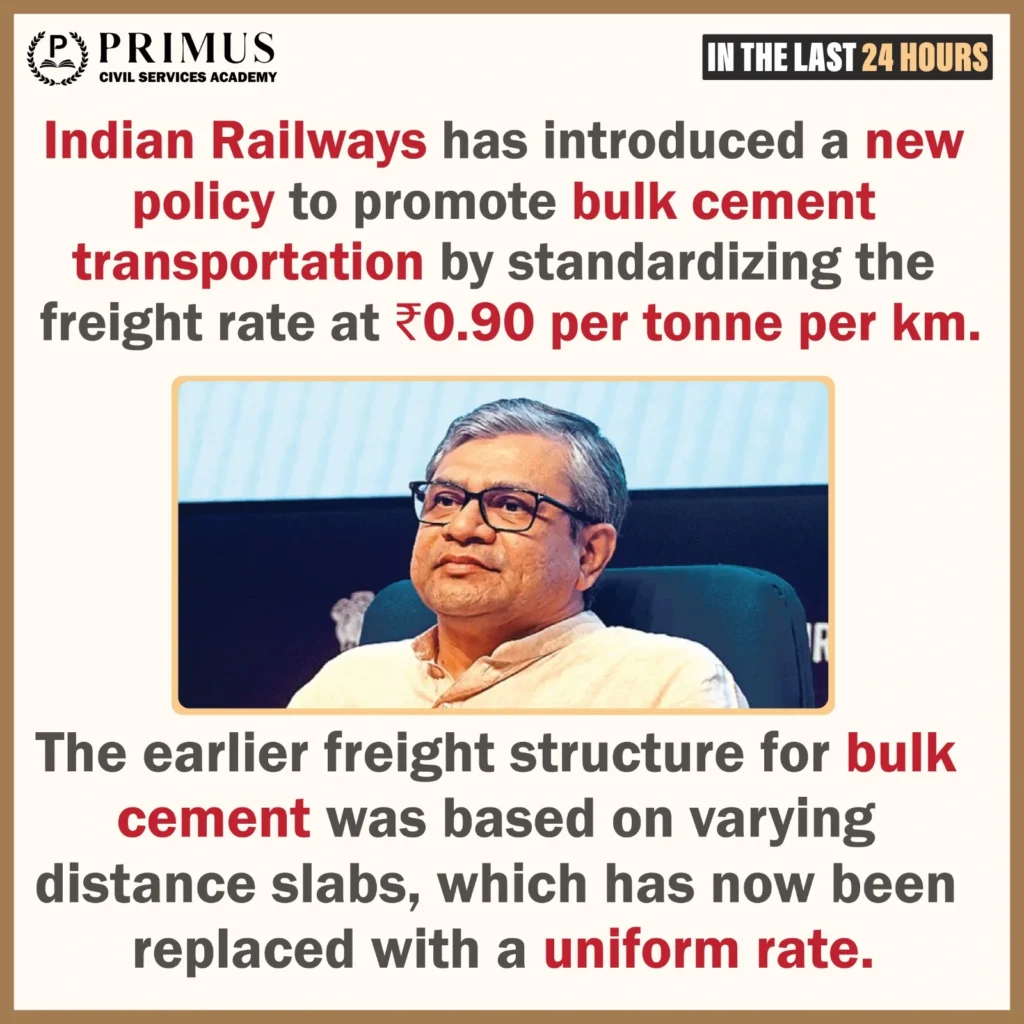
- Railways set a flat freight rate of ₹ 0.90 per tonne-km for bulk cement, removing previous distance-and-weight slabs.
- Policy promotes tank containers for bulk cement transport, enabling efficient, end-to-end, and pollution-free logistics.
- Railways will build bulk cement terminals, with specialized wagons, silos, and hoppers to facilitate cheaper supply.
Indian Railways
Indian Railways, the world’s fourth-largest rail network, is central to India’s economic integration, mass mobility, and freight movement. It underpins connectivity, trade, employment, and regional development across the country.
Facts about Indian Railways
- Extensive Rail Network: Over 68,000 km of track makes India the fourth-largest railway system globally, serving as the nation’s transport backbone.
- Huge Passenger Load: Carries 23 million passengers daily, ensuring high social mobility and connecting remote and urban regions.
- Rising Freight Movement: FY25 freight reached 906.9 MT, up 2.2%, with strong growth in containers (7.7%) and clinker/miscellaneous goods (7%).
- High Electrification: 97% of broad-gauge routes electrified, lowering fuel costs and supporting clean-energy commitments.
- Freight Share Goal: Government targets raising freight share from 35% to 45% by 2030, aligned with India’s Paris Agreement NDCs.
- Improved Safety: Consequential accidents fell 80% (2016–21), though 95% still stem from driver error, necessitating better training and automation.
Issues & Challenges
- Overloaded Routes: Many corridors operate beyond 150% capacity, increasing delays, congestion, and limiting routine maintenance.
- Safety Deficiencies: Frequent derailments, collisions, and fires arise due to outdated technology, infrastructure gaps, and human error.
- Financial Limitations: Fare populism and limited private investment restrict funds for modernisation, maintenance, and new technologies.
- Governance Bottlenecks: Centralised control, bureaucratic delays, and political interference slow project execution and reforms.
- HR Shortages & Service Gaps: Lack of skilled manpower, long hours, and weak training affect efficiency; cleanliness, punctuality, and catering remain concerns.
Government Initiatives
Finance & Administration:
Rail Infrastructure Development Fund (RIDF) created to fund capital projects.
Rail Drishti Portal launched for transparency.
Organisational Reforms:
Eight Group A services merged into Indian Railway Management Service (IRMS).
Railway Board restructured; HR processes digitised.
Infrastructure Development:
National Rail Plan (NRP) 2030 to prepare for 2050 traffic demands.
Indigenous Vande Bharat trains expand semi-high-speed capacity.
Dedicated Freight Corridors (EDFC & WDFC) funded by World Bank and Japan.
Safety & Security:
Railway Safety Fund (RSF) targets elimination of unmanned crossings.
TCAS/KAVACH and Zero Accident Mission enhance safety.
Meri Saheli improves women’s safety; CORAS tackles terrorism and Naxalism.
Freight & Logistics:
Freight on Priority Policy improves customer-centric services.
Kisan Rail boosts agri logistics.
Gati Shakti Cargo Terminal Policy promotes terminal expansion.
Digitisation & Connectivity:
Wi-Fi at 6,045 stations; surveillance systems installed.
PM Gati Shakti integrates multimodal logistics for seamless freight/passenger movement.
Human Resource Development:
Rail Kaushal Vikas Yojana trains youth in rail sector skills.
Project Saksham upgrades staff competencies.
Tourism Promotion:
Bharat Gaurav Trains operate theme-based tourism circuits to boost cultural and heritage tourism.
Way Forward
- Infrastructure Modernisation: Upgrade tracks, stations, coaches, and signalling; expand high-speed rail and ICT-driven operations.
- Independent Safety Regulator: Establish a dedicated safety authority as recommended by Kakodkar Committee (2012).
- PPP & FDI Promotion: Attract private and foreign players to enhance technology adoption and service quality.
- Corporatisation & Decentralisation: Separate freight/passenger operations; empower Zonal Railways for faster decisions — per Bibek Debroy Committee (2015).
- Safety Upgradation: Remove level crossings, automate signalling, and expand DFCs to reduce congestion and accidents.
- HR Reforms: Fill vacancies, strengthen training, improve working conditions — supported by Rakesh Mohan Committee (2001).
- Monetise Railway Land: Use surplus land and airspace for commercial ventures to generate non-fare revenue.
- Passenger Service Enhancement: Improve cleanliness, punctuality, catering, digital ticketing, and real-time train tracking.
- DFCs Expansion: Further develop dedicated corridors to separate freight and passenger traffic, lowering logistics costs and improving efficiency.
A modern, safe, and technology-driven Indian Railways can transform national logistics, boost economic competitiveness, and deliver world-class mobility, shaping India’s journey toward sustainable, inclusive, and high-speed growth.
Prelims MCQ
Q. With reference to bio-toilets used by Indian Railways, consider the following statements: (PYQ 2015)
1. The decomposition of human waste in the bio-toilets is initiated by a fungal inoculum.
2. Ammonia and water vapour are the only end products in this decomposition which are released into the atmosphere.
Which of the statements given above is/are correct?
A. 1 only
B. 2 only
C. Both 1 and 2
D. Neither 1 nor 2
Correct Answer: (d) Neither 1 nor 2
Explanation:
• **Statement 1 – Incorrect:** Indian Railway bio-toilets use anaerobic bacterial inoculum developed by DRDO, not fungi.
• **Statement 2 – Incorrect:** End products are methane, carbon dioxide, and water (biogas + treated effluent), not just ammonia and water vapour.
These bio-digesters ensure eco-friendly decomposition of waste without manual handling.
Mains Question
Q. Why is Public Private Partnership (PPP) required in infrastructural projects? Examine the role of PPP model in the redevelopment of Railway Stations in India. (PYQ 2022)
India will continue to treat terrorists and their sponsors alike, relations with China improved significantly: Army Chief General Upendra Dwivedi
Relevance to UPSC
GS Paper III: Internal Security & Defence
- Underlines the “two-front threat” from Pakistan and China (military collusion).
- Signals India’s readiness & deterrence posture (e.g., in Operation Sindoor).
More About the News
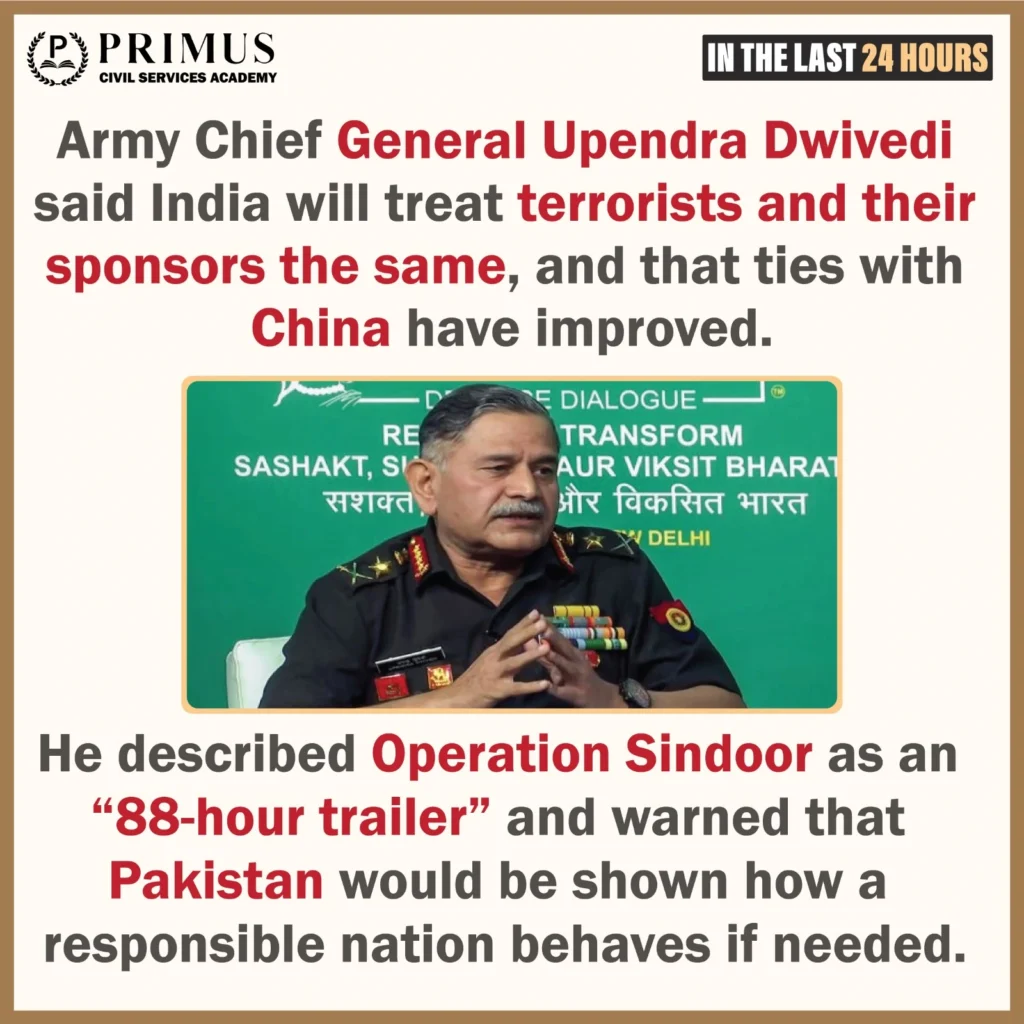
- Army Chief Gen Upendra Dwivedi warns that India will treat terrorists and their state sponsors equally, especially those backing cross-border terror.
- He emphasized the “two-front threat” from a high degree of collusion between Pakistan and China.
- He noted that India–China military interactions have improved, but strategic vigilance at the LAC remains vital.
Operation Sindhoor
What Is It?
- A high-precision Indian strike operation (7 May 2025) in retaliation for the Pahalgam terror attack on 22 April 2025.
- Targeted terrorist infrastructure, not Pakistani military bases, to dismantle networks of groups like JeM, LeT, and Hizbul Mujahideen.
- India described it as “measured, non-escalatory,” using stand-off weapons from its own airspace.
Sites Targeted
- Nine locations across Pakistan and Pakistan-occupied Kashmir (PoK): Muzaffarabad, Kotli, Bahawalpur, Rawalakot, Chakswari, Bhimber, Neelum Valley, Jhelum, Chakwal.
- Key terror group infrastructure: JeM’s HQ at Bahawalpur, LeT’s base at Muridke, recruitment & training camps in PoK.
Missiles, Drones & Other Weapons Used
- Precision-guided missiles launched by the Indian Air Force.
- Loitering munitions (drones) were used to strike some of the sites.
- India reportedly jammed and bypassed Chinese-origin air defence systems during the operation.
- Post-strike, India recovered PL-15 missile debris (Chinese origin) and Yiha (Turkish) drones, indicating use of advanced hostile capabilities by Pakistan.
Diplomatic Challenges Faced & How India Tackled Them
- Accusations of an “act of war” by Pakistan’s leadership following the strikes.
- Risk of international condemnation and escalation: India insisted its strikes were purely against terror infrastructure, not civilian or military Pakistani facilities.
- Economic and diplomatic retaliations: India suspended trade with Pakistan, revoked visas, and imposed economic pressure without triggering full-scale war.
- Communication & narrative-building: India held briefings, explained its position to world powers, and emphasized its “calibrated response.”
- Eventually, Pakistan requested a ceasefire, which India accepted, showing diplomatic restraint.
How It Shaped India’s Security Doctrine
- Threshold expansion: Strikes went deeper than past operations (e.g., Balakot), signaling a willingness to hit high-value terror sites far inside adversary territory.
- Non-escalatory deterrence: Used standoff weapons and avoided targeting Pakistani military installations, reinforcing a posture of measured retaliation.
- Technological edge: Demonstrated strong electronic warfare, air defence interception (against drones/missiles), and precision strike capability.
- Integrated military-diplomatic strategy: Combined kinetic action with economic sanctions and international narrative-building to isolate terrorism-supporting infrastructure.
Way Forward
- Institutionalize doctrinal clarity on the use of missile & drone strikes for counter-terrorism.
- Continue strengthening indigenous defence tech: EW systems, counter-UAV, stealth munitions.
- Maintain calibrated deterrence: ensure responses hit terror infrastructure, avoid civilian/military escalation.
- Leverage economic tools (sanctions, trade suspension) as part of national security strategy.
- Enhance diplomatic outreach to explain India’s security actions to the global community.
- Build all-domain readiness (air, space, cyber) to counter multi-vector threats.
- Keep reinforcing intelligence fusion (human, SIGINT, satellite) to identify terror networks early.
Operation Sindoor signals a new era of calibrated yet deep retaliation against terrorism — India must now institutionalise this strategy, combining precision force with diplomatic leverage to deter future cross-border threats.
Prelims MCQ
Q. Operations undertaken by the Army towards upliftment of the local population in remote areas to include addressing of their basic needs is called: (PYQ 2024)
A. Operation Sankalp
B. Operation Maitri
C. Operation Sadbhavana
D. Operation Madad
Correct Answer: (c) Operation Sadbhavana
Explanation:
• Operation Sadbhavana is an Indian Army humanitarian initiative in Jammu & Kashmir.
• It focuses on development, education, healthcare, infrastructure, and community welfare in remote and conflict-affected regions.
• The mission aims to build trust with civilians, uplift local communities, and promote long-term peace and stability.
Therefore, the correct answer is (c) Operation Sadbhavana.
Mains Question
Q. Increasing cross-border terrorist attacks in India and growing interference in the internal affairs of several member-states by Pakistan are not conducive for the future of SAARC (South Asian Association for Regional Cooperation). Explain with suitable examples. (PYQ 2016)
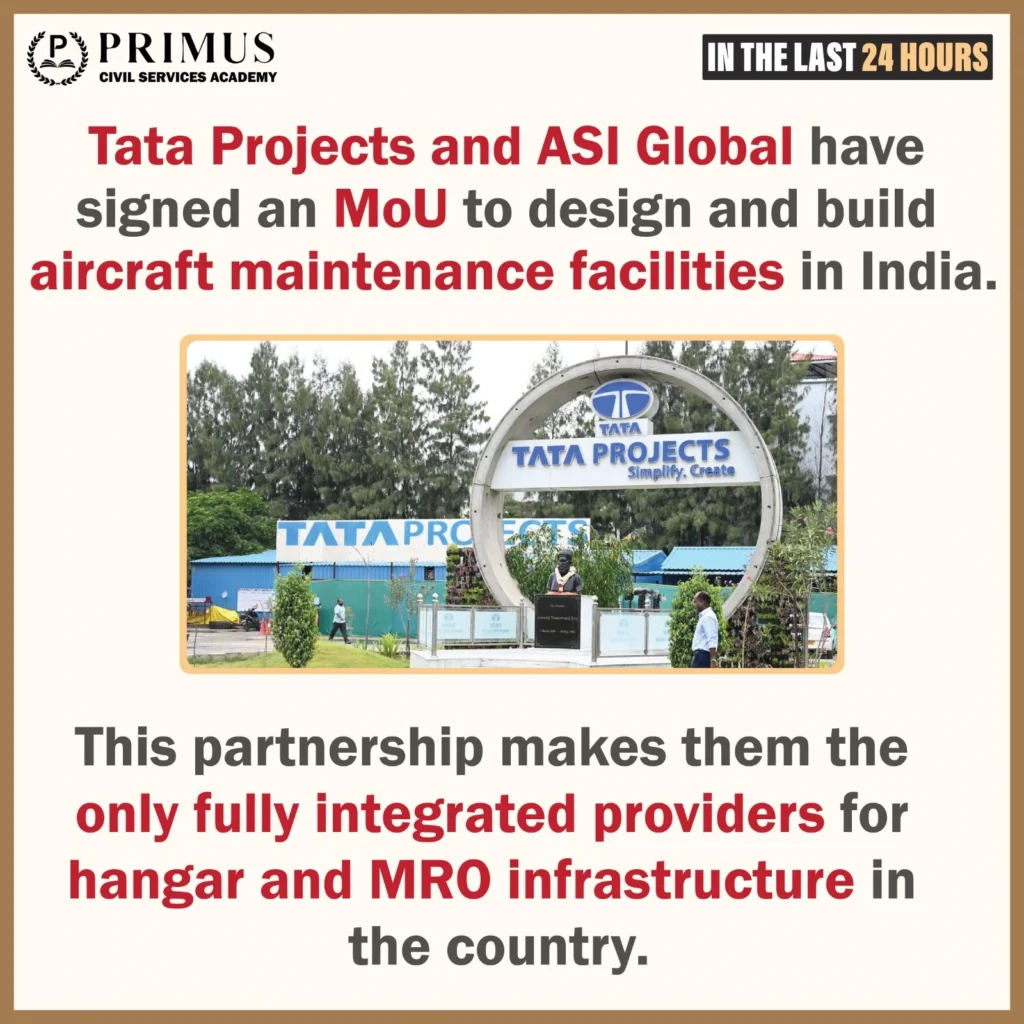
Tata Projects, ASI Global sign MOU to design, construct aircraft maintenance facilities in India
Relevance to UPSC
GS Paper II: Governance
- Reflects public-private partnerships (PPP) in strategic infrastructure.
More about the News
- Tata Projects and ASI Global signed a MoU to build modern MRO (Maintenance, Repair & Overhaul) hangars across India.
- The partnership merges Tata’s EPC (engineering, procurement, construction) strength with ASI’s modular hangar-design expertise.
- Their aim is to deliver world-class, turnkey aircraft maintenance facilities to support India’s rapidly growing aviation sector.
Public Private Partnerships (PPP)
Public-Private Partnerships (PPPs) are collaborative arrangements where governments and private entities share resources, expertise, and risks to deliver efficient, innovative, and cost-effective infrastructure and public services.
Need for PPP
- Bridging Infrastructure Deficits: India faces large gaps in transport, energy (including renewables like solar power), urban services, and logistics. PPPs facilitate resource pooling and coordinated expertise to build essential infrastructure.
- Mobilising Private Capital: With constrained public finances, PPPs attract private investment, reducing fiscal stress and enabling large-scale project execution.
- Harnessing Private Sector Efficiency: The private sector contributes innovation, advanced technology, cost control, and timely execution, improving overall project performance.
- Balanced Risk Sharing: PPPs allow distribution of risks—operational and financial risks to private players, and regulatory/policy risks to the government—ensuring better project sustainability.
- Improving Service Quality: Competitive pressure on private operators enhances service standards and user satisfaction, contributing to economic growth.
Public–Private Partnership Models
- Build-Operate-Transfer (BOT): Private entity designs, finances, constructs, and operates the asset for a concession period, recovers costs via user fees, and transfers ownership back to the government.
- Build-Own-Operate (BOO): Private firm builds, owns, and operates the asset permanently; government may offer incentives or policy support.
- BOT–Annuity Model: Developer constructs the project and receives fixed performance-linked annuity payments from the government, reducing revenue risks.
- Operations & Maintenance (O&M) Contracts: Short-term outsourcing of asset operation or maintenance to private players without private investment in asset creation.
- Engineering, Procurement and Construction (EPC): Government funds the project; private contractor designs and constructs it without long-term operational responsibility.
- Hybrid Annuity Model (HAM): Government provides 40% upfront funding; private developer finances the remaining 60% through equity and debt; government pays annuities, reducing traffic risk.
- Design-Build-Finance-Operate (DBFO): Private partner designs, finances, builds, and operates the facility under long-term contractual terms.
- Lease-Develop-Operate (LDO): Private operator leases an existing asset, upgrades it, and operates it for a specified period.
Public–Private Partnerships in India
- India has executed over 1,800 PPP projects across transport, energy, and urban sectors, with investments exceeding ₹24 lakh crore (as of March 2025).
- The 2025 Union Budget emphasizes PPPs in housing, power, logistics, and urban infrastructure, mandating ministries and states to identify viable PPP projects for the coming three years.
- The National Infrastructure Pipeline (NIP) targets ₹111 lakh crore investment in five years, with PPPs serving as a major financing mechanism.
Government Measures to Promote PPPs
- Viability Gap Funding (VGF): Supports up to 40% of project cost for economically necessary but commercially unviable projects.
- National Monetisation Pipeline (NMP): Aims to mobilize ₹6 lakh crore (FY 2021–25) by leasing core government assets across major sectors.
- India Infrastructure Project Development Fund (IIPDF): Finances project preparation activities like feasibility studies and PPP structuring.
- 100% FDI in SPVs: Automatic route allows full foreign investment in Special Purpose Vehicles to boost PPP participation.
Challenges in Public–Private Partnerships
- Regulatory Delays: Cost overruns (₹5.01 lakh crore across 449 projects as of 2024) due to land acquisition issues and slow environmental approvals.
- Risk Allocation Issues: Poorly defined risk sharing leads to conflicts, inefficiencies, and stalled projects.
- Long-Term Contract Vulnerabilities: Long concession periods may become unfavourable due to economic or policy changes (“obsolescing bargains”).
- Financing Constraints: Limited availability of long-term credit, high debt levels, and weak operational capacity affect private sector participation.
- Weak Dispute Resolution: Inefficient arbitration and judicial delays increase costs and extend project timelines.
Way Forward
- Policy Clarity: Streamlined regulations and standardised procedures to reduce uncertainty and ensure smoother project execution.
- Institutional Capacity Building: Strengthening PPP units to handle project design, negotiation, and contract management.
- Robust Risk Frameworks: Clear, fair, and sector-specific risk allocation templates to enhance investor confidence.
- Stakeholder Participation: Early involvement of local communities and stakeholders for greater transparency and social acceptance.
- Strong Monitoring & Accountability: Transparent performance audits and real-time monitoring systems to ensure timely delivery and reduce cost overruns.
Strengthening PPPs through transparent regulation, fair risk allocation, and technological innovation will drive sustainable infrastructure growth, enhance service quality, and support India’s long-term economic transformation and development aspirations.
Prelims MCQ
Q. Which of the following Committees are related to Public Private Partnership (PPP)?
A. S.S. Tarapore Committee
B. P.J. Nayak Committee
C. Rangarajan Committee
D. Vijay Kelkar Committee
Correct Answer: (d) Vijay Kelkar Committee
Explanation:
• S.S. Tarapore Committee – Related to Capital Account Convertibility.
• P.J. Nayak Committee – Related to governance reforms in Public Sector Banks.
• Rangarajan Committee – Related to Poverty Estimation.
• Vijay Kelkar Committee – Recommended reforms to strengthen Public–Private Partnerships (PPP) in India, especially in infrastructure projects.
Therefore, the correct answer is (d) Vijay Kelkar Committee.
Mains Question
Q. Examine the developments of Airports in India through Joint Ventures under Public-Private Partnership (PPP) model. What are the challenges faced by the authorities in this regard? (PYQ 2017)
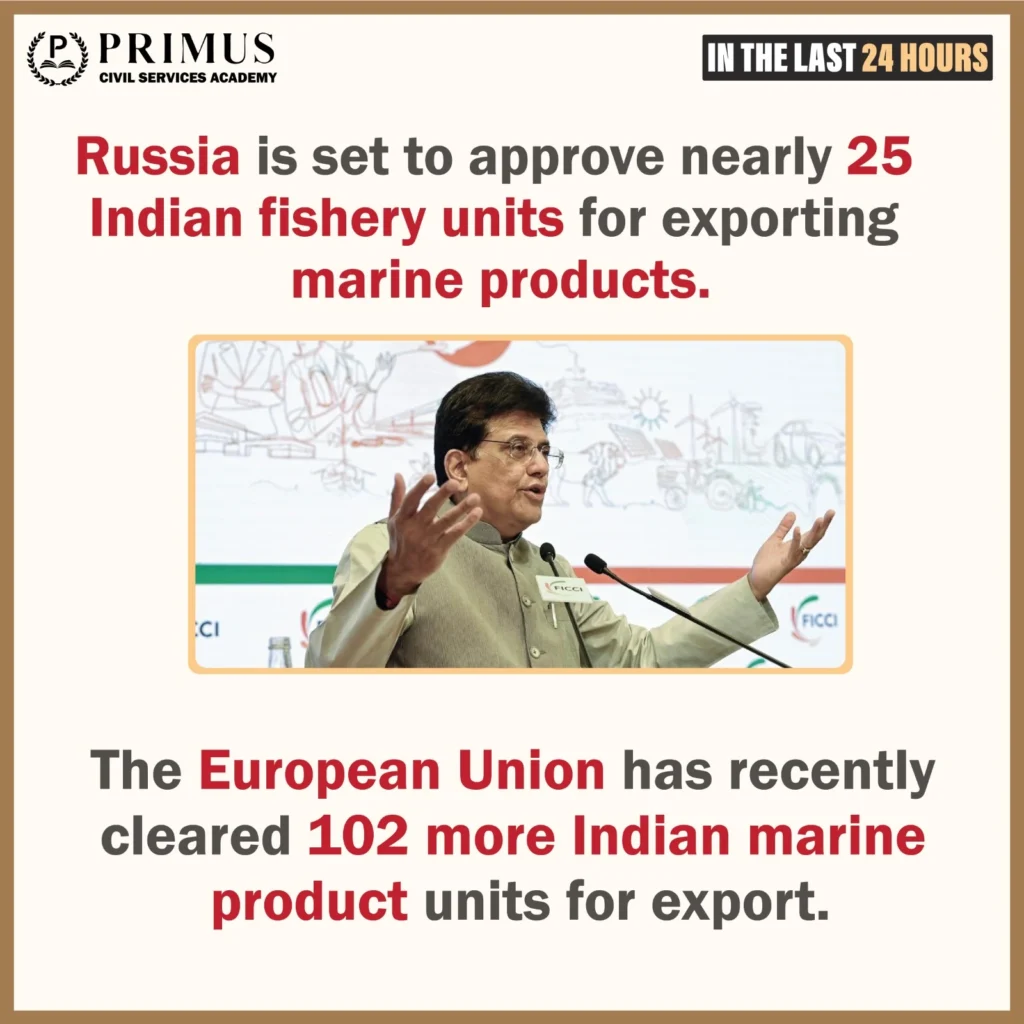
Russia to soon approve nearly 25 Indian fishery units for exports
Relevance to UPSC
GS Paper II: International Relations
- Strengthens bilateral trade ties between India and Russia, signalling closer economic cooperation.
- Reflects how India is diversifying markets for its marine exports.
GS Paper III: Economy & Trade
- Impacts India’s marine export sector, especially shrimp and seafood — a key export industry.
- Helps reduce reliance on limited export destinations, enhancing trade resilience.
- Fisheries growth contributes to the blue economy, sustainable livelihood, and maritime resource utilisation.
More about the News
- Russia is set to approve nearly 25 Indian fishery units, allowing them to export shrimp and other seafood.
- This move is part of India’s strategy to diversify marine export markets, especially amid US tariffs on shrimp.
- India is also negotiating with multiple countries, including UAE and EU, to expand its seafood export footprint.
India-Russia Ties
New Delhi – Moscow relations are a long-standing, pragmatic strategic partnership grounded in Cold War-era ties in defence, nuclear and heavy industry cooperation. Since the 2000 “Strategic Partnership” declaration, ties have broadened into energy, trade, space and people-to-people links even as global geopolitics (Ukraine conflict, US/EU pressure) complicate the relationship. Energy diplomacy (notably growing Russian crude imports) and defence cooperation remain central pillars.
Evolution of the Relations
- 1947–1991 (Soviet era): Close ties—Soviet support for India’s industrialisation, defence supplies and diplomatic backing.
- 1991–2000 (Post-Cold War recalibration): Relations adjusted to new multipolar realities; economic links weakened but strategic ties persisted.
- 2000 (Strategic Partnership) onwards: Declaration (2000) upgraded relationship; regular high-level visits and institutional mechanisms created.
- 2010s: Deepening defence cooperation (major supplier of defence equipment), civil nuclear agreements, and energy ties.
- 2022–2025: Post-Ukraine war dynamics: India’s purchases of discounted Russian crude rise sharply, drawing Western scrutiny and tariff threats; ties acquire greater economic/strategic salience.
Strengths in the relations
- Defence cooperation (reliable supplier): Russia remains India’s principal supplier of major platforms (Su-series aircraft, T-90 tanks, ship systems). Example: Ongoing purchases, licensed production and technology transfers in defence.
- Energy collaboration & security: Russia supplies crude oil and has stakes in energy projects—helping India’s energy diversification. Example: Surge in Russian seaborne oil imports since 2023.
- Historical trust & political convergence: Decades of diplomatic goodwill and regular strategic dialogues. Example: Annual summits, high-level visits and institutionalised mechanisms since 2000.
- Technology & civil-nuclear cooperation: Joint projects in nuclear energy and space cooperation. Example: Long-term civil nuclear cooperation agreements and collaboration in peaceful space activities.
- Multilateral coordination (energy, BRICS): Shared platforms like BRICS and SCO provide political/economic coordination. Example: Joint BRICS engagements and trade/economic initiatives.
Weaknesses in the relations
- Economic asymmetry & limited trade diversification: Trade is concentrated in a few sectors; overall bilateral trade lags potential. Example: Despite strong defence ties, non-energy trade remains modest compared to India’s trade with the US/EU.
- Western pressure & geopolitical cost: India’s close engagement with Russia has attracted Western pushback (tariffs, diplomatic friction). Example: 2025 U.S. tariffs tied to India’s Russian oil purchases.
- Over-dependence on Russian defence supplies: Reliance on ageing platforms can slow modernisation and interoperability with Western systems. Example: Need to diversify suppliers even while upgrading legacy Russian equipment.
- Sanctions-related risks: Transactions with Russia can attract secondary sanctions or commercial risk. Example: Complexities in payments/insurance for Russian oil after Western sanctions/post-2022 measures.
- Diplomatic balancing acts: Managing relations with Russia while deepening ties with the U.S. and EU is delicate. Example: New tensions in India-US trade/strategic dialogues over India’s Russian purchases.
Challenges in the relations
- Geopolitical backlash (trade penalties): Example: U.S. tariffs in 2025 in response to India’s Russian oil purchases.
- Payment & logistics constraints under sanctions regimes: Example: Need for alternative payment mechanisms and shipping arrangements after Western restrictions.
- Modernisation vs interoperability dilemma in defence acquisitions: Example: Upgrading Russia-origin platforms while integrating Western systems in the Indian military.
- Limited trade diversification and low private investment flows: Example: Beyond state-led deals, private sector bilateral investment remains limited.
- Global diplomatic optics & alliance pressures: Example: India’s balancing act at BRICS/Shanghai meetings while facing Western criticism.
How the challenges are being countered
- Diplomatic engagement & messaging: India reiterates sovereign energy choices and explains national interest rationale in bilateral and multilateral fora. Example: FM / EAM public statements defending imports.
- Alternative payment and insurance mechanisms: Use of rupee-rouble/third-country arrangements and state facilitation to keep trade flowing. Example: Special banking/payment channels and state support for logistics.
- Diversification strategy in defence procurement: Gradual diversification to multiple vendors while maintaining key Russian supplies during transition. Example: Parallel deals with Western firms and indigenous procurement drives.
- Economic diplomacy and engagement with partners: Negotiations with the U.S./EU to explain India’s stance and seek mitigation (trade dialogues). Example: Bilateral trade talks and reassurances to key partners.
- Strengthening BRICS / South-South cooperation: Using alternative multilateral platforms to expand trade and finance options. Example: BRICS outreach on energy and development financing.
Initiatives taken together
- Defence R&D and manufacturing cooperation (licence production & joint projects). In
- Energy deals (long-term crude/equity in oil & gas projects)
- BRICS/SCO collaboration on trade, technology and development finance.
- Civil nuclear cooperation and space/technology exchanges.
Way forward
- Strategic diversification: Maintain core defence/energy ties but diversify suppliers and trade baskets.
- Strengthen economic diplomacy: Proactively manage external pressures via dialogue and trade negotiations.
- Institutionalise payment/insurance safeguards: Build resilient alternative trade mechanisms to mitigate sanction risks
- Boost private sector linkages: Encourage Indian and Russian private investment and joint ventures beyond state deals.
- Use multilateral forums pragmatically: Leverage BRICS/SCO for cooperation while keeping Western partnerships active.
New Delhi – Moscow ties will likely remain a stable strategic pillar for New Delhi driven by defence and energy complementarities, but their future utility will depend on India’s ability to manage geopolitical costs, diversify economic engagement, and institutionalise resilient trade mechanisms. Balancing deepened bilateral cooperation with broader global partnerships will define India’s strategic autonomy in the coming decade.
Prelims MCQ
Q. Consider the following statements about India–Russia relations:
1. The “Declaration on the India–Russia Strategic Partnership” was signed in 2000.
2. Russia is India’s largest supplier of crude oil as of 2025.
3. India’s purchases of Russian crude after 2022 have had no impact on its trade relations with Western partners.
Which of the statements given above is/are correct?
A. 1 only
B. 1 and 2 only
C. 2 and 3 only
D. 1, 2 and 3
Correct Answer: (b) 1 and 2 only
Explanation:
• Statement 1 – Correct: The 2000 Declaration formally established the India–Russia Strategic Partnership.
• Statement 2 – Correct: By 2024–25, Russia became India’s largest supplier of seaborne crude oil.
• Statement 3 – Incorrect: India’s post-2022Russian oil imports led to Western scrutiny and trade frictions (e.g., U.S. tariff actions in 2025).
Hence, only Statements 1 and 2 are correct.
Mains Question
Q. Critically examine the contemporary India–Russia strategic partnership in the post-2022 geopolitical environment. Discuss the opportunities and constraints for India — particularly in defence and energy cooperation — and suggest policy measures India should adopt to balance strategic autonomy with broader international partnerships.