

October 28th Current Affairs
Table of Contents
How to make a study plan or timetable for UPSC exam
Stay connected via Google News Follow us for the latest travel updates and guides. Home / What is the right
ಬಾರಿಸು ಕನ್ನಡ ಡಿಂಡಿಮವ
Stay connected via Google News Follow us for the latest travel updates and guides. Home / ‘ಬಾರಿಸು ಕನ್ನಡ ಡಿಂಡಿಮವ’ ದೇಶದ
UPSC CSAT Average PYQ with Solutions
Stay connected via Google News Follow us for the latest travel updates and guides. UPSC CSAT Average PYQ with Solutions
Hypothesis in Sociological Research
Stay connected via Google News Follow us for the latest travel updates and guides. Home / Hypothesis in Sociological Research
Sampling Errors in Sociological Research
Stay connected via Google News Follow us for the latest travel updates and guides. Home / Sampling Errors in Sociological
Sampling in Sociology
Stay connected via Google News Follow us for the latest travel updates and guides. Home / Sampling in Sociology Sampling
Variables in Sociological Research
Stay connected via Google News Follow us for the latest travel updates and guides. Home / Variables in Sociological Research
Nomothetic and Idiographic Methods in Sociology
Stay connected via Google News Follow us for the latest travel updates and guides. Home / Nomothetic and Idiographic Methods
Focus Group Discussion (FGD) in Sociology
Stay connected via Google News Follow us for the latest travel updates and guides. Home / Focus Group Discussion (FGD)
Biographical Studies in Sociology
Stay connected via Google News Follow us for the latest travel updates and guides. Home / Biographical Studies in Sociology
Japan PM Takaichi plans to recommend Trump for Nobel Peace Prize
Relevance to UPSC
GS Paper II: International Relations
- Demonstrates bilateral diplomacy and strategic alignment between major powers (USA & Japan).
- Highlights issues of global value-chains (critical minerals & rare earths), which tie into economic/strategic security.
- Reflects on the role of peace diplomacy and international awards as tools of soft-power and diplomacy.
More About the News
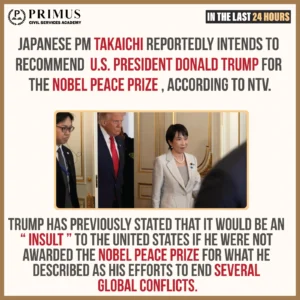
- Sanae Takaichi (Prime Minister of Japan) has announced her intention to nominate Donald Trump (U.S. President) for the Nobel Peace Prize during their bilateral meeting in Tokyo.
- The announcement followed the U.S.–Japan meeting in which the two countries signed agreements on critical minerals and rare earth supply-chains, signalling deeper economic and security collaboration.
- Takaichi praised Trump’s role in recent cease-fire efforts and security diplomacy, stating that “in such a short period of time the world started to enjoy more peace”.
Nobel Prize
The Nobel Prize, established by the will of Alfred Nobel in 1895, is one of the most prestigious global awards recognizing outstanding contributions in science, literature, and peace. It symbolizes the pursuit of knowledge, innovation, and human progress. Over the decades, it has become a benchmark for excellence and a source of inspiration worldwide.
History of the Nobel Prize
- Established in 1895 by Swedish industrialist Alfred Nobel, inventor of dynamite.
- First prize awarded in 1901.
- Created to reward those “who, during the preceding year, have conferred the greatest benefit to humankind.”
Categories of the Nobel Prize
- Physics
- Chemistry
- Physiology or Medicine
- Literature
- Peace
- Economic Sciences (added in 1968 in memory of Alfred Nobel)
How Nobel Laureates Are Chosen
- Nominations are invited from experts, professors, previous laureates, and institutions.
- Committees in respective fields evaluate contributions for originality, impact, and benefit to humanity.
- Decisions finalized by the Swedish Royal Academies (except the Peace Prize by the Norwegian Nobel Committee).
Significance of the Nobel Prize
- Recognizes and honors groundbreaking contributions to humanity.
- Inspires global research, innovation, and peace efforts.
- Enhances international visibility and credibility of laureates and their institutions.
Benefits of Receiving the Award
- Monetary reward and medal/certificate.
- Global recognition and prestige.
- Opportunities for further research, collaboration, and influence.
Prominent Indians Who Have Won the Nobel Prize
- Rabindranath Tagore (1913) – Literature
- C.V. Raman (1930) – Physics
- Mother Teresa (1979) – Peace
- Subrahmanyan Chandrasekhar (1983) – Physics
- Amartya Sen (1998) – Economics
- Kailash Satyarthi (2014) – Peace
The Nobel Prize will continue to motivate innovation, ethical research, and global cooperation. Emerging fields like climate science, AI, and biotechnology are likely to shape future laureates. Strengthening international collaboration will ensure the award remains a catalyst for human progress and societal benefit.
Prelims MCQ
Q. Which of the following statements regarding the Nobel Prize is/are correct?
1. The Nobel Peace Prize is awarded by a committee appointed by the Norwegian Nobel Institute.
2. The Prize in Economic Sciences was part of Alfred Nobel’s original will.
3. Nominees for the Nobel Prize can include previous laureates and recognized professors.
A. 1 and 2 only
B. 1 and 3 only
C. 2 and 3 only
D. 1, 2, and 3
Statement 1 is correct: Peace Prize is awarded by the Norwegian Nobel Committee. Statement 2 is incorrect: The Economics prize was established in 1968, not part of Nobel’s original will. Statement 3 is correct: Previous laureates and professors are eligible to nominate candidates.
Mains Question
Q. Discuss the significance of the Nobel Prize in promoting global scientific, literary, and peace initiatives. Evaluate how recognition through such awards influences research priorities, policy-making, and international cooperation.
Great Nicobar project will boost India’s maritime global trade, says Amit Shah
Relevance to UPSC
GS Paper I: Geography
- Considering the region (Andaman & Nicobar Islands) is ecologically sensitive and geopolitically strategic, the project implicates physical geography, island ecology, coastal health and disaster vulnerability.
GS Paper III: Infrastructure, Environment, Economic Development & Security
- The development of large-scale port infrastructure on Great Nicobar Island impacts maritime logistics, coastal shipping, economic corridor connectivity—key for economic growth.
- Also touches on maritime security, given strategic location near critical sea lanes of communication, and thereby the security dimension of infrastructure.
GS Paper IV: Ethics
- Raises issues of inclusive development, tribal rights, environment vs development, sustainable infrastructure and ethical decision-making in mega-projects.
More About the News
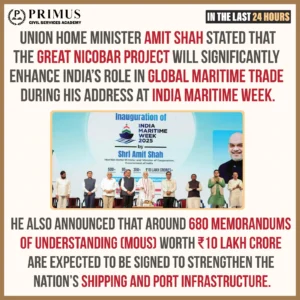
- The Great Nicobar Island mega-project, announced by Amit Shah, is being developed as a port-led hub to boost India’s maritime and global trade reach.
- The site’s strategic location near the Malacca Strait and deep natural draft make it ideal for a trans-shipment port, giving India a regional maritime advantage.
- The project is part of India’s larger “blue economy”, maritime infrastructure push and efforts to enhance coastal connectivity, logistics and trade capacity.
Great Nicobar Project
The Great Nicobar Project, located at the southern tip of the Andaman and Nicobar Islands, is a multi-component infrastructure initiative aimed at transforming the island into a strategic, trade, and logistics hub. It integrates economic growth, national security, and regional connectivity within India’s Indo-Pacific vision and Blue Economy framework.
Objectives of the Great Nicobar Project
- Develop a trans-shipment port at Galathea Bay to reduce dependence on foreign ports.
- Strengthen India’s maritime and trade connectivity along key global shipping routes.
- Promote the blue economy through sustainable use of marine resources.
- Enhance strategic and defence capabilities in the Indo-Pacific region.
- Boost island and regional development by improving infrastructure and livelihoods.
Need for the Project
- Geostrategic Importance: Strengthens India’s presence in the Indo-Pacific and checks Chinese influence through the String of Pearls strategy.
Example: Enhances India’s surveillance near the Strait of Malacca. - Trade and Logistics Competitiveness: India loses shipping revenue as most cargo is trans-shipped via foreign ports.
Example: The project aims to capture India’s own trans-shipment business worth billions annually. - Economic Diversification and Job Creation: Supports coastal and island economy through manufacturing, logistics, and tourism.
Example: Estimated 5 lakh direct and indirect jobs over 30 years. - Reducing Supply Chain Vulnerability: Diversifies port infrastructure to reduce pressure on mainland ports.
Example: Alternative logistics route during mainland port congestion. - Regional Integration with South and Southeast Asia: Improves maritime cooperation with ASEAN nations. Example: Enhances Act East Policy connectivity with Indonesia and Thailand.
Challenges Faced
- Environmental Clearance and Ecological Sensitivity: The island is part of a UNESCO Biosphere Reserve.
Example: MoEFCC faced criticism for fast-tracking clearances. - Tribal Rights and Social Acceptance: Ensuring the Shompen and Nicobarese consent under FRA, 2006.
Example: Limited local consultation reported during early project stages. - Disaster and Climate Vulnerability: The region is prone to cyclones, tsunamis, and earthquakes.
Example: 2004 Tsunami devastated Nicobar; resilience measures essential. - Logistical and Connectivity Constraints: Remote location increases cost and difficulty of materials and manpower transport.
Example: Supplies from mainland take over a week via ship. - Geopolitical Sensitivities: Regional powers may perceive militarization as assertive.
Example: China may respond through influence in nearby Myanmar or Sri Lanka.
Way Forward
- Adopt Sustainable Island Development Model balancing growth and ecology.
- Implement Integrated Coastal Zone Management (ICZM) for environmental protection.
- Enhance Stakeholder Engagement including tribal communities and local governance.
- Use Green Infrastructure such as renewable energy and low-impact construction.
- Institutionalize Environmental Monitoring via independent scientific panels.
- Coordinate Defence–Civil–Economic Agencies to ensure strategic and economic synergy.
The Great Nicobar Project, if pursued sustainably, can transform India into a maritime power balancing strategic security, ecological stewardship, and inclusive island development for a resilient Indo-Pacific future.
Prelims MCQ
Q. Which one of the following pairs of islands is separated from each other by the ‘Ten Degree Channel’? (PYQ 2014)
A. Andaman and Nicobar
B. Nicobar and Sumatra
C. Maldives and Lakshadweep
D. Sumatra and Java
Mains Question
Q. Environmental impact assessment studies are increasingly undertaken before the project is cleared by the government. Discuss the environmental impacts of coal- fired thermal plants located at Pitheads. (PYQ 2023)
Supreme Court prefers ignoring attack against CJI with contempt it deserves; SC Bar Association disagrees

Relevance to UPSC
GS Paper II: Judiciary
- Illustrates the workings of judiciary as an institution and how contempt jurisdiction is exercised and the discretionary role of the presiding judge under the Contempt of Courts Act.
- Raises issues around institutional respect, independence of judiciary, judicial decorum, and checks on lawyer conduct inside court.
GS Paper IV: Ethics & Integrity in Public Life
- The matter brings into focus ethical conduct of advocates, responsibility and professional ethics of the legal community, dignity of constitutional roles and the question of how institutions respond to behaviour undermining their integrity.
More About the News
- The Supreme Court of India (SC) stated it is not inclined to initiate criminal-contempt proceedings under the Contempt of Courts Act, 1971 against advocate Rakesh Kishore who hurled a shoe at the B. R. Gavai (Chief Justice of India) during court proceedings.
- The bench observed that the CJI had already declined to pursue action himself, and hence proceeding further might give the incident undue publicity and prolong its “shelf-life”.
- The Court said it would instead consider framing guidelines for preventing such attacks and glorification of such acts via media/social media, and strengthen courtroom security.
Contempt of Court
Contempt of Court ensures respect for the judiciary and upholds its authority, maintaining the rule of law and public confidence in the justice system essential for a healthy democracy.
What is Contempt of Court
- Contempt of Court refers to any act that disrespects or disobeys the authority of the judiciary.
- Its objective is to protect the dignity, authority, and impartial functioning of the courts.
- Defined under the Contempt of Courts Act, 1971.
Constitutional Provisions
- Article 129: Supreme Court has power to punish for contempt of itself.
- Article 142(2): Empowers Supreme Court to investigate and punish for contempt.
- Article 215: High Courts have power to punish for contempt of themselves.
- Derived from the inherent powers of courts to ensure justice.
Types of Contempt
- Civil Contempt: Wilful disobedience to court judgments, orders, or directions.
- Criminal Contempt: Acts that scandalize or lower the authority of the court, interfere with judicial proceedings, or obstruct the administration of justice.
Important Judgments Related to Contempt
- E.M.S. Namboodiripad v. T.N. Nambiar (1970): Criticism of judges can amount to contempt if it undermines public confidence in the judiciary.
- Arundhati Roy Case (2002): Demonstrated the balance between freedom of speech and contempt powers.
- Prashant Bhushan Case (2020): Reiterated that fair criticism is permissible but malicious attacks on the judiciary are not.
- Mulgaokar Case (1978): Established that contempt powers should be exercised sparingly and with restraint.
Drawbacks
- Vague definition allows for subjective interpretation and misuse.
- Conflict with Article 19(1)(a) – limits freedom of speech.
- Used to suppress legitimate criticism of the judiciary.
- Colonial legacy — inherited from British legal framework.
- Lack of clear guidelines on what constitutes “scandalizing the court.”
Way Forward
- Narrow the scope of criminal contempt through legislative review.
- Establish clear judicial guidelines to differentiate criticism from contempt.
- Promote judicial accountability and transparency to build respect naturally.
- Encourage constructive criticism to strengthen democratic oversight.
Increase public legal literacy on the role and dignity of the judiciary.
While contempt powers are vital to preserve judicial integrity, India’s future lies in balancing judicial authority with freedom of expression, ensuring transparency, accountability, and respect through democratic trust rather than fear.
Prelims MCQ
Q. Which of the following statements regarding the Nobel Prize is/are correct?
1. The Nobel Peace Prize is awarded by a committee appointed by the Norwegian Nobel Institute.
2. The Prize in Economic Sciences was part of Alfred Nobel’s original will.
3. Nominees for the Nobel Prize can include previous laureates and recognized professors.
A. 1 and 2 only
B. 1, 2 and 4
C. 3 and 4 only
D. 3 only
Statement 1 – Correct: The H.N. Sanyal Committee (1961) recommended reforms that led to the Contempt of Courts Act, 1971. Statement 2 – Correct: Articles 129 and 215 empower the Supreme Court and High Courts to punish for contempt of themselves. Statement 3 – Incorrect: The Constitution does not define civil and criminal contempt; these are defined under the Contempt of Courts Act, 1971.
Mains Question
Q. The most significant achievement of modern law in India is the constitutionalization of environmental problems by the Supreme Court.” Discuss this statement with the help of relevant case laws. (PYQ 2022)
Japan sees world's first yen-pegged stablecoin debut
Relevance to UPSC
GS Paper III: Technology & Digital Economy
- Covering the role of blockchain, fintech, payments infrastructure, and digital innovation in the financial sector is a key for Science & Technology, its developments and their applications and effects in everyday life”.
- Raises questions of financial stability, regulatory oversight, monetary policy implications, and systemic risk in digital assets.
- Touches on cybersecurity, data governance and the shift in payments systems—relevant for modern economic security and governance.
More about the News
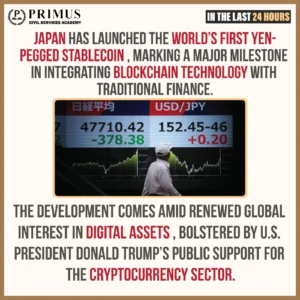
- Japan has launched the world’s first yen-pegged stablecoin, issued by the startup JPYC, which is fully convertible to the yen and backed by Japanese savings and government bonds.
- The issuer aims to mint up to 10 trillion yen (approx US $66 billion) worth over three years, waiving initial transaction fees and planning to earn via interest on government bonds.
- The move signals Japan’s deeper commitment to integrating blockchain-based finance and stablecoin infrastructure, while regulators caution about stablecoins bypassing traditional banking systems.
Central Bank Digital Currency (CBDC)
Central Bank Digital Currency (CBDC) is a digital form of fiat money issued by a nation’s central bank, aiming to modernize the monetary system and promote financial inclusion in a digital economy.
What is CBDC?
- CBDC is a legal tender issued by the Reserve Bank of India (RBI) in electronic form.
- It represents a sovereign currency, equivalent in value to paper money and coins.
- Unlike cryptocurrencies, it is regulated, centralized, and backed by the government.
- Two forms:
- Retail CBDC (e₹-R): For individuals and businesses.
- Wholesale CBDC (e₹-W): For interbank settlements.
Advantages of CBDC
- Reduced Transaction Costs: Eliminates intermediaries, ensuring faster and cheaper payments.
- Financial Inclusion: Enables digital payments even in remote areas via offline modes.
- Transparency and Security: Blockchain or DLT ensures traceability and reduces fraud.
- Efficient Monetary Policy: Enables real-time tracking and better control over money supply.
- Reduced Dependency on Cash: Lowers printing, distribution, and storage costs of physical currency.
Challenges Associated with CBDC
- Cybersecurity Risks: Vulnerable to hacking and data breaches.
- Privacy Concerns: Potential for state surveillance over user transactions.
- Technological Readiness: Requires high digital infrastructure and literacy.
- Financial Disintermediation: Banks may lose deposits if people prefer holding CBDC.
- Limited Public Awareness: Lack of understanding may slow adoption rates.
Way Forward
- Strong Cybersecurity Framework to safeguard digital assets.
- Pilot-based Implementation for gradual adaptation and public trust.
- Legal and Regulatory Clarity for data protection and usage norms.
- Public Awareness Campaigns to promote digital literacy.
- Interoperability with Global Systems to facilitate cross-border transactions.
CBDC represents the future of money—combining innovation with state-backed stability. With robust safeguards and inclusive design, it can transform India’s digital economy and strengthen its financial sovereignty.
Prelims MCQ
Q.
With reference to Central Bank Digital Currencies (CBDCs), consider the following statements: (PYQ 2023)
1. It is possible to make payments in a digital currency without using the US dollar or SWIFT system.
2. A digital currency can be distributed with conditions programmed into it, such as a time-frame for spending it.
Which of the statements given above is/are correct?
A. 1 and 2 only
B. 2 only
C. 2 and 3 only
D. 3 only
Statement 1 – Correct: CBDCs allow direct transactions between central banks or individuals, bypassing intermediary systems like SWIFT or reliance on the US dollar for international payments. Statement 2 – Correct: CBDCs can include programmable features, enabling governments to set conditions such as time limits, sector-specific use, or spending caps for targeted benefits or subsidies.
Mains Question
Q. Pradhan Mantri Jan Dhan Yojana (PMJDY) is necessary for bringing unbanked to the institutional finance fold. Do you agree with this for financial inclusion of the poorer section of the Indian society? Give arguments to justify your opinion. (PYQ 2016)
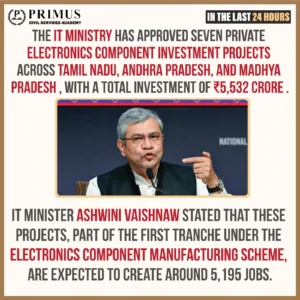
IT Ministry approves 7 private electronics component investments in T.N., A.P., M.P.
Relevance to UPSC
GS Paper III: Manufacturing Sector, Development of Economy and Technology
- The manufacturing of electronics components involves advanced manufacturing, supply-chains, and critical infrastructure — relevant under “Science & Technology” and “Industrial policy”.
- It also has implications for strategic sectors (telecom, defence, electronics) which feed into national security and technology sovereignty.
More about the News
- The Electronics Components Manufacturing Scheme (ECMS) has approved the first seven projects with a cumulative investment of approx ₹5,532 crore under its component manufacturing incentive framework.
- These projects are expected to generate output worth around ₹36,559 crore and create over 5,100 direct jobs, helping reduce dependence on imports of key electronics components such as PCBs, laminates and camera modules.
- A large share of these projects (five out of seven) are set up in Tamil Nadu, with others in Andhra Pradesh and Madhya Pradesh, indicating regional clusters emerging in the electronics ecosystem.
Semiconductor Industry in India
The global semiconductor industry is witnessing exponential growth, and for India Semiconductor Mission to succeed, India must build a strong domestic semiconductor ecosystem to fuel its digital, economic and strategic ambitions.
Global Growth Trends of the Semiconductor Industry
- Global semiconductor sales reached about US $627.6 billion in 2024, up by 19.1 % compared with 2023.
- Global foundry / advanced-chip revenue continues to surge, driven by AI, 5G, data-centres and EV demand.
- Forecasts suggest the semiconductor industry will continue double-digit growth in the near term.
India’s Growth in the Semiconductor Industry
- India’s semiconductor market was about US $38 billion in 2023 and estimated at US $45-50 billion in 2024-25.
- It is projected to reach US $103.5 billion by 2030, at a CAGR of 13.8 %.
- India accounts for only a small share of global wafer fabrication capacity, but has large end-demand growth and design talent.
Need for a Robust Semiconductor Industry in India
- To reduce import-dependency on chips and components essential for electronics, telecom, defence and automotive sectors.
- To leverage booming domestic demand in devices, IoT, EVs, AI and data-centres and convert it into domestic value-addition.
- To strengthen strategic autonomy and security, given semiconductors are critical inputs in defence, space, high-tech and supply-chains.
- To capture value in the global semiconductor value chain, moving beyond design to manufacturing, packaging and testing.
- To generate quality employment and stimulate high-tech industrial ecosystems, including upstream supply-chain, materials, tools, talent and R&D.
Challenges Faced
- High Capital Investment & Gestation period because Fabs cost billions of dollars and India’s ecosystem is still nascent.
- Infrastructure & supply-chain bottlenecks, as it needs uninterrupted power, ultra-pure water, local chemicals and materials are weak.
- Skilled talent shortage, although strong in design, India lacks large numbers of fabrication/testing skilled workforce.
- Technology access & global competition, advanced nodes, proprietary equipment and some export restrictions challenge India’s entry.
- Ecosystem and project implementation delays, many projects under ISM are in planning or early stages.
Government Initiatives Taken
- Launch of India Semiconductor Mission (ISM) to build full value-chain of design, fabrication, packaging and testing.
- Fiscal incentives: e.g., design-linked incentive scheme, subsidies up to 50 % for fabs/ATMP under ISM.
- Approval of multiple semiconductor manufacturing projects, partnership approvals with global firms.
Global Best Practices India Can Learn
- Taiwan/South Korea model of deep integration of design-manufacturing-packaging, strong cluster ecosystems.
- United States’ CHIPS-and-Science Act style large subsidies, R&D investment, and talent ecosystem.
- Singapore’s packaging/testing cluster strategy: back-end of value chain developed in parallel with fab-less front-end.
Way Forward
- Strengthen upstream supply-chain: Local production of wafers, specialty gases/chemicals, tools and equipment.
- Focus on tier-1 and tier-2 nodes: Begin with mature-node fabs (e.g., 28 nm) while ramping towards advanced nodes.
- Expand design ecosystem and IP creation: Increase R&D investment, university-industry collaboration, incubators.
- Ramp up skill development: Intensive programmes for fabrication, packaging, testing, EDA tools with industry participation.
- State-level clustering and dedicated semiconductor parks: Integrate infrastructure, logistics, policy and industry in one place.
If India builds a resilient semiconductor ecosystem combining design, manufacturing and supply-chains, it can emerge as a global hub—powering its future digital economy, defence capacity and technological sovereignty.
Prelims MCQ
Q. Which of the following statements about the World Para Athletics Championships is/are correct?
1. It is conducted biennially under the International Paralympic Committee (IPC).
2. The classification system in para-athletics is based solely on age categories.
3. India participates and selects athletes through the Khelo India Para Games and TOPS.
A. 1 only
B. 2 only
C. Both 1 and 2
D. Neither 1 nor 2
Statement 1 – Incorrect: India is not among the top producers of silicon wafers; most are imported from China, Taiwan, and Malaysia. Statement 2 – Incorrect: Solar power tariffs are determined by competitive bidding conducted by agencies, while the Solar Energy Corporation of India (SECI) only acts as a nodal implementing agency, not a tariff-setting authority.
.Mains Question
Q. Why is nanotechnology one of the key technologies of the 21st century? Describe the salient features of Indian Government’s Mission on Nanoscience and Technology and the scope of its application in the development process of the country. (PYQ 2016)