

November 03rd Current Affairs
Table of Contents
Carbon Border Adjustment Mechanism (CBAM)
Stay connected via Google News Follow us for the latest travel updates and guides. Home / Carbon Border Adujustment Mechanism
ಬಾರಿಸು ಕನ್ನಡ ಡಿಂಡಿಮವ
Stay connected via Google News Follow us for the latest travel updates and guides. Home / ‘ಬಾರಿಸು ಕನ್ನಡ ಡಿಂಡಿಮವ’ ದೇಶದ
UPSC CSAT Average PYQ with Solutions
Stay connected via Google News Follow us for the latest travel updates and guides. UPSC CSAT Average PYQ with Solutions
Hypothesis in Sociological Research
Stay connected via Google News Follow us for the latest travel updates and guides. Home / Hypothesis in Sociological Research
Sampling Errors in Sociological Research
Stay connected via Google News Follow us for the latest travel updates and guides. Home / Sampling Errors in Sociological
Sampling in Sociology
Stay connected via Google News Follow us for the latest travel updates and guides. Home / Sampling in Sociology Sampling
Variables in Sociological Research
Stay connected via Google News Follow us for the latest travel updates and guides. Home / Variables in Sociological Research
Nomothetic and Idiographic Methods in Sociology
Stay connected via Google News Follow us for the latest travel updates and guides. Home / Nomothetic and Idiographic Methods
Focus Group Discussion (FGD) in Sociology
Stay connected via Google News Follow us for the latest travel updates and guides. Home / Focus Group Discussion (FGD)
Biographical Studies in Sociology
Stay connected via Google News Follow us for the latest travel updates and guides. Home / Biographical Studies in Sociology
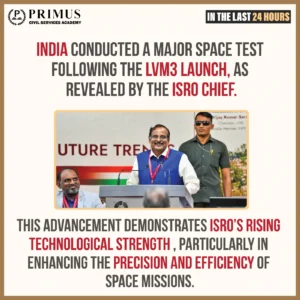
India quietly did a big test in space after LVM3 launch, ISRO chief reveals
Relevance to UPSC
GS Paper III: Science & Technology, Defence & Space
- Relates to advancement in indigenous cryogenic propulsion and cutting-edge aerospace technology demonstrated during the LVM3-M5 mission.
- Enhances India’s strategic launch capabilities, crucial for heavy-lift missions, Gaganyaan, and future space station programmes.
More About the News
- ISRO conducted its first-ever in-orbit test of the C25 cryogenic upper stage during the LVM3-M5 launch carrying the CMS-03 satellite.
- The test ignited the C25 thrust chamber under microgravity, yielding vital data on engine performance, control, and stability in space.
- This breakthrough boosts India’s heavy-lift, multi-satellite, and human spaceflight capabilities, advancing goals like Gaganyaan and a future space station.
LVM3-M5
The LVM3‑M5 heavy-launch rocket marks a pivotal leap for India’s space programme, embodying advanced launch capability, strategic autonomy and enhanced global outreach through space diplomacy.
What is LVM3-M5?
- It is the fifth operational flight of India’s heavy-lift rocket family (LVM3, also known as GSLV-Mk III) developed by Indian Space Research Organisation (ISRO).
- It is capable of placing satellites of about 4,000 kg into Geosynchronous Transfer Orbit (GTO).
- The LVM3-M5 mission carried the satellite CMS‑03 (also known as GSAT-7R) weighing approximately 4,410 kg, India’s heaviest communication satellite launched to GTO from Indian soil.
Significance of LVM3-M5
- Demonstrates India’s self-reliant heavy-launch capability, reducing dependency on foreign launch services.
- Strengthens national communications infrastructure, especially for multi-band, wide-region connectivity (including maritime/ oceanic regions).
- Enhances India’s readiness for future missions: heavier satellites, crewed missions (e.g., human spaceflight) and inter-planetary exploration.
- Boosts strategic/defence capabilities: satellite communications, potential data for military/naval operations, maritime domain awareness.
How this helps India achieve soft-power diplomacy?
- Offers India as a competitive launch destination for international satellites, enabling launch service exports and commercial space collaborations.
- Elevates India’s image as a space-faring nation with cutting-edge capability, which enhances diplomatic ties, technology diplomacy and global prestige.
- Opens doors for space-based partnerships: data sharing, earth-observation services, communication networks with other countries—deepening South-South cooperation.
- Serves as a platform for India to contribute to global challenges (e.g., disaster monitoring, climate data), thus building normative leadership in space sustainability and governance.
Other space organisations which have achieved this landmark
- SpaceX (USA): With the Falcon Heavy and Super Heavy/Starship systems achieving heavy-lift capability.
- Arianespace / European Space Agency: With Ariane 5 and Ariane 6 designed for large payloads to GTO.
- Roscosmos (Russia): With Proton-M, Angara heavy lift vehicles over decades.
- China National Space Administration (CNSA): With Long March heavy-lift rockets (e.g., Long March 5) deploying large communications/earth-observation satellites.
By mastering home-grown heavy-lift launch capability via LVM3-M5, India is not just launching satellites, it’s launching a new era of technological leadership, strategic autonomy and global space diplomacy potential.
Prelims MCQ
Q. With reference to India’s satellite launch vehicles, consider the following statements: (PYQ 2018)
1. PSLVs launch satellites useful for Earth resources monitoring whereas GSLVs are designed mainly to launch communication satellites.
2. Satellites launched by PSLV appear to remain permanently fixed in the same position in the sky, as viewed from a particular location on Earth.
3. GSLV Mk III is a four-stage launch vehicle with the first and third stages using solid rocket motors, and the second and fourth stages using liquid rocket engines.
A. 1 only
B. 2 and 3 only
C. 1 and 3 only
D. 3 only
PSLV places Earth observation satellites in polar sun-synchronous orbits used for resource and remote sensing. GSLV is used for geostationary communication satellites, not PSLV. GSLV Mk III (LVM3) has three stages: two solid boosters, one liquid core, and one cryogenic upper stage, not four.
Mains Question
Q. Critically examine how the success of the LVM3-M5 mission advances India’s strategic and diplomatic objectives in space. Discuss the implications for India’s soft-power, commercial space market, and regional geopolitical influence.
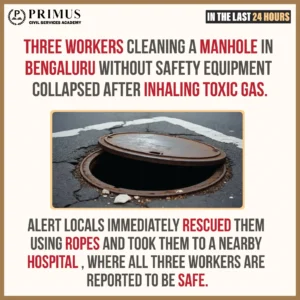
Three workers collapse inside manhole in Neelasandra due to toxic gas, rescued by locals
Relevance to UPSC
GS Paper II: Governance
- Emphasises the role of local governance and municipal authorities in ensuring occupational safety and timely emergency response.
GS Paper III: Environment
- Reflects the environmental and public health hazards posed by toxic gas accumulation in confined spaces such as manholes and sewers.
- Links occupational safety with urban sanitation management, emergency medical response, and environmental risk mitigation.
- Calls for improved safety infrastructure, gas detection systems, and training for municipal workers handling hazardous environments.
GS Paper IV: Ethics in Public Administration
- Raises ethical concerns regarding the duty of care and moral responsibility of employers and contractors toward vulnerable workers.
- Questions the ethical conduct of public officials in enforcing labour and safety regulations meant to protect human life.
- Emphasises the value of compassion, human dignity, and accountability in administrative decision-making related to worker welfare.
More About the News
- Three workers cleaning a blocked man-hole in Neelasandra (Bengaluru) collapsed after inhaling toxic gases, having entered without safety gear.
- Local residents used ropes to pull all three out and rushed them to a nearby hospital; they are now out of danger.
- The contractor reportedly ignored mandatory safety norms and equipment use, prompting police registration of a case for endangering workers’ lives.
Manual Scavenging
Manual scavenging, a caste-linked and hazardous practice involving the manual cleaning of human waste, persists in India despite legal bans, reflecting deep-rooted social inequality, governance lapses, and infrastructural gaps.
What is Manual Scavenging?
- Definition (ILO): Manual scavenging refers to cleaning of human waste from dry latrines, septic tanks, and sewers manually.
- Legal Ban: The Employment of Manual Scavengers and Construction of Dry Latrines (Prohibition) Act, 1993 made the practice and construction of dry toilets punishable.
- Historical Background: The practice dates back to 600 BCE, with references in Naradasamhita listing it as a duty assigned to slaves.
- Social Context: Rooted in caste-based discrimination, the practice primarily affects Dalit communities (97%).
Reasons for Continued Prevalence
- Caste and Social Stigma: Deep-rooted caste hierarchies perpetuate occupational segregation and exclusion.
- Poor Law Enforcement: Weak implementation of prohibition laws allows the practice to continue.
- Contractor Exploitation: Contractors underpay workers despite high service costs (₹20,000–30,000 per tank vs ₹300–500 daily wage).
- Unsanitary Latrines: Persistence of dry and unsafe toilets sustains the demand for manual cleaning.
- Unorganised Labour: Absence of unions limits workers’ bargaining power and representation.
- Poverty & Lack of Alternatives: Inadequate rehabilitation and skill development trap workers in unsafe jobs.
Issues Faced by Sanitation Workers
- Health Hazards: Exposure to toxic gases, pathogens, and sewage leads to chronic respiratory, skin, and infectious diseases.
- Unsafe Conditions: Frequent fatal accidents in manholes and drains (472 deaths between 2016–2020 – Safai Karmachari Andolan).
- Lack of Protective Gear: About 65% of sanitation workers lack safety equipment (NSKFDC Report).
- Low Wages & Exploitation: Extremely poor pay and irregular employment.
- Social Discrimination: Persistent caste bias and denial of dignity.
- Child Labour: Poverty forces children of workers into similar occupations.
Government Measures
Legal Framework:
- Employment of Manual Scavengers and Construction of Dry Latrines Act, 1993: First law prohibiting manual scavenging.
- Prohibition of Employment as Manual Scavengers and their Rehabilitation (PEMSR) Act, 2013: Broadened definition to include septic tanks and railways; focused on rehabilitation.
- SC/ST (Prevention of Atrocities) Act, 1989: Criminalises employing or compelling SC/ST persons into scavenging.
- Protection of Civil Rights Act, 1995: Prohibits enforcing caste-based occupations.
Policies & Schemes:
- NAMASTE Scheme: Mechanisation of sewer and septic tank cleaning; safety and skill training.
- Self-Employment Scheme for Rehabilitation of Manual Scavengers (SRMS): Financial and livelihood support for rehabilitation.
- National Safai Karamchari Finance and Development Corporation (NSKFDC): Provides financial aid and empowerment programs.
- National Urban Sanitation Policy (NUSP): Promotes safe sanitation and elimination of manual scavenging.
- Pradhan Mantri Awas Yojana (PMAY): Includes housing support for sanitation workers.
Way Forward
- Strict Enforcement: Full implementation of PEMSR Act, 2013 with accountability mechanisms.
- Mechanisation: Replace human entry into sewers with machines and robotics.
- Rehabilitation & Livelihoods: Provide vocational training, financial aid, and alternative employment.
- Social Security: Ensure health insurance, pensions, and welfare benefits for workers and families.
- Awareness & Social Reform: Combat caste prejudice, promote dignity of labour, and sensitise communities.
Eliminating manual scavenging requires strict law enforcement, mechanisation, social rehabilitation, and mindset change—ensuring dignity, safety, and alternative livelihoods for sanitation workers in a technologically empowered, inclusive India.
Prelims MCQ
Q. ‘Rashtriya Garima Abhiyaan’ is a national campaign to, (PYQ 2016)
A. rehabilitate the homeless and destitute persons and provide them with suitable sources of livelihood
B. release the sex workers from their practice and provide them with alternative sources of livelihood
C. eradicate the practice of manual scavenging and rehabilitate the manual scavengers
D. release the bonded labourers from their bondage and rehabilitate them
Mains Question
Q. To ensure effective implementation of policies addressing the water, sanitation and hygiene needs the identification of the beneficiary segments is to be synchronized with anticipated outcomes. Examine the statement in the context of the WASH scheme. (PYQ 2017)
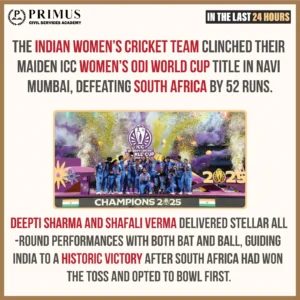
India Win First-Ever ICC Women’s ODI World Cup; President Droupadi Murmu, PM Modi Congratulate Team
Relevance to UPSC
GS Paper II: Governance & Social Justice
The win underscores policy efforts promoting women’s participation in sports, aligning with initiatives like Khelo India, Beti Bachao Beti Padhao, and National Sports Policy.
Highlights the empowerment of women athletes, breaking gender barriers and promoting inclusivity in national development.
Demonstrates how governance reforms and institutional support can translate into equitable opportunities and social transformation.
GS Paper III: Sports Infrastructure
Reflects the outcomes of enhanced sports infrastructure, access to training facilities, and focus on grassroots talent identification.
Showcases sports as a tool for nation-building, human resource development, and international recognition.
Encourages public-private partnerships and increased investment in women’s sports to sustain long-term athletic excellence.
More About the News
- The ICC Women’s ODI World Cup 2025 final saw India women’s cricket team defeat South Africa women’s cricket team by 52 runs, securing their first-ever Women’s ODI World Cup title.
- Key performances included Shafali Verma’s 87 and Deepti Sharma’s all-round display (58 runs + 5-wickets), which powered India to a total of 298/7 and restricted South Africa to 246.
- The victory, achieved at the DY Patil Stadium in Navi Mumbai and witnessed by a packed crowd, is widely hailed as a “1983 moment” for Indian women’s cricket, promising a transformative impact on the sport’s popularity and investment.
Sports Governance in India
Sports governance in India has evolved from being state-driven and elitist to a multi-stakeholder system involving government, federations, and private entities. It reflects the intersection of youth empowerment, diplomacy, health, and economic growth. In the 21st century, sports is not just about medals but also about soft power, inclusivity, and nation-building.
Evolution of Sports Governance in India
- Pre-Independence – Sports were elite-driven (cricket, hockey under colonial clubs).
- Post-Independence (1947–70s) – State-led promotion; creation of National Sports Federations (NSFs), All India Council of Sports.
- 1980s–90s – Rise of Sports Authority of India (SAI), focus on infrastructure, Asian Games 1982 as turning point.
- 2000s onwards – Khelo India, PPP models, IPL/ISL; greater private involvement.
- Current phase – Digitalisation, corporate sponsorship, gender equity, and global competitiveness.
Constitutional & Non-Constitutional Provisions
- Constitutional
- Sports is in the State List (Seventh Schedule, Entry 33).
- Article 21A (Right to Education) indirectly promotes sports through school curriculum.
- Directive Principles: Article 47 (improvement of health, nutrition) links to sports promotion.
- Non-Constitutional
- National Sports Policy (2001, draft 2017).
- Guidelines for recognition of National Sports Federations.
- Judicial interventions (e.g., Lodha Committee on BCCI).
- Constitutional
Major Agencies/Departments Involved
- Ministry of Youth Affairs & Sports (MoYAS).
- Sports Authority of India (SAI).
- National Sports Federations (e.g., BCCI, AIFF, Hockey India).
- Indian Olympic Association (IOA).
- State-level sports councils & academies.
Advantages of Sports Governance
- National Prestige – Success boosts India’s global standing. (e.g., Neeraj Chopra’s Olympic gold)
- Youth Development – Harnessing demographic dividend. (e.g., Khelo India identifies grassroots talent)
- Economic Growth – Job creation, tourism. (e.g., IPL contributes ₹11,500 crore annually to GDP)
- Social Inclusion – Women & differently-abled representation. (e.g., Paralympics medal success)
- Diplomacy & Soft Power – Strengthens India’s image abroad. (e.g., hosting 2010 CWG, 2023 Cricket World Cup)
Impacts of Sports Governance
- Improved Performance – Rise in medal tallies. (e.g., Tokyo Olympics 2020 – India’s best ever)
- Infrastructure Development – World-class stadiums. (e.g., Kalinga Stadium, Odisha for hockey)
- Professionalisation – Emergence of leagues. (e.g., ISL in football, Pro Kabaddi League)
- Cultural Unity – National integration through sports. (e.g., cricket as unifying factor)
- Health Promotion – Encourages fitness. (e.g., Fit India Movement)
Challenges Faced
- Bureaucratic delays – Inefficient clearances. (e.g., controversies in IOA elections)
- Corruption & Mismanagement – Fund misuse. (e.g., CWG 2010 scam)
- Over-politicisation – Politicians dominate federations. (e.g., BCCI governance issues)
- Inadequate Grassroots Support – Limited rural outreach. (e.g., talent loss in tribal regions)
- Gender & Equity gaps – Unequal opportunities, harassment. (e.g., recent Wrestling Federation of India protests)
Government Initiatives
- Khelo India Scheme (2018).
- Target Olympic Podium Scheme (TOPS).
- National Centre of Sports Science and Research (NCSSR).
- Fit India Movement.
- Pension & awards schemes for athletes (Arjuna, Dronacharya, Dhyan Chand awards).
Best Practices
- Global
- Australia’s AIS (Australian Institute of Sport) – integrated coaching, science, nutrition.
- UK’s National Lottery Funding – sustained athlete support led to Olympic success.
- India
- Odisha Model – State as sports sponsor; major investment in hockey.
- Private academies – JSW Sports, Gopichand Badminton Academy nurturing global champions.
- Global
Lodha Committee Report – Key Recommendations
- Age & Tenure Restrictions: Office-bearers must be below 70 years, serve a maximum of 3 terms, and not hold consecutive terms.
- One Person – One Post: No individual can hold multiple posts across BCCI/state cricket associations.
- Cooling-off Period: Mandatory 3-year cooling-off after one term before seeking re-election.
- Player Representation: Inclusion of former players in cricket administration through a Players’ Association.
- Transparency & Accountability: Mandatory auditing of accounts, and CAG nominee on the Apex Council for oversight.
- Conflict of Interest Rules: Strict definitions and prevention of conflict of interest (players, administrators, selectors, commentators).
- Separation of Roles: Clear division between governance (Apex Council) and management (CEO & professional staff).
- Zonal System Abolished: Presidential elections not to be based on zones; equal voting rights for all associations.
- Right to Information (RTI): Suggested bringing BCCI under RTI Act for transparency.
- Regulation of IPL: Independent governing body for IPL to avoid overlap with BCCI administration.
- Age & Tenure Restrictions: Office-bearers must be below 70 years, serve a maximum of 3 terms, and not hold consecutive terms.
Way Forward
- Transparent governance with accountability in federations.
- Sports as a Fundamental Right under Right to Education.
- Public-private partnerships for infrastructure.
- Grassroots expansion beyond metros.
- Gender-sensitive reforms and safe environment for athletes.
Sports governance in India is at a critical inflection point, balancing tradition with modernisation. By fostering transparency, inclusivity, and global best practices, India can transform into a sporting powerhouse. The future lies in aligning sports with youth aspirations, digital platforms, and international competitiveness.
Prelims MCQ
Q. With reference to Sports Governance in India, consider the following statements:
1. Sports is included in the Union List of the Indian Constitution.
2. The Sports Authority of India (SAI) is an autonomous body under the Ministry of Youth Affairs & Sports.
3. The Target Olympic Podium Scheme (TOPS) is aimed at identifying grassroots-level talent in schools.
Which of the above statements is/are correct?
A. 2 only
B. 1 and 3 only
C. 2 and 3 only
D. 1, 2 and 3
Sports is in the State List, not Union List. SAI is an autonomous body under MoYAS. TOPS is for elite athletes’ Olympic preparation, not grassroots identification (that’s Khelo India).
Mains Question
Q. Sports governance in India reflects both its strengths in youth power and weaknesses in institutional design. Examine the evolution of sports governance in India. Highlight the challenges it faces and suggest reforms for building India into a global sporting power.
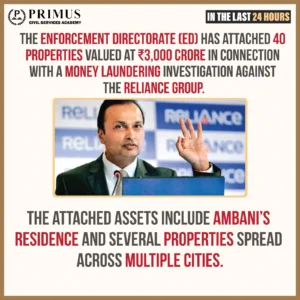
ED attaches 40 assets worth ₹3,000 crore linked to Anil Ambani’s Reliance Group across Delhi, Mumbai, Chennai
Relevance to UPSC
GS Paper II: Governance
- Highlights the role of regulatory agencies like the ED, CBI, and SEBI in ensuring corporate transparency and enforcing financial discipline.
- Emphasises strict implementation of laws such as PMLA, FEMA, and the Banking Regulation Act to curb financial malpractices.
- Reflects on the importance of institutional integrity and governance mechanisms in preventing large-scale corporate frauds.
GS Paper III: Economy & Financial Sector
- Indicates vulnerabilities in India’s financial system due to corporate fund diversion and rising NPAs.
- Underscores the need for strong oversight, better credit evaluation, and transparent financial architecture.
- Stresses the importance of sustainable corporate governance and accountability for maintaining investor confidence and economic stability.
GS Paper IV: Ethics & Integrity in Public Life
- Brings ethical focus on the moral responsibility of corporate leaders and public officials in managing public trust and resources.
- Raises concerns about fiduciary negligence, corruption, and misuse of power in corporate governance.
- Reinforces the need for transparency, accountability, and ethical conduct to strengthen financial integrity in public life.
More about the News
- The Enforcement Directorate (ED) provisionally attached over 40 properties valued at around ₹3,000 crore belonging to the Reliance Anil Ambani Group across Delhi, Mumbai, Chennai and other cities.
- The action was taken under the Prevention of Money Laundering Act (PMLA) in connection with alleged fund-diversion, loan fraud and money-laundering involving group companies and banks between 2017-19.
- Properties seized include the PALI Hill residence of Anil Ambani in Mumbai, land parcels, office-premises and flats in multiple cities; investigations have flagged control failures such as loans processed before sanction and inadequate documentation.
Prevention of Money Laundering Act (PMLA)
The Prevention of Money Laundering Act (PMLA), 2002 was enacted to combat financial crimes by preventing the conversion of illicit funds into legitimate assets, ensuring transparency, and protecting economic integrity.
Overview
- Enacted in 2002 and came into force in 2005.
- Implemented by the Enforcement Directorate (ED) under the Department of Revenue, Ministry of Finance.
- Aims to prevent and control money laundering, and to confiscate property derived from criminal proceeds.
- Aligns with international commitments such as the Financial Action Task Force (FATF) recommendations.
Objectives of PMLA
- Prevent and control money laundering and related financial crimes.
- Confiscate and seize proceeds of crime obtained through illegal means.
- Establish a regulatory framework for financial institutions to report suspicious transactions.
- Strengthen India’s compliance with global anti-money laundering (AML) standards.
- Deter the use of the financial system for terror financing and illicit trade.
Important Provisions
- Section 3: Defines money laundering as any process or activity connected with proceeds of crime.
- Section 4: Prescribes punishment — imprisonment up to 7 years (10 years for NDPS offences) and fines.
- Section 5: Allows provisional attachment of property believed to be proceeds of crime.
- Section 8: Provides for adjudication and confiscation of attached properties.
- Section 12: Mandates banks and financial institutions to maintain records and report transactions.
- Section 24: Presumption of guilt lies with the accused unless proven otherwise.
- Section 50: Empowers ED officers with civil court-like powers to summon and record statements.
Need for Such a Law
- To curb black money generation and circulation.
- To prevent the use of illicit funds for terrorism, drug trafficking, and corruption.
- To align with international obligations under FATF and UN conventions.
- To strengthen financial system credibility and investor confidence.
- To ensure accountability and transparency in high-value financial transactions.
Challenges in Implementation
- Overreach of Enforcement Powers: Allegations of misuse by ED and lack of judicial oversight.
- Ambiguity in “Proceeds of Crime”: Broad definitions lead to interpretational conflicts.
- Burden of Proof Reversal: Accused must prove innocence, raising due process concerns.
- Low Conviction Rate: Despite thousands of cases, conviction remains below 1%.
- Political Misuse Allegations: Perceived targeting of political opponents weakens credibility.
- Coordination Gaps: Poor inter-agency cooperation and delayed trials.
Way Forward
- Ensure judicial oversight over ED’s powers to maintain fairness.
- Narrow and clarify the definition of proceeds of crime.
- Improve capacity building and training for investigating officers.
- Foster international cooperation in tracking cross-border transactions.
- Strengthen institutional independence to prevent political misuse.
- Enhance transparency and accountability in enforcement actions.
To secure India’s financial integrity, the PMLA must balance stringent anti-laundering measures with procedural fairness, institutional transparency, and international cooperation, ensuring an accountable and resilient financial ecosystem.
Prelims MCQ
Q.
With reference to the Prevention of Money Laundering Act (PMLA), 2002, consider the following statements:
1. The Enforcement Directorate (ED) is the primary agency responsible for implementing the Act.
2. The burden of proof under PMLA lies solely on the prosecution.
3. The Act allows for provisional attachment of property suspected to be derived from proceeds of crime.
Which of the statements given above is/are correct?
A. 1 and 3 only
B. 1 only
C. 2 and 3 only
D. 1, 2 and 3
The Enforcement Directorate is the nodal agency enforcing PMLA. The burden of proof under Section 24 lies primarily on the accused, not the prosecution. Section 5 permits provisional attachment of property suspected to be proceeds of crime.
Mains Question
Q. Discuss how emerging technologies and globalisation contribute to money laundering. Elaborate measures to tackle the problem of money laundering both at national and international levels. (PYQ 2021)
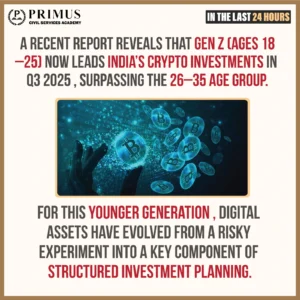
Gen Z leads India's crypto investments in Q3 2025
Relevance to UPSC
GS Paper II: Governance & Regulation)
- Highlights governance challenges in regulating emerging digital assets like cryptocurrencies within India’s financial framework.
- Emphasises the need for a balanced regulatory mechanism ensuring innovation while safeguarding investors.
- Draws attention to issues of consumer protection, transparency, and policy harmonisation with global crypto regulations (e.g., FATF norms, MiCA framework).
GS Paper III: Economy & Capital Market
- Reflects shifting investment behaviour among India’s youth, indicating greater participation in decentralized financial markets.
- Illustrates the evolution of financial innovation through blockchain-based assets and digital finance.
- Highlights risks to financial stability, speculative volatility, and the need for stronger institutional oversight and risk-management frameworks.
More about the News
- According to a Q3 2025 report by CoinSwitch, India’s Gen Z (ages 18–25) now leads the country’s crypto-investor base with 37.6%, overtaking Millennials (26–35) at 37.3%.
- Metro cities like Delhi (19.3%), Bengaluru (8.9%) and Mumbai (7.0%) still dominate crypto activity, though growing participation from Tier-2/3 cities signals deeper adoption.
- The report shows a shift from risky experimentation to more mature investment patterns among young investors, with increased allocation to large-cap cryptos like Bitcoin and Ethereum.
Cryptocurrency
Cryptocurrency refers to a digital or virtual currency that uses cryptography for security and operates on decentralized blockchain technology, enabling peer-to-peer transactions without intermediaries like banks or governments.
Overview of Cryptocurrency
- A form of digital currency designed to work as a medium of exchange through a computer network.
- Unlike traditional currencies, it is not issued or regulated by any central authority.
- Transactions are recorded on a public distributed ledger (blockchain) ensuring transparency and immutability.
How Does It Work?
- Based on blockchain technology, a decentralized database maintained by a network of computers (nodes).
- Each transaction is verified through cryptographic consensus mechanisms like Proof of Work (PoW) or Proof of Stake (PoS).
- Users store cryptocurrencies in digital wallets and transact using private and public keys.
What is Blockchain Technology?
- A distributed ledger system that records transactions across multiple computers securely.
- Each block contains data, a timestamp, and a cryptographic hash linking it to the previous block.
- Provides transparency, immutability, and decentralization, making fraud or tampering extremely difficult.
Popular Cryptocurrencies Globally
- Bitcoin (BTC): First and most popular cryptocurrency, created in 2009 by Satoshi Nakamoto.
- Ethereum (ETH): Supports smart contracts and decentralized applications (DApps).
- Ripple (XRP): Focused on real-time cross-border payment systems.
- Litecoin (LTC): Faster transaction version of Bitcoin.
- Tether (USDT): Stablecoin pegged to the US dollar to minimize volatility.
Pros and Cons of Cryptocurrency
Aspect | Pros | Cons |
Decentralization | Eliminates intermediaries like banks, reduces transaction costs. | Lack of oversight increases risks of misuse. |
Transparency | Blockchain ensures traceability and immutability of records. | Public ledgers may still allow anonymity for illicit transfers. |
Speed & Efficiency | Enables fast global transactions. | Network congestion can slow processing times. |
Financial Inclusion | Provides access to the unbanked population. | Requires internet access and tech literacy. |
Investment Opportunities | Offers high potential returns and diversification. | Extreme volatility can cause huge losses. |
Innovation | Supports emerging technologies like DeFi and NFTs. | Unregulated innovations may lead to scams. |
Challenges in Regulating Cryptocurrency
- Absence of Global Consensus: Different nations have varying regulatory stances.
- Risk of Illicit Use: Potential for money laundering, terror financing, and tax evasion.
- High Volatility: Frequent price fluctuations create investor risk.
- Consumer Protection: Lack of grievance redressal or accountability for fraud.
- Technological Complexity: Difficult for policymakers to keep pace with rapid innovation.
Current Legal Status in India
- Not recognized as legal tender, but holding and trading are not illegal.
- Regulated indirectly under the Prevention of Money Laundering Act (PMLA), 2002 (since March 2023).
- Income Tax Act (2022 amendment): 30% tax on profits from Virtual Digital Assets (VDAs) and 1% TDS on transactions.
- The Reserve Bank of India (RBI) continues to warn against risks while promoting its Central Bank Digital Currency (CBDC).
Way Forward
- Develop a comprehensive regulatory framework balancing innovation and risk.
- Encourage global cooperation through FATF and G20 platforms for uniform crypto norms.
- Promote public awareness and financial literacy to ensure safe digital investments.
- Invest in blockchain R&D for secure and transparent financial systems.
As cryptocurrencies reshape global finance, India must craft balanced, forward-looking regulations that encourage technological innovation, ensure financial stability, and uphold consumer protection, fostering responsible participation in the digital economy.
Prelims MCQ
Q.With reference to “Blockchain Technology”, consider the following statements: (PYQ 2020)
1. It is a public ledger that everyone can inspect, but which no single user controls.
2. The structure and design of blockchain is such that all the data in it are about cryptocurrency only.
3. Applications that depend on basic features of blockchain can be developed without anybody’s permission.
Which of the statements given above is/are correct?
A. 1 only
B. 1 and 2 only
C. 2 only
D. 1 and 3 only
Statement 1 – Correct: Blockchain is a distributed public ledger where data is stored across multiple nodes without centralized control. Statement 2 – Incorrect: Blockchain is not limited to cryptocurrencies; it supports applications like smart contracts, supply chain management, and digital identity verification. Statement 3 – Correct: Blockchain’s open-source and permissionless nature allows developers to build decentralized applications without seeking approval from a central authority.
.Mains Question
Q. What is Cryptocurrency? How does it affect global society? Has it been affecting Indian society also? (PYQ 2019)