

November 04th Current Affairs
Table of Contents
Carbon Border Adjustment Mechanism (CBAM)
Stay connected via Google News Follow us for the latest travel updates and guides. Home / Carbon Border Adujustment Mechanism
ಬಾರಿಸು ಕನ್ನಡ ಡಿಂಡಿಮವ
Stay connected via Google News Follow us for the latest travel updates and guides. Home / ‘ಬಾರಿಸು ಕನ್ನಡ ಡಿಂಡಿಮವ’ ದೇಶದ
UPSC CSAT Average PYQ with Solutions
Stay connected via Google News Follow us for the latest travel updates and guides. UPSC CSAT Average PYQ with Solutions
Hypothesis in Sociological Research
Stay connected via Google News Follow us for the latest travel updates and guides. Home / Hypothesis in Sociological Research
Sampling Errors in Sociological Research
Stay connected via Google News Follow us for the latest travel updates and guides. Home / Sampling Errors in Sociological
Sampling in Sociology
Stay connected via Google News Follow us for the latest travel updates and guides. Home / Sampling in Sociology Sampling
Variables in Sociological Research
Stay connected via Google News Follow us for the latest travel updates and guides. Home / Variables in Sociological Research
Nomothetic and Idiographic Methods in Sociology
Stay connected via Google News Follow us for the latest travel updates and guides. Home / Nomothetic and Idiographic Methods
Focus Group Discussion (FGD) in Sociology
Stay connected via Google News Follow us for the latest travel updates and guides. Home / Focus Group Discussion (FGD)
Biographical Studies in Sociology
Stay connected via Google News Follow us for the latest travel updates and guides. Home / Biographical Studies in Sociology
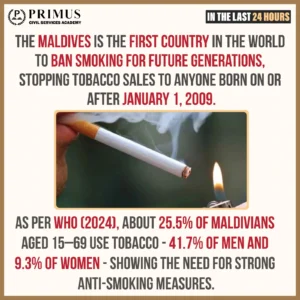
Maldives tobacco ban: Maldives becomes first country to impose generational smoking ban
Relevance to UPSC
GS Paper II: Governance & Social Justice
- Highlights the role of the state in protecting public health through legislation and preventive regulation.
- Demonstrates the government’s proactive policy intervention in reducing health risks among youth through a generational tobacco ban.
- Reflects on the implementation of WHO guidelines and alignment with global health governance frameworks.
- Encourages debate on rights vs. regulation, balancing individual freedom with the state’s duty to safeguard public health.
GS Paper IV: Ethics in Public Administration
- Raises questions about the ethical responsibility of the state to protect citizens’ health and future generations.
- Emphasises the principle of intergenerational equity, ensuring current decisions safeguard the well-being of those yet to be born.
- Highlights the ethical dimension of policymaking in prioritising collective welfare over commercial interests.
- Promotes values of compassion, responsibility, and foresight in public health administration and governance.
More About the News
- The island-nation Maldives has become the first country in the world to introduce a generational ban on tobacco: those born on or after 1 January 2007 are prohibited from buying, using or selling any form of tobacco.
- The law also bans import, sale, distribution, possession and use of e-cigarettes and vaping products for all ages, as part of its wider tobacco control regime.
- According to World Health Organization (WHO) data, about 25.5 % of Maldivian people aged 15-69 were tobacco users in 2024 (41.7 % males, 9.3 % females) — signalling the magnitude of the public-health challenge.
E-Cigarette
E-cigarettes, or electronic nicotine delivery systems, represent a modern health challenge blending technology and addiction and is posing serious risks to youth, respiratory health and public health regulation worldwide.
About E-Cigarettes (Vapes/ENDS)
- E-cigarettes (or vapes) are battery-operated devices that heat an e-liquid (containing nicotine, propylene glycol, glycerin, and flavouring chemicals) to produce an aerosol for inhalation.
- Unlike traditional cigarettes, they do not burn tobacco, but deliver nicotine through vapour, mimicking the act of smoking.
Global Tobacco and Vaping Trends
- Rising Vaping Among Youth: Over 15 million adolescents (13–15 yrs) use e-cigarettes—9 times higher than adults.
- Global Prevalence: More than 100 million people vape globally, including 86 million adults.
- Tobacco Decline: Global tobacco users dropped from 1.38 billion (2000) to 1.2 billion (2024).
- Regional Trends: Southeast Asia saw male tobacco use fall from 70% → 37%, while Europe now records the highest prevalence (24.1%).
Health Risks of E-Cigarettes
- Addictive Nicotine: Impairs adolescent brain development and harms pregnant women and fetuses.
- Toxic Compounds: Emissions contain formaldehyde, acrolein, and other volatile organic compounds that damage lungs and DNA.
- Respiratory Harm: Ultrafine particles penetrate deep into the lungs, worsening asthma and respiratory conditions.
- Flavouring Chemicals: Substances like diacetyl can cause “popcorn lung” (bronchiolitis obliterans) — an irreversible disease.
Ethical Concerns
- Misleading Claims: Marketed as smoking-cessation aids despite limited scientific evidence.
- Youth Addiction: Raises ethical issues by reinforcing nicotine dependence among adolescents.
- Public Health Burden: Shifts addiction and disease risk to vulnerable, low-income groups, worsening health inequities.
Regulation in India
Prohibition of Electronic Cigarettes Act, 2019
- Complete Ban: Outlaws production, manufacture, import, export, transport, sale, storage, and advertisement of e-cigarettes.
- Penalties:
- Manufacture/sale/advertisement → Up to 1 year jail or ₹1 lakh fine (first offence); Up to 3 years or ₹5 lakh fine for repeat offences.
- Storage → Up to 6 months jail or ₹50,000 fine, or both.
- Exemption: Permits e-cigarettes only for approved research/testing purposes.
- Complete Ban: Outlaws production, manufacture, import, export, transport, sale, storage, and advertisement of e-cigarettes.
Supporting Frameworks
- COTPA, 2003: Regulates tobacco through advertising bans, health warnings, and public smoking restrictions.
- National Tobacco Control Programme (NTCP): Focuses on awareness, cessation services, monitoring, and state-level enforcement.
Challenges in Enforcement
- Online Availability: About 60% of vape products remain accessible through e-commerce platforms.
- Youth Marketing: Influencer promotions and flavoured vapes target minors.
- Lack of Quit Support: Only 20% of tobacco users have access to cessation counselling or nicotine replacement therapy (GATS 2022).
- Product Evasion: Constant innovation and rebranding help companies bypass customs and enforcement.
Way Forward
- AI-Based Digital Surveillance: Use AI tools to track online sales and promotions (like the EU’s Track & Trace system).
- Youth Awareness: Integrate anti-vaping modules under NTCP; replicate models like New Zealand’s “Vape-Free Schools.”
- Strengthen Cessation Support: Expand mCessation Programme and helplines to reach rural and youth populations.
- Inter-Agency Task Force: Establish a central enforcement body including MoHFW, IT Ministry, and Customs for coordinated nicotine control.
A future health policy must integrate digital surveillance, behavioural awareness, and preventive education to counter vaping addiction and safeguard India’s demographic dividend from nicotine-induced health disorders.
Prelims MCQ
Q. With reference to E-cigarettes (Electronic Nicotine Delivery Systems – ENDS), consider the following statements:
1. E-cigarettes produce aerosol by heating liquid containing nicotine instead of burning tobacco.
2. The Prohibition of Electronic Cigarettes Act, 2019 allows their sale under licensed outlets for adult smokers.
3. Nicotine exposure through e-cigarettes can affect adolescent brain development.
Which of the statements given above is/are correct?
A. 1 only
B. 2 and 3 only
C. 1 and 3 only
D. 3 only
E-cigarettes heat nicotine liquids to create vapour, not smoke. The 2019 Act completely bans their production, sale, and advertisement. Nicotine harms adolescent brain development, causing long-term addiction and cognitive issues.
Mains Question
Q. Despite the 2019 ban, the growing use of e-cigarettes among Indian youth highlights the gaps in digital regulation and health education. Discuss policy measures needed to address this emerging public health challenge.
MICA launches Social Media Influencer programme for digital creators

Relevance to UPSC
GS Paper II – Governance, Social Justice, and Education
- Demonstrates government or institutional responses in the educational/training sector — highlighting upskilling and capacity-building in the digital economy.
- Reflects on the role of public/private institutions in shaping new career pathways and governance of emerging sectors (creator economy) through structured programmes.
- Raises issues of equitable access, digital literacy, and inclusion in education/training which are core to social justice and governance.
GS Paper III – Economy, Technology & Development
- Links to the structural transformation of the economy via digital platforms and the creator ecosystem, relevant for the new economic order in India.
- Involves emerging technologies (generative AI, digital content creation) — showing how technology intersects with skills, employment, and economic development.
- Provides a case for policy discussion on how to regulate, support and integrate new forms of employment (digital creators) into formal frameworks.
More About the News
- MICA, Ahmedabad has introduced a 25-week online Social Media Influencer Programme for aspiring and active content creators, focusing on personal branding, content strategy, and generative AI.
- The initiative aims to strengthen India’s fast-growing $250 billion creator economy by blending academic learning with industry-based internships.
- The course covers platform algorithms, monetisation, and audience growth, taught collaboratively by MICA faculty and industry experts.
Social Media and Content Creators
Social media content creation has evolved into a global digital economy—reshaping communication, employment, and governance—where individuals influence opinions, markets, and culture through creativity, technology, and audience engagement.
Overview
- Social media platforms (YouTube, Instagram, X, etc.) have created a “creator economy” where individuals monetise content via ads, sponsorships, and digital products.
- India has over 100 million digital creators, contributing significantly to digital marketing and youth entrepreneurship.
- Institutes like MICA and government programmes promote structured training and ethical digital engagement.
Impact on Society
- Democratisation of media: Enables ordinary citizens to express, educate, and influence public discourse.
- Economic empowerment: Generates income and jobs for youth, women, and rural entrepreneurs.
- Cultural influence: Promotes diversity, local languages, and soft power diplomacy.
- Governance linkage: Facilitates citizen-government interaction and awareness of social issues.
Challenges Faced
- Misinformation and hate speech: Unverified or polarising content affects public order.
- Mental health concerns: Pressure for validation and exposure to online toxicity.
- Monetisation inequalities: Platform algorithms favour larger creators, limiting smaller voices.
- Privacy and copyright issues: Data misuse and plagiarism remain under-regulated.
Supreme Court Rulings / Judicial Views
- Shreya Singhal v. Union of India (2015): Upheld freedom of speech online, striking down Section 66A of IT Act for being vague and suppressive.
- Faheema Shirin v. State of Kerala (2019): Recognised internet access as part of Right to Education and Right to Privacy under Article 21.
- Ajit Mohan v. Delhi Legislative Assembly (2021): Emphasised accountability of social media platforms in preventing misuse.
Government Encouragement for Content Creators
- National Creators Award (2024): Recognises excellence in digital innovation, storytelling, and nation-building.
- Digital India and MyGov initiatives: Engage creators for public awareness campaigns.
- Startup India & Skill India: Encourage youth-led innovation and digital entrepreneurship.
- MICA’s Social Media Influencer Programme: Academic push to professionalise digital creators.
Way Forward
- Digital literacy and ethical training for creators.
- Transparent platform regulation ensuring algorithmic fairness.
- Stronger data protection laws and accountability frameworks.
- Public-private partnerships to integrate creators into national development messaging.
India’s future digital ecosystem must nurture responsible creators—balancing freedom with accountability so that social media becomes a tool for informed citizenship, cultural expression, and inclusive national development.
Prelims MCQ
Q. With reference to India’s digital creator ecosystem, consider the following statements: 1. The National Creators Award is organised by the Ministry of Electronics and Information Technology. 2. The Shreya Singhal judgment of 2015 strengthened online freedom of expression by striking down Section 66A of the IT Act. 3. MICA has launched India’s first structured academic programme for social media influencers. Which of the statements given above is/are correct?
A. 1 and 2 only
B. 2 and 3 only
C. 1 and 3 only
D. 1, 2 and 3
Mains Question
Q. Child cuddling is now being replaced by mobile phones. Discuss its impact on the socialization of children. (PYQ 2023)
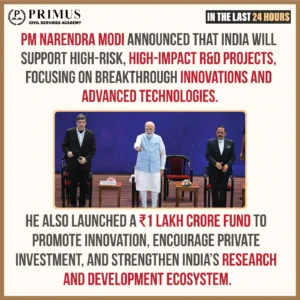
India backing high risk, high impact R&D projects: PM Modi
Relevance to UPSC
GS Paper II – Governance & Science & Innovation Policy
- Illustrates the role of the government in formulating high-level policy to promote R&D and private sector participation.
- Reflects aspects of institutional reforms, regulation (procurement, incentives) and governance of science and technology.
- Helps answer questions on innovation policy, public–private partnerships, and how governance can drive tech-led development.
GS Paper III – Economy, Technology & Development
- Ties into the theme of technology-driven growth and the transition from a knowledge-economy to innovation-economy.
- Highlights R&D investment, innovation ecosystem, startups, patents — all relevant for economic development and competitiveness.
- Offers a case for discussing India’s ambition to become a global science & technology powerhouse, and the structural shifts required.
More About the News
- The Narendra Modi-led government launched a ₹1 lakh crore “Research, Development & Innovation” fund to back “high-risk, high-impact” R&D projects in India.
- For the first time, capital is being earmarked explicitly for high-risk, high-impact projects, and reforms are being introduced to promote an ecosystem of “Ease of Doing Research” — from procurement to market transition.
- The move comes as India’s R&D expenditure has doubled over the past decade, patents have increased 17-fold, and the country is positioning itself as a global innovation hub.
Research & Development Ecosystem in India
India’s R&D ecosystem forms the backbone of its innovation-driven growth, encompassing government labs, academia, and private industry—yet it struggles with underfunding, weak linkages, and limited global competitiveness.
Key Statistics
- GERD (Gross Expenditure on R&D): India spends just 0.64% of GDP on R&D, far below the global average of 1.79%.
- Private Sector Contribution: Private firms account for only 37% of India’s R&D spending, compared to 68% in the US and 75% in China.
- Applied Research Share: Only 13% of R&D funding is directed toward applied research, limiting innovation and commercialisation.
- Global Innovation Index 2024: India ranks 39th globally, reflecting moderate progress.
- Women in R&D: Women form 14% of India’s R&D workforce, below the global average of 30%.
Reasons for Low R&D Performance
- Inadequate Funding: R&D investment remains stagnant at 0.64% of GDP, compared to 2.8% (US) and 4.2% (South Korea).
- Weak Private Sector Role: Only 36.4% of India’s R&D is driven by private firms, unlike developed nations where it exceeds 50%.
- Regulatory Bottlenecks: Lengthy approvals and limited fiscal incentives discourage private R&D initiatives.
- Brain Drain: Over 3 million Indian-origin scientists work abroad, reducing domestic research talent.
- Weak Industry-Academia Linkages: Less than 10% of R&D institutions collaborate effectively with industries.
Challenges Hindering R&D
- Low Private Sector Participation: Private contribution remains at 36.4%, well below the global benchmark.
- Talent Drain: About 85,000 Indian researchers work overseas due to better facilities and pay.
- Fragmented Ecosystem: Poor coordination among public labs, universities, and startups stifles innovation.
- Infrastructural Deficiencies: Outdated labs and limited high-performance computing restrict progress.
- Unbalanced Research Focus: Only 13% of funding supports applied research, impeding commercial outcomes.
Government Initiatives to Strengthen R&D
- Anusandhan National Research Foundation (ANRF): Promotes collaboration among academia, industry, and government; provides sustained funding support.
- National AI Mission: Accelerates AI research and deployment in key sectors like health, agriculture, and education.
- Science and Engineering Research Board (SERB): Supports basic and applied scientific projects through grants and fellowships.
- Atal Innovation Mission (AIM): Encourages youth innovation via Atal Tinkering Labs and Atal Incubation Centers.
- Biotechnology Industry Research Assistance Council (BIRAC): Fosters biotech innovation through industry-academia partnerships.
- Ucchatar Avishkar Yojana (UAY): Promotes advanced, industry-oriented research solving national challenges.
- National Mission on Quantum Technologies & Applications (NMQTA): Aims to make India a global hub for quantum computing and cryptography.
Way Forward
- Increase R&D Spending: Target 1% of GDP by 2030 through joint government–industry initiatives.
- Develop Innovation Corridors: Create research clusters linking universities, startups, and public labs.
- Encourage Investigator-Led Research: Expand funding autonomy via SERB-like models for high-impact studies.
- Adopt Mission-Oriented Focus: Launch dedicated missions in genomics, renewable energy, and advanced materials.
- Leverage CSR and FDI: Expand CSR scope for R&D and attract foreign research investment.
- Enhance Diversity: Promote women, rural innovators, and underrepresented communities in scientific fields.
By enhancing funding, fostering industry-academia collaboration, and promoting inclusive innovation, India can transform its R&D ecosystem into a global hub of scientific excellence and sustainable technological leadership.
Prelims MCQ
Q. Which of the following statements is/are correct regarding National Innovation Foundation-India (NIF)? (PYQ 2015)
1. NIF is an autonomous body of the Department of Science and Technology under the Central Government.
2. NIF is an initiative to strengthen the highly advanced scientific research in India’s premier scientific institutions in collaboration with highly advanced foreign scientific institutions.
Select the correct answer using the code given below:
A. 1 only
B. 2 only
C. Both 1 and 2
D. Neither 1 nor 2
NIF is an autonomous body under the Department of Science and Technology (DST) established in 2000. It focuses on grassroots innovations and traditional knowledge from informal sectors, not high-end research collaboration. Hence, Statement 1 is correct, while Statement 2 is incorrect.
Mains Question
Q. Scientific research in Indian universities is declining, because a career in science is not as attractive as are business professions, engineering or administration, and the universities are becoming consumer-oriented. Critically comment. (PYQ 2014)
Domestic help alleges custodial assault by Bengaluru police after techie couple complain that diamond ring is missing

Relevance to UPSC
GS Paper II – Governance, Constitution & Administration
- Highlights issues in law enforcement and police governance, including custodial accountability and police-station practices.
- Raises questions about rights of arrested/detained persons, the role of the police in upholding constitutional safeguards such as Article 21 (Right to life and personal liberty).
- Pertains to public administration and administrative justice, focusing on how institutions respond to allegations of misconduct.
GS Paper IV – Ethics in Public Administration
- Poses ethical concerns regarding the duty of care, human dignity and fair treatment by public servants (police) towards all citizens, especially vulnerable workers.
- Brings in themes of accountability, transparency, integrity in administrative and policing practices.
- Encourages discussion on ethical oversight and protection of rights within the criminal justice system.
More about the News
- A domestic worker and her husband allege that personnel of the Varthur Police Station in Bengaluru physically assaulted them after accusing the worker of stealing a diamond ring.
- The woman claims she had picked up a ₹100 note dropped by her employer with intent to return it, but the situation escalated into detention and violence at the police station.
- The case has prompted calls for an internal inquiry into police conduct and brought into focus the issue of custodial violence against vulnerable migrant workers.
Custodial Death
Custodial death occurs when an individual dies while under police or judicial custody, reflecting systemic issues of torture, abuse of power, and failure to uphold constitutional and human rights protections.
Overview
- Custodial torture refers to physical or mental abuse inflicted by law enforcement or other authorities on individuals in their custody.
- It represents a grave violation of human rights and dignity, often resulting in custodial deaths during detention or interrogation.
Types of Custodial Torture
- Physical Torture: Beatings, electric shocks, suffocation, sexual assault, forced stress positions, and denial of medical treatment.
- Psychological Torture: Threats, humiliation, solitary confinement, sleep deprivation, and mock executions.
- Coercive Confessions: Extracting confessions or information through duress or inhuman treatment.
Custodial Torture in India – Data and Trends
- Custodial Deaths (2016–2022): Around 11,656 deaths nationwide; Uttar Pradesh (2,630) highest, followed by Tamil Nadu (490).
- Preventive Detention Abuse: Tamil Nadu detained 2,129 people in 2022, nearly half of India’s total under preventive laws.
- Marginalised Communities: SCs form 38.5% of detainees in Tamil Nadu, showing disproportionate targeting.
Constitutional and Legal Safeguards
Constitutional Provisions:
- Article 14: Ensures equality before the law; no official is above it.
- Article 21: Protects right to life and personal liberty, including freedom from torture or cruel treatment.
- Article 20(1): Prohibits retrospective or excessive punishment.
- Article 20(3): Guards against self-incrimination, preventing forced confessions.
Legal Provisions (Post-2023 Criminal Law Reforms):
- Section 120, Bharatiya Nyaya Sanhita (BNS), 2023: Punishes any public servant who causes hurt or grievous hurt to extract confession or information.
- Section 35, Bharatiya Nagarik Suraksha Sanhita (BNSS), 2023: Mandates documented and justified arrests.
- Section 22, Bharatiya Sakshya Adhiniyam (BSA), 2023: Invalidates confessions obtained through coercion, inducement, or threat.
International Provisions
- UN Charter (1945): Affirms dignity and humane treatment of all prisoners.
- Universal Declaration of Human Rights (1948): Prohibits torture and ensures personal security.
- UN Convention Against Torture (UNCAT, 1984): India signed but has not ratified it, despite global commitment to end torture.
Challenges in Preventing Custodial Torture
- No Specific Anti-Torture Law: India lacks a dedicated legislation criminalising torture; provisions are fragmented across laws.
- Weak Enforcement & Impunity: Between 2017–2022, zero convictions recorded out of 345 inquiries into custodial deaths.
- Underpowered Institutions: NHRC and SHRCs lack enforcement authority and financial independence.
- Overcrowded Prisons: Operating at 130% capacity, creating inhumane conditions.
- Fear Among Victims: Retaliation threats and lack of legal aid discourage reporting.
- Judicial Delays: Prolonged trials, poor witness protection, and limited fast-track courts.
- Non-Compliance: D.K. Basu Guidelines (1996) often ignored—missing arrest memos, lack of medical exams, and delayed legal access.
Key Recommendations and Judicial Interventions
Law Commission of India (273rd Report, 2017):
- Recommended ratifying UNCAT (1984).
- Proposed a draft Prevention of Torture Bill, 2017, to criminalise torture and ensure victim compensation.
Major Judicial Rulings:
- D.K. Basu v. State of West Bengal (1997):
- Laid down arrest and detention guidelines; emphasised State liability in custodial violence cases.
- Laid down arrest and detention guidelines; emphasised State liability in custodial violence cases.
- State of UP v. Ram Sagar Yadav (1985):
- Placed burden of proof on the police officer in custodial torture cases.
- Placed burden of proof on the police officer in custodial torture cases.
- Nambi Narayanan v. State of Kerala (2018):
- Highlighted psychological trauma from wrongful prosecution and unlawful detention.
- D.K. Basu v. State of West Bengal (1997):
NHRC Recommendations:
- Mandated that District Magistrates and SPs must report any custodial torture or death to the NHRC Secretary General within 24 hours.
- Non-compliance may be treated as suppression of evidence.
Measures to Address Custodial Torture:
- Strengthen Legal Framework: Enact a comprehensive anti-torture law aligned with UNCAT; ensure strict penalties and victim compensation.
- Institutional Accountability: Establish district-level custodial review units for independent investigation.
- Police Reforms:
- Separate law enforcement and investigation wings.
- Introduce human rights and ethical training for police and magistrates.
- Independent Oversight:
- Mandate judicial supervision of custodial procedures.
- Create independent investigative bodies for custodial deaths and torture cases.
- Victim Protection: Provide legal aid, anonymity, and psychological support to survivors.
Custodial torture undermines India’s constitutional promise of dignity and justice. Ensuring accountability through legislative reform, institutional independence, and human rights–oriented policing is vital for restoring public faith in rule of law.
Prelims MCQ
Q. Right to Privacy is protected as an intrinsic part of Right to Life and Personal Liberty. Which of the following in the Constitution of India correctly and appropriately imply the above statement? (PYQ 2018)
A. Article 14 and the provisions under the 42nd Amendment to the Constitution.
B. Article 17 and the Directive Principles of State Policy in Part IV.
C. Article 21 and the freedoms guaranteed in Part III.
D. Article 24 and the provisions under the 44th Amendment to the Constitution.
The Supreme Court in Justice K.S. Puttaswamy (2017) case held that the Right to Privacy is implicit in Article 21 (Right to Life and Personal Liberty). It is also protected by the broader framework of Part III fundamental rights. Privacy thus forms an essential aspect of personal dignity, autonomy, and liberty under the Constitution.
Mains Question
Q. Though the Human Rights Commissions have contributed immensely to the protection of human rights in India, yet they have failed to assert themselves against the mighty and powerful. Analysing their structural and practical limitations, suggest remedial measures. (PYQ 2021)
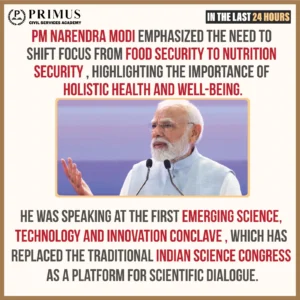
Need for shift in focus from food security to nutrition security: PM
Relevance to UPSC
GS Paper III: Science & Technology, Environment and Climate Change
- Connects to agricultural development, technological adoption in farming, boosting productivity, rural growth and agri-innovation ecosystems.
- Emphasising soil health, bio-fertilisers, sustainable agriculture links to environmental sustainability and climate-smart farming.
More about the News
- At ESTIC 2025, PM Modi called for harnessing science and technology to enhance agriculture through innovations in soil health, bio-fertilisers, and agri-tech.
- He urged a shift from food security to nutrition security, using emerging technologies to modernise farming and allied sectors.
- The Prime Minister highlighted building a strong innovation ecosystem driven by digital infrastructure, research reforms, and private-sector participation to empower rural communities.
Food Security in India
Food security ensures that every individual has access to sufficient, safe, and nutritious food for an active and healthy life, forming the foundation of national stability, economic growth, and human dignity.
What is Food Security?
- Meaning: Food security goes beyond mere access to meals; it ensures that all individuals have physical, social, and economic access to sufficient, safe, and nutritious food at all times.
- Dimensions of Food Security:
- Availability: Domestic production, food imports, and buffer stock in government granaries.
- Accessibility: Food must be physically and socially within reach of everyone.
- Affordability: Individuals should have the financial means to buy adequate and nutritious food.
- Essence: True food security exists when food is available, accessible, and affordable to all without discrimination.
- Meaning: Food security goes beyond mere access to meals; it ensures that all individuals have physical, social, and economic access to sufficient, safe, and nutritious food at all times.
Current Framework for Food Security in India
- Constitutional Backing:
- No explicit “right to food,” but Article 21 (Right to Life) implies the right to live with dignity, which includes access to food and basic needs.
- No explicit “right to food,” but Article 21 (Right to Life) implies the right to live with dignity, which includes access to food and basic needs.
- Buffer Stock Mechanism:
- The Food Corporation of India (FCI) procures grains at Minimum Support Prices (MSP) and maintains buffer stocks for distribution.
- The Food Corporation of India (FCI) procures grains at Minimum Support Prices (MSP) and maintains buffer stocks for distribution.
- Public Distribution System (PDS):
- A key instrument in ensuring access to essential commodities like rice, wheat, sugar, and kerosene at subsidized prices.
- Some States distribute additional commodities (pulses, oils, spices) through PDS outlets.
- National Food Security Act (NFSA), 2013:
- Transformed food distribution from a welfare approach to a rights-based framework.
- Covers 75% of rural and 50% of urban population.
- Entitlements:
- Antyodaya Anna Yojana (AAY): Poorest households get 35 kg foodgrains/month.
- Priority Households (PHH): 5 kg per person/month.
- Mandates eldest woman (18+) as head of household on ration cards.
- Child Nutrition: Free nutritious meals under ICDS/Anganwadi and Mid-Day Meal schemes for children aged 6 months–14 years.
Challenges to Food Security in India
- Soil Degradation: Overuse of chemicals and deforestation degrade soil; nearly one-third of global soil already affected, threatening crop yields.
- Invasive Pests and Weeds:
Examples: Fall Armyworm (2018) devastated maize crops; locust attacks (2020) hit Rajasthan and Gujarat. - Weak Management Systems: PDS inefficiencies—leakages, fake ration cards, poor grievance redressal, and social audit failures.
- Procurement Imbalances: Overemphasis on rice and wheat due to MSP policy leads to crop diversification issues and grain wastage (~₹50,000 crore annually).
- Climate Change: Erratic monsoons, floods, and heatwaves affect 60% rainfed farmland, threatening food output.
Led to export bans (e.g., broken rice in 2022) to control domestic supply. - Global Supply Chain Disruptions: COVID-19 and Russia–Ukraine war (2022) worsened global food inflation; both countries supply 27% of global wheat trade, affecting dependent regions in Africa and Asia.
- Soil Degradation: Overuse of chemicals and deforestation degrade soil; nearly one-third of global soil already affected, threatening crop yields.
Government Measures to Ensure Food Security in India
- National Food Security Act (NFSA), 2013: Provides subsidised foodgrains to about two-thirds of India’s population, shifting from a welfare to a rights-based approach.
- Public Distribution System (PDS): Distributes essential commodities like rice, wheat, sugar, and kerosene at subsidised rates through fair price shops.
- Pradhan Mantri Garib Kalyan Anna Yojana (PMGKAY): Provides additional free foodgrains to NFSA beneficiaries during crises like COVID-19.
- Integrated Child Development Services (ICDS): Offers nutritious meals, health check-ups, and education to children under six years and pregnant/lactating women.
- Mid-Day Meal Scheme (PM POSHAN): Provides free cooked meals to school children, improving nutrition and school attendance.
Way Forward
- Promote Sustainable Agriculture: Enhance productivity through biotechnology, nano-urea, micro-irrigation, and watershed management. Establish Special Agricultural Zones for ICT-based crop monitoring.
- Adopt Precision Agriculture: Leverage information technology, AI, and data analytics to optimize input use, reduce costs, and increase yields.
- Strengthen Aadhaar-Linked Ration Cards: Ensure Aadhaar seeding to minimize exclusion errors and improve targeted delivery under NFSA.
- Improve Transparency and Storage: Deploy IT-based tracking, enhance storage infrastructure, and create village-level foodgrain banks with food coupons linked to Aadhaar.
- Adopt an Integrated Approach: Address food security through interlinked policies on inequality, environmental sustainability, and indigenous food systems to build a resilient green economy.
Prelims MCQ
Q.In the context of India’s preparation for Climate-Smart Agriculture, consider the following statements: (PYQ 2021)
1. The ‘Climate-Smart Village’ approach in India is a part of a project led by the Climate Change, Agriculture and Food Security (CCAFS), an international research programme.
2. The project of CCAFS is carried out under Consultative Group on International Agricultural Research (CGIAR) headquartered in France.
3. The International Crops Research Institute for the Semi-Arid Tropics (ICRISAT) in India is one of the CGIAR’s research centres.
Which of the statements given above are correct?
A. 1 and 2 only
B. 2 and 3 only
C. 1 and 3 only
D. 1, 2 and 3 only
CCAFS, an international research programme under CGIAR, promotes the Climate-Smart Village (CSV) approach to integrate climate resilience in agriculture. CGIAR, headquartered in France, coordinates global agricultural research. ICRISAT, based in Hyderabad, is one of CGIAR’s research centres focusing on dryland crops and sustainable farming systems.
Mains Question
Q. In what way could replacement of price subsidy with Direct Benefit Transfer (DBT) change the scenario of subsidies in India? Discuss. (PYQ 2015)