

November 10th Current Affairs
Table of Contents
Carbon Border Adjustment Mechanism (CBAM)
Stay connected via Google News Follow us for the latest travel updates and guides. Home / Carbon Border Adujustment Mechanism
ಬಾರಿಸು ಕನ್ನಡ ಡಿಂಡಿಮವ
Stay connected via Google News Follow us for the latest travel updates and guides. Home / ‘ಬಾರಿಸು ಕನ್ನಡ ಡಿಂಡಿಮವ’ ದೇಶದ
UPSC CSAT Average PYQ with Solutions
Stay connected via Google News Follow us for the latest travel updates and guides. UPSC CSAT Average PYQ with Solutions
Hypothesis in Sociological Research
Stay connected via Google News Follow us for the latest travel updates and guides. Home / Hypothesis in Sociological Research
Sampling Errors in Sociological Research
Stay connected via Google News Follow us for the latest travel updates and guides. Home / Sampling Errors in Sociological
Sampling in Sociology
Stay connected via Google News Follow us for the latest travel updates and guides. Home / Sampling in Sociology Sampling
Variables in Sociological Research
Stay connected via Google News Follow us for the latest travel updates and guides. Home / Variables in Sociological Research
Nomothetic and Idiographic Methods in Sociology
Stay connected via Google News Follow us for the latest travel updates and guides. Home / Nomothetic and Idiographic Methods
Focus Group Discussion (FGD) in Sociology
Stay connected via Google News Follow us for the latest travel updates and guides. Home / Focus Group Discussion (FGD)
Biographical Studies in Sociology
Stay connected via Google News Follow us for the latest travel updates and guides. Home / Biographical Studies in Sociology
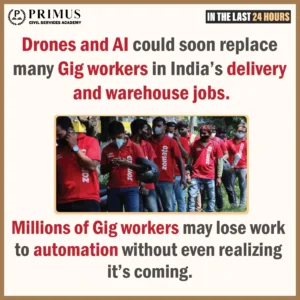
The next wave of layoffs in India might not be in offices but on the streets
Relevance to UPSC
GS Paper III: Indian Economy, Employment & Technology
- Economic disruption—AI and automation threaten the livelihoods of over 12 million gig workers, indicating a structural transformation of India’s labour market.
- Impact on inclusive growth—risk of deepening income inequality and unemployment, especially among youth and low-skill workers.
- Shift in growth model—from labour-intensive to tech-driven sectors, demanding new strategies for sustainable employment generation.
- Emerging technologies—use of drones, robotics, and AI in logistics and services reshaping productivity, efficiency, and future work models.
- SDGs—challenges to achieving decent work and economic growth (SDG 8) and reducing inequalities (SDG 10).
- Impact of technological change (AI/automation) on employment policy, requiring updates to labour laws and workforce protection mechanisms.
- Challenges of the gig economy and informal workforce—highlighting governance gaps, lack of social security, and need for welfare inclusion (e-Shram, Code on Social Security).
More About the News
- India’s ~12 million-strong gig workforce faces disruption as AI-driven automation (drones/robots) begins replacing low-skill delivery and dark-store jobs.
- Many gig workers lack formal employment status, social security and upskilling pathways, making them highly vulnerable to technological displacement.
- While still growing, the gig sector’s ability to absorb young unemployed may weaken if large-scale automation and technology adoption accelerate.
Gig Economy
The gig economy refers to a labor market characterized by short-term, flexible, freelance or contractual work facilitated largely through digital platforms. It has grown rapidly with the rise of app-based services like Uber, Swiggy, and Urban Company. This model reflects the global shift toward technology-driven, on-demand work.
Evolution of Gig Economy
- Traditional freelancing – Earlier limited to writers, artists, and small contractors. (e.g., freelance journalists in 1990s)
- Platform-based rise – With internet penetration, platforms like Upwork, Fiverr emerged in the 2000s.
- App-based model – Smartphones enabled services like Uber (2009) and Zomato/Swiggy (2014-15).
- Pandemic boost – COVID-19 increased reliance on delivery workers, telemedicine, edtech tutors.
- Diversification – Now extends to white-collar gig work (consulting, coding, digital marketing on Toptal, Freelancer).
Features
- Flexibility – Workers choose hours; e.g., Ola drivers logging in/out anytime.
- Task-based remuneration – Pay per ride/delivery; e.g., Swiggy orders.
- Platform intermediation – Apps connect workers to consumers; e.g., Urban Company beauticians.
- Technology-driven monitoring – GPS, rating systems; e.g., Uber’s rider feedback.
- Low entry barrier – Minimal formal education/skills needed; e.g., bike + smartphone sufficient for food delivery.
Impacts
- Employment generation – Millions engaged in India; e.g., ~7.7 million gig workers (NITI Aayog, 2022).
- Supplementary income – Students/part-timers earning via freelancing on Fiverr.
- Urban service efficiency – Quick commerce (Blinkit, Zepto) meets rising demand.
- Social inclusion – Women/disabled persons access remote freelancing; e.g., online tutoring.
- Economic growth driver – Gig economy could create 90 million jobs in India by 2030 (BCG report).
Advantages
- Flexibility for workers – Control over schedules; e.g., Uber drivers.
- Consumer convenience – 24/7 services; e.g., Swiggy Instamart groceries.
- Entrepreneurial opportunities – Freelancers run independent businesses; e.g., graphic designers on Upwork.
- Skill diversification – Multiple gigs allow varied experience; e.g., coders switching between projects.
- Boost to digital economy – Expands online payment adoption; e.g., UPI integration with gig platforms.
Disadvantages
- Job insecurity – No guaranteed income; e.g., Ola drivers during lockdowns.
- Lack of social security – No PF/ESI benefits; e.g., Swiggy delivery partners.
- Algorithmic exploitation – Dynamic pricing cuts worker earnings; e.g., Uber surge pricing benefits platform.
- Mental & physical strain – Long working hours for incentives; e.g., Blinkit riders under tight deadlines.
- Inequality – Limited to urban areas; rural India still excluded.
Challenges Faced
- Regulatory ambiguity – Are gig workers employees or contractors? (Case: UK Supreme Court ruling Uber drivers as workers, 2021)
- Low bargaining power – Platforms unilaterally set terms. (Swiggy strikes for better pay)
- Digital divide – Rural workers excluded due to lack of access.
- Income instability – Seasonal demand fluctuations; e.g., fewer rides during lockdowns.
- Safety & insurance issues – Delivery partners at risk without adequate coverage.
Government Initiatives
- Code on Social Security, 2020 – Includes gig and platform workers in social security framework.
- e-Shram Portal (2021) – National database for unorganised workers including gig workers.
- PM-SYM – Pension scheme for unorganised workers (can cover gig workforce).
- Skill India / PMKVY – Reskilling to prepare workers for new gig opportunities.
- State-level schemes – Rajasthan’s Platform-based Gig Workers Act, 2023 ensures welfare board and fund.
Best Practices
Global:
- UK (Uber case, 2021) – Supreme Court recognised Uber drivers as “workers” entitled to minimum wage, holiday pay.
- California (Prop 22, 2020) – Mixed model: gig workers remain contractors but receive benefits like accident insurance.
India:
- Rajasthan Gig Workers Act, 2023 – First state law to protect gig workers, mandates welfare fund.
- Karnataka Digital Economy Mission – Promotes freelancing hubs and skilling programs for gig workforce.
Way Forward
- Clear legal framework for worker classification.
- Social security coverage (insurance, PF-like schemes).
- Encourage platform accountability for fair wages.
- Promote digital literacy & rural inclusion.
- Foster tripartite dialogue among government, platforms, and workers.
The gig economy is a double-edged sword—while it drives innovation, jobs, and consumer convenience, it also creates new vulnerabilities for workers. India’s future lies in balancing flexibility with protection, making the gig sector a sustainable engine for inclusive growth.
Prelims MCQ
Q. With reference to the Gig Economy in India, consider the following statements:
1. The Code on Social Security, 2020, legally recognises gig and platform workers.
2. The Rajasthan Gig Workers Act, 2023, is India’s first state-level legislation dedicated to gig workers’ welfare.
3. Gig workers are entitled to Employees’ Provident Fund (EPF) benefits under existing labour laws.
Which of the above statements is/are correct?
A. 1 and 2 only
B. 2 and 3 only
C. 1 and 3 only
D. 1, 2 and 3
Correct Answer: (a) 1 and 2 only
Explanation:
- Statement 1 – Correct: The Code on Social Security, 2020 legally recognises gig and platform workers and includes them within the social security framework.
- Statement 2 – Correct: The Rajasthan Gig Workers Act, 2023 is India’s first dedicated state legislation for the welfare of gig and platform workers.
- Statement 3 – Incorrect: Gig workers are not entitled to EPF benefits under existing labour laws. They are recognised separately from regular employees.
Hence, the correct answer is (a) 1 and 2 only.
Mains Question
Q. The gig economy reflects the future of work but exposes vulnerabilities in labour rights and social security. Critically analyse the evolution, opportunities, and challenges of the gig economy in India. Suggest measures to ensure a balance between innovation and worker welfare.
Blue Origin scrubs launch of Escapade Mars mission due to bad weather

Relevance to UPSC
GS Paper III – Science & Technology & Space Missions
- The mission’s objective to study Mars’ magnetosphere and atmospheric loss links to planetary science, technological capability, and space‐research investment.
- Use of heavy-lift reusable rockets and involvement of private sector ties into technological innovation, commercialization of space, cost‐efficiency, and future space economy.
- Reflects environmental/space environment concerns (space weather effects, atmospheric loss) and how advanced missions inform climate/planetary studies and long-term sustainability of space activities.
More About the News
- Blue Origin delayed its Escapade mission to Mars aboard the New Glenn rocket due to cumulus cloud rule safety concerns.
- The twin spacecraft “Blue” and “Gold” aim to investigate Mars’ magnetosphere and atmospheric loss, launching via a heavy-lift reusable rocket.
- The scrubbed launch underscores weather and regulatory constraints in commercial spaceflight, even as private entities push reusable rocket tech.
Mars Orbiter Mission (MOM)
Space exploration symbolizes human curiosity and scientific advancement, fostering innovation, global cooperation, and strategic strength. India’s growing space capabilities reflect its aspiration for self-reliance, scientific leadership, and planetary understanding.
Mars Orbiter Mission (MOM) – Overview
- Also known as: Mangalyaan
- Launched by: Indian Space Research Organisation (ISRO)
- Launch date: 5 November 2013
- Launch vehicle: PSLV-C25 (Polar Satellite Launch Vehicle)
- Launch site: Satish Dhawan Space Centre, Sriharikota.
- India became:
- 1st Asian nation to reach Mars orbit.
- 1st country globally to do so in its maiden attempt.
Agencies Involved
- Primary agency: Indian Space Research Organisation (ISRO)
- Supporting agencies:
- Indian Deep Space Network (IDSN), Byalalu
- ISRO Telemetry, Tracking and Command Network (ISTRAC)
- Space Applications Centre (SAC)
- Vikram Sarabhai Space Centre (VSSC)
- Liquid Propulsion Systems Centre (LPSC)
- Primary agency: Indian Space Research Organisation (ISRO)
Objectives of the Mission
Scientific Objectives:
Study Martian surface features, morphology, and atmosphere.
Analyse mineral composition and methane presence (potential indicator of life).
Understand dust storms and escape processes of Mars’ atmosphere.
Technological Objectives:
Demonstrate India’s capability in interplanetary space missions.
Develop and operate deep space communication, navigation, and autonomy systems.
Test onboard systems, power management, and orbit manoeuvring for deep space conditions.
Important Technologies Used:
Liquid Apogee Motor (LAM): For interplanetary orbit insertion.
Deep Space Network (IDSN): For long-distance communication and tracking.
Autonomous Navigation & Control Systems: To manage signal delays (~20 min between Earth and Mars).
Compact spacecraft design: Lightweight (≈1337 kg total mass).
Solar array system: Generating ~840 W power.
Main Parts and Payloads
Instrument | Purpose |
Mars Colour Camera (MCC) | Imaging Martian surface and atmosphere. |
Thermal Infrared Imaging Spectrometer (TIS) | Studying surface composition and thermal emissions. |
Methane Sensor for Mars (MSM) | Detecting methane presence. |
Lyman Alpha Photometer (LAP) | Measuring deuterium-hydrogen ratio for water loss study. |
Mars Exospheric Neutral Composition Analyser (MENCA) | Analyzing composition of Martian exosphere. |
Important Successful Missions of ISRO
- Chandrayaan-1 (2008): Confirmed presence of water on the Moon.
- Mars Orbiter Mission (2013): India’s first interplanetary mission.
- Chandrayaan-2 (2019): Orbiter successfully studying Moon from orbit.
- Chandrayaan-3 (2023): Soft landing near lunar south pole – historic achievement.
- Aditya-L1 (2023): India’s first solar observatory mission.
- PSLV-C37 (2017): Launched 104 satellites in a single mission – world record.
Highlights of Mars Orbiter Mission
- Cost: ₹450 crore only (~$74 million) — one of the cheapest Mars missions ever.
- Designed and completed in just 18 months.
- Operated successfully for over 8 years (designed lifespan: 6 months).
- Produced valuable scientific data and over 1000 images of Mars.
- Showcased India’s cost-effective and efficient space engineering.
Need for Such Space Explorations
- Scientific advancement: Understanding planetary systems and evolution.
- Technological innovation: Drives indigenous R&D in robotics, communication, materials.
- Strategic prestige: Enhances India’s status among spacefaring nations.
- Economic potential: Boosts space commerce and satellite exports.
- Inspiration for youth: Fosters scientific temper and innovation culture.
Challenges in Building Space Missions
- Miniaturization & weight constraints for interplanetary launch.
- Deep space communication delay and autonomous decision-making.
- Thermal management under varying solar conditions.
- Precise trajectory control for orbit insertion millions of kilometres away.
- Limited budget and resources compared to major space agencies.
Way Forward
- Strengthen R&D for reusable launch vehicles and interplanetary propulsion.
- Promote public-private partnerships under ISRO’s IN-SPACe and NSIL.
- Expand planetary missions — e.g., Shukrayaan (Venus Mission) and Gaganyaan (Human Spaceflight).
- Invest in space-based AI and autonomous navigation.
- Encourage international collaboration in data sharing and deep space research.
India’s Mars Orbiter Mission exemplifies affordable innovation and global leadership in space technology, paving the way for future deep-space explorations, scientific discovery, and enhanced planetary understanding.
Prelims MCQ
Q. Consider the following statements: (PYQ 2016)
1. The Mangalyaan launched by ISRO is also called the Mars Orbiter Mission.
2. It made India the second country to have a spacecraft orbit Mars after the USA.
3. It made India the only country to be successful in making its spacecraft orbit Mars in its very first attempt.
Which of the statements given above is/are correct?
A. 1 only
B. 2 and 3 only
C. 1 and 3 only
D. 1, 2 and 3
Statement 1 – Correct: Mangalyaan is officially called the Mars Orbiter Mission (MOM) — India’s first interplanetary mission.
Statement 2 – Incorrect: India was not the second country; the USSR and the European Space Agency had already orbited Mars before India.
Statement 3 – Correct: India became the first nation to reach Mars orbit in its maiden attempt — an unprecedented success.
Hence, the correct answer is (c) 1 and 3 only.
Mains Question
Q. Discuss India’s achievements in the field of Space Science and Technology. How the application of this technology has helped India in its socio-economic development? (PYQ 2016)
Daaru, chakna and 'party all night': New videos from Bengaluru prison surface

Relevance to UPSC
GS Paper II – Governance & Accountability
- Raises questions about the accountability of public officials (warders / jail officials) and the mechanisms to enforce discipline in correctional institutions.
- Underlines the challenge of effective governance in penal institutions, needing reforms in correctional services, transparency and citizen trust.
GS Paper III – Internal Security
- The incident shows security vulnerabilities (unauthorised mobile phones, access privileges) in high-security prison facilities, representing internal security risk.
- Demonstrates need for modernization of prison services (surveillance, digital monitoring, staff accountability) under reforms for national internal security architecture.
More About the News
- A viral video from Bengaluru’s Parappana Agrahara prison shows inmates drinking liquor, dancing and partying — images of blatant security breach.
- High-risk inmates including a serial rapist and alleged ISIS recruiter were seen with mobile phones, TVs and VIP-style privileges in the jail.
- Karnataka government orders high-level inquiry and promises strict action to plug prison lapses and restore institutional credibility.
Prison Reforms
Prison reforms in India aim to transform jails from punitive institutions into centers of reformation and rehabilitation, ensuring justice, dignity, and reintegration of prisoners into society through humane and constitutional approaches.
Historical Overview
- Pre-Independence Era: Prisons were primarily instruments of punishment under colonial rule; focus was on control, not reform.
- Indian Jail Committee (1919–1920): Recommended classification of prisoners, vocational training, and improved living conditions.
- Post-Independence: Reformative justice gained prominence through recommendations by committees and Supreme Court judgments emphasizing human rights.
- Justice A.N. Mulla Committee (1980–83): Advocated for a National Prison Commission and reorientation towards reformation.
Constitutional and Statutory Provisions
- Article 21: Ensures the Right to Life and Personal Liberty — includes dignity and humane treatment of prisoners.
- Article 39A: Mandates free legal aid to ensure fair trial.
- Article 14: Guarantees equality before law, applicable to all, including prisoners.
- Article 42: Ensures humane conditions of work, indirectly applicable to prison labor.
- Prisons Act, 1894: Primary law governing prison administration — outdated and criticized for colonial character.
- Prison Manuals (Model Prison Manual, 2016): Provides updated guidelines on prison management, rights, health, and rehabilitation.
Regulation of Prisons in India
- State Subject (List II, Entry 4): Prison administration is the responsibility of individual state governments.
- Ministry of Home Affairs (MHA): Issues advisories and Model Prison Manuals to guide states.
- National Crime Records Bureau (NCRB): Collects and publishes prison data annually.
- Director General (Prisons): Oversees state-level management, under Home Department.
- District Jail Authorities: Handle daily prison operations under state supervision
Issues Faced by Prisons
- Overcrowding: Occupancy rate exceeds 130% in several states.
- Undertrial Prisoners: Over 75% of inmates are undertrials — violation of Article 21.
- Poor Infrastructure: Lack of sanitation, healthcare, and separate facilities for women and juveniles.
- Human Rights Violations: Reports of custodial violence, torture, and suicides.
- Inadequate Staff: High inmate-to-guard ratio and lack of trained personnel.
- Poor Rehabilitation Programs: Limited access to education, skill training, or post-release support.
Major Committee Recommendations
- Mulla Committee (1980–83):
- Emphasized rehabilitation over retribution.
- Suggested separation of undertrials and convicts.
- Recommended National Prison Commission and modern training for prison staff.
- Justice V.R. Krishna Iyer Committee (1987):
- Advocated for legal aid, speedy trials, and humanization of prisons.
- Model Prison Manual (2016):
- Promotes open prisons, vocational training, recreational facilities, and use of technology for record-keeping.
- Law Commission of India (268th Report, 2017):
- Recommended bail reforms, decriminalization of minor offences, and reducing undertrial population.
Way Forward
- Modernize Prison Infrastructure: Smart surveillance, digitized records, and separate facilities for vulnerable groups.
- Undertrial Management: Use of technology for virtual hearings, fast-track courts, and regular bail reviews.
- Focus on Rehabilitation: Skill development, education, and post-release employment assistance.
- Community and NGO Involvement: Encourage public participation in reformation efforts.
- Adopt Open Prison Model: Encourage reform through trust, labor, and social reintegration.
- Training and Sensitization: Professional training for prison staff on human rights and psychology.
- Legislative Reform: Replace the outdated Prisons Act, 1894, with a modern Correctional Services Act.
Future prison reforms must prioritize transformation over punishment, ensuring dignity, reformation, and reintegration of prisoners through humane governance, modern infrastructure, and a rehabilitative justice approach aligned with constitutional values.
Prelims MCQ
Q. With reference to India, consider the following statements: (PYQ 2021)
1. When a prisoner makes out a sufficient case, parole cannot be denied to such prisoner because it becomes a matter of his/her right.
2. State Governments have their own Prisoners Release on Parole Rules.
Which of the statements given above is/are correct?
A. 1 only
B. 2 only
C. Both 1 and 2
D. Neither 1 nor 2
Statement 1 – Incorrect: Parole is not a fundamental or legal right. It is a discretionary relief granted by prison authorities under specified conditions.
Statement 2 – Correct: Since prisons are a State subject (List II, Seventh Schedule), State Governments frame their own parole rules under the Prisons Act, 1894.
Hence, the correct answer is (b) 2 only.
Mains Question
Q. National Human Rights Commission (NHRC) in India can be most effective when its tasks are adequately supported by other mechanisms that ensure the accountability of a government. In light of above observation assess the role of NHRC as an effective complement to the judiciary and other institutions in promoting and protecting human rights standards. (PYQ 2014)
Assam cabinet clears bill banning polygamy, compensation for affected women
Relevance to UPSC
GS Paper I – Society
- Deals with social practice of polygamy, impact on women’s rights, traditional/traditional-tribal customs & social change.
- Examines cultural diversity, role of customary practices (in Sixth Schedule regions) and their challenge under modern law reform.
GS Paper II – Governance, Constitution & Social Justice
- Addresses gender justice and empowerment of women, aligning with constitutional values (Equality before law, Article 14; Prohibition of discrimination, Article 15).
- Raises questions of interplay between uniformity of marriage laws and exceptions under the Sixth Schedule—federal structure, tribal autonomy and inclusive governance.
More about the News
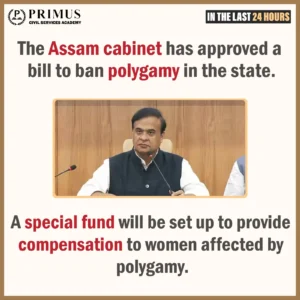
- The Assam Cabinet approved the “Assam Prohibition of Polygamy Bill, 2025”, banning polygamy statewide (except some tribal areas).
- Under the Bill, offenders may face up to seven years’ rigorous imprisonment, making polygamy a cognisable offence.
- A compensation fund will be created to assist women affected by polygamous marriages, ensuring social support and redress.
Caste System in India
The caste system in India is a traditional social stratification mechanism dividing society into hierarchical groups based on birth and occupation. While it historically structured social roles and responsibilities, it also led to social inequalities and discrimination. Despite legal abolition of untouchability, caste continues to influence socio-economic and political dynamics in India.
Evolution of the Caste System in India
- Vedic Period: The Varna system classified society into Brahmins, Kshatriyas, Vaishyas, and Shudras based on occupational duties.
- Post-Vedic/Medieval Period: The Jati system emerged with hundreds of sub-castes defining social and occupational identity.
- Colonial Period: British administration formalized caste classifications for census and governance purposes.
- Post-Independence: The Constitution abolished untouchability (Article 17) and introduced affirmative action policies.
- Modern Era: Caste remains a key factor in politics, social mobility, and access to resources.
Features of the Caste System
- Hereditary: Caste identity is inherited at birth.
- Occupational Specialization: Each caste traditionally linked to specific professions.
- Endogamy: Marriage generally occurs within the same caste.
- Social Hierarchy: Caste groups are ranked, influencing social status and privileges.
- Religious Sanction: Often justified and reinforced through religious texts and beliefs.
Need for a Caste System
- Social Order: Provided a structured framework for roles and duties. Example: Brahmins as priests maintained religious rituals.
- Occupational Continuity: Ensured specialized skills passed through generations. Example: Blacksmith castes produced tools for communities.
- Cultural Identity: Preserved unique traditions and customs of each group. Example: Rajputs retaining martial heritage.
- Community Support: Social networks provided support during crises. Example: Jati-based community funds for weddings and emergencies.
- Political Representation: Caste representation ensured voices of certain groups were acknowledged in councils. Example: Zamindar influence in local governance.
Issues with Caste System
- Social Inequality: Lower castes faced systemic discrimination. Example: Dalits denied temple entry.
- Limited Mobility: Restricted occupational choices. Example: Shudras confined to menial jobs.
- Untouchability: Segregation and social exclusion. Example: Denial of access to wells and public spaces.
- Inter-caste Conflicts: Competition over resources led to violence. Example: Caste riots in Bihar and Uttar Pradesh.
- Hindrance to Meritocracy: Social status often prioritized over talent. Example: Certain elite castes monopolizing education and employment opportunities.
Impacts of the Caste System
- Economic Disparities: Scheduled Castes and Tribes remain underrepresented in high-income jobs. Example: Low representation in corporate leadership.
- Political Dynamics: Caste-based vote banks influence election outcomes. Example: Mandal Commission politics in 1990s.
- Educational Inequalities: Marginalized castes have lower literacy rates. Example: SC/ST literacy gap in rural India.
- Social Stratification: Maintains hierarchical social structures. Example: Preference for same-caste interactions in rural villages.
- Cultural Segregation: Certain customs and festivals remain caste-specific. Example: Community-specific religious festivals.
Challenges Faced
- Eradicating Discrimination: Persistent social biases against Dalits and backward classes. Example: Manual scavenging still prevalent.
- Reservation Backlash: Opposition from upper castes regarding affirmative action. Example: Protests against OBC quotas.
- Political Manipulation: Caste mobilization for electoral gains can create tensions. Example: Caste-based alliances and conflicts.
- Urban-Rural Divide: Caste discrimination persists in rural areas despite urban dilution. Example: Segregated neighborhoods in villages.
- Data Limitations: Incomplete caste data hampers policy targeting. Example: Lack of comprehensive caste census data.
- Eradicating Discrimination: Persistent social biases against Dalits and backward classes. Example: Manual scavenging still prevalent.
Caste Census
- Purpose: Collect detailed caste-based demographic data to improve policy-making, especially for SC/ST/OBC welfare.
- Latest Effort: India conducted caste enumeration as part of the Socio-Economic and Caste Census (SECC) 2011, with plans for updates under debate.
- Significance: Helps implement affirmative action, reduce inequalities, and target subsidies effectively.
Way Forward
- Promote social awareness and education to reduce caste prejudices.
- Strengthen the implementation of legal safeguards like the Scheduled Castes and Tribes (Prevention of Atrocities) Act.
- Encourage inter-caste marriages and community integration.
- Conduct a comprehensive caste census for better policymaking.
- Empower marginalized groups through skill development and economic opportunities.
The caste system, while historically structuring Indian society, continues to influence socio-economic and political dynamics. Efforts must focus on eradicating discrimination, ensuring equitable opportunities, and promoting social harmony. A balanced approach integrating legal, educational, and social reforms is essential for an inclusive future.
Prelims MCQ
Q. Which Constitutional provision abolishes “untouchability” in India?
A. Article 15
B. Article 17
C. Article 19
D. Article 21
Correct Answer: (b) Article 17
Explanation: Article 17 of the Indian Constitution explicitly abolishes untouchability
and forbids its practice in any form. It also declares that enforcement of any disability arising out of untouchability
shall be an offence punishable by law.
Mains Question
Q. Examine the evolution of the caste system in India and analyze its continuing socio-economic and political impact. Suggest measures to mitigate caste-based inequalities.
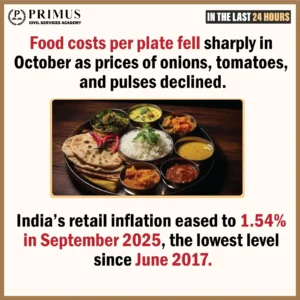
Per plate food cost see sharp drop in October as onion, tomato, pulse prices tumbled: CRISIL
Relevance to UPSC
GS Paper II: Social Justice
- Highlights the role of government in regulating agricultural production, imports (pulses), and ensuring food supply chain stability, important for welfare policy.
- Underlines social welfare implications—lower food costs improve living standards, especially for vulnerable households, tying into inclusive growth and governance of welfare schemes.
GS Paper III: Health, Food Security & Food Inflation
- The sharp drop in the cost of a home-cooked thali reflects easing food inflation, impacting household expenditure and consumption patterns.
- Declines in key commodity prices (onion, tomato, pulses) show supply‐side dynamics and import policies influencing food security and affordability.
- The trend is relevant to macro-economic management (inflation control, purchasing power) and links to fiscal/monetary policy effectiveness in India.
More about the News
- The cost of preparing a home-cooked vegetarian thali fell about 17 % year-on-year in October; non-veg thali dropped nearly 12 %.
- Steep declines in onion (-51 %), tomato (-40 %), potato (-31 %) and pulses (-17 %) drove the fall in everyday meal costs.
- Despite vegetable price drops, rising edible-oil (+11 %) and LPG (+6 %) costs limited further decline in overall meal costs.
Consumer Price Index (CPI)
The Consumer Price Index (CPI) is a statistical measure that examines the average change in prices paid by consumers for goods and services over time. It is a key indicator of inflation and cost of living, informing monetary policy, wage adjustments, and social welfare measures. Accurate CPI measurement is critical for economic planning, financial stability, and protecting vulnerable populations.
Background
- Introduced globally in the early 20th century as a tool to measure cost of living changes.
- In India, CPI was first compiled in 1947 by the Labour Bureau to monitor price changes for industrial workers.
- Currently, CPI data is compiled for Rural, Urban, and Combined categories and for specific groups like agricultural laborers (CPI-AL) and rural laborers (CPI-RL).
Evolution
- Early CPI focused on urban industrial workers (WPI used more for wholesale prices).
- 2011: CPI (Rural + Urban) introduced as the official measure for inflation by the Ministry of Statistics & Programme Implementation (MoSPI).
- Ongoing updates include base year revisions (latest 2019=100) and inclusion of digital consumption patterns.
Key Data Sets
- All-India CPI for Agricultural Labourers (CPI-AL)
- Consumer Price Index for Rural Labourers (CPI-RL)
- Combined CPI (Urban + Rural) for general inflation measurement
- Monthly and year-on-year inflation trends (e.g., August 2025: CPI-AL rose 0.76% month-on-month, CPI-RL 0.69%).
Features of CPI
- Measures price changes for a representative basket of goods & services.
- Includes food, clothing, housing, transport, health, education.
- Reflects consumer cost of living rather than wholesale prices.
- Updated periodically for accuracy with changing consumption patterns.
- Used for policy, wage adjustments, and inflation targeting.
Uses of CPI
- Inflation monitoring for RBI monetary policy.
- Adjusting wages and pensions for cost of living changes.
- Social welfare planning (e.g., subsidies, MNREGA wages).
- Economic research and forecasting.
- Price indexation in contracts and taxation.
Advantages of CPI
- Monetary Policy Guidance: Helps RBI adjust repo/CRR rates to control inflation.
- Social Welfare Planning: Determines MGNREGA wages, PDS entitlements.
- Economic Benchmarking: Helps track purchasing power and cost-of-living trends.
- Indexation of Salaries and Pensions: Ensures real income protection; e.g., DA adjustments for central government employees.
- Transparent Policy Tool: Provides clear data for fiscal and subsidy decisions.
Disadvantages of CPI
- Urban Bias: Basket may overrepresent urban spending habits.
- Excludes Quality Changes: Fails to account for improved product quality over time.
- Regional Variations Ignored: May not reflect local price trends accurately.
- Lagging Indicator: Monthly CPI updates may not capture sudden price shocks.
- Data Collection Issues: Misreporting or delays can affect accuracy, e.g., informal market prices.
Impacts of Its Usage
- Policy Decisions: Inflation targeting by RBI using CPI trends.
- Wage Adjustments: DA revisions for government employees based on CPI.
- Subsidy Allocation: PDS and social security programs calibrated on CPI data.
- Investment Planning: CPI informs bond yields, inflation-indexed securities.
- Public Awareness: Citizens track inflation and cost of living for household budgeting.
Challenges Faced:
- Changing Consumption Patterns: Digital goods and services not fully captured.
- Data Collection in Rural Areas: Logistical difficulties in remote areas.
- Informal Economy: Prices in unorganized sectors are often excluded.
- Regional Disparities: CPI may understate inflation in certain states.
- Time Lag: Data compilation delays reduce real-time usefulness.
Recommendations by Committees
Expert Group on CPI (2014, MoSPI):
- Update basket items periodically.
- Include more rural consumption patterns.
- Improve data collection methods using technology.
Government Measures:
- Revised base year to 2019=100.
- Regular monthly publication of CPI data by MoSPI.
- Integration of CPI in inflation targeting framework by RBI.
- Expansion of rural and occupational-specific indices like CPI-AL and CPI-RL.
Best Global Practices
- US: Bureau of Labor Statistics (BLS) regularly updates consumption basket and weights.
- EU: Harmonized Index of Consumer Prices (HICP) allows cross-country inflation comparison.
- Japan: Includes quality-adjusted price changes for durable goods.
- UK: Uses nationwide online and offline price collection for real-time accuracy.
Way Forward
- Incorporate digital and online consumption patterns.
- Improve real-time data collection via technology and big data.
- Expand regional and income-group-specific CPIs.
- Use CPI as a decision-support tool for targeted subsidies and monetary policy.
- Enhance public understanding and transparency of CPI methodology.
Types of Price Indexes
Type of Index | Features | Advantages | Disadvantages |
Consumer Price Index (CPI) | Measures retail prices for consumer goods & services | Reflects cost of living, guides policy | May not capture quality or regional variation |
Wholesale Price Index (WPI) | Measures price changes at wholesale/producer level | Tracks producer-level inflation | Doesn’t reflect consumer prices directly |
Producer Price Index (PPI) | Prices received by producers | Early inflation indicator | Excludes services, consumer-level impact |
GDP Deflator | Measures price changes of all goods/services in GDP | Comprehensive measure of economy-wide inflation | Less frequent, not useful for monthly adjustments |
Table of Key Items Included and Excluded in CPI
Category | Key Items Included | Key Items Excluded |
Food & Beverages | Rice, wheat, pulses, vegetables, fruits, milk, meat, eggs, sugar, edible oils, tea, coffee | Alcoholic beverages, tobacco (in some CPI variants), packaged snacks |
Housing | Rent for housing, fuel for cooking/heating, maintenance charges | Purchase of land or property, real estate investment |
Clothing & Footwear | Garments, shoes, sandals, traditional clothing | Luxury designer wear, imported footwear |
Fuel & Light | LPG, kerosene, electricity, firewood | Petrol, diesel (sometimes tracked separately in WPI) |
Transport & Communication | Public transport, bus fares, telephone, mobile charges, internet services | Personal vehicle purchase, insurance premiums |
Medical & Health | Medicines, doctor consultations, hospital charges | Cosmetic surgery, luxury health services |
Education | Tuition fees for school/college, books, stationery | Private coaching or overseas education fees |
Recreation & Culture | Newspapers, cinema, cultural activities | Luxury recreation, foreign travel |
Miscellaneous | Personal care items, domestic services, household goods | Luxury consumer goods, speculative investments |
CPI remains a cornerstone of economic planning and inflation management. Modernization, regional inclusivity, and digital integration will enhance its accuracy and policy relevance. Accurate CPI measurement ensures informed decision-making and protects citizens’ purchasing power in a rapidly evolving economy.
Prelims MCQ
Q. Consider the following statements about the Consumer Price Index (CPI) in India & select the correct answer:
1. CPI measures changes in the price of a basket of consumer goods and services.
2. CPI-AL is used for setting minimum support prices for crops.
3. CPI data is used by RBI for inflation targeting.
Options:
A. 1 and 2 only
B. 2 and 3 only
C. 1 and 3 only
D. All of the above
Correct Answer: (c) 1 and 3 only
Explanation:
- Statement 1 – Correct: CPI tracks the change in prices of a basket of goods and services representing consumer spending habits.
- Statement 2 – Incorrect: Minimum Support Prices (MSPs) are determined mainly by the Commission for Agricultural Costs and Prices (CACP)
- Statement 3 – Correct: The RBI uses CPI (combined) as the key measure for inflation targeting under the monetary policy framework.
Mains Question
Q. Critically examine the role of Consumer Price Index (CPI) in India’s economic policy framework. Discuss its advantages, limitations, and the steps needed to make CPI a more inclusive and real-time indicator of inflation.