

November 11th Current Affairs
Table of Contents
UPSC Current Affairs – July 24th
Stay connected via Google News Follow us for the latest travel updates and guides. July11th Current Affairs <a href=”https://primusias.com”>Home</a> /
UPSC Current Affairs – July 18th
Stay connected via Google News Follow us for the latest travel updates and guides. July18th Current Affairs <a href=”https://primusias.com”>Home</a> /
UPSC Current Affairs – July 17th –
Stay connected via Google News Follow us for the latest travel updates and guides. July17th Current Affairs <a href=”https://primusias.com”>Home</a> /
UPSC Current Affairs – July 16
Stay connected via Google News Follow us for the latest travel updates and guides. July 16th Current Affairs <a href=”https://primusias.com”>Home</a>
UPSC Current Affairs – July 15th
Stay connected via Google News Follow us for the latest travel updates and guides. July15th Current Affairs <a href=”https://primusias.com”>Home</a> /
UPSC Current Affairs – July 14th
Stay connected via Google News Follow us for the latest travel updates and guides. July14th Current Affairs <a href=”https://primusias.com”>Home</a> /
UPSC Current Affairs – July 13th
Stay connected via Google News Follow us for the latest travel updates and guides. July13th Current Affairs <a href=”https://primusias.com”>Home</a> /
UPSC Current Affairs – July 11th
Stay connected via Google News Follow us for the latest travel updates and guides. July11th Current Affairs <a href=”https://primusias.com”>Home</a> /
UPSC Current Affairs – July 10th
Stay connected via Google News Follow us for the latest travel updates and guides. July10th Current Affairs <a href=”https://primusias.com”>Home</a> /
UPSC Current Affairs – July 9th
Stay connected via Google News Follow us for the latest travel updates and guides. July 9th Current Affairs <a href=”https://primusias.com”>Home</a>
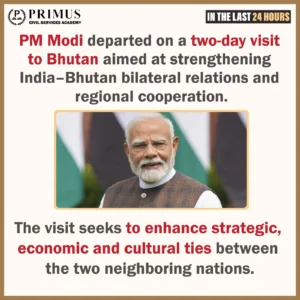
PM Modi Leaves for Two-Day Visit to Bhutan to Strengthen Bilateral Ties
Relevance to UPSC
GS Paper II: International Relations
- Strengthening India’s Neighbourhood First Policy through enhanced bilateral cooperation and mutual trust with Bhutan.
- Promotion of regional stability and strategic ties amid evolving geopolitical dynamics in South Asia.
- Focus on cross-border connectivity, trade, and people-to-people relations reinforcing India’s role as a trusted development partner.
- Consolidation of soft power diplomacy through cultural exchange and participation in Bhutan’s national celebrations.
More About the News
- PM Modi departed for a two-day visit to Bhutan aimed at deepening the “special friendship” and cooperation between the two nations.
- During the trip, the PM will co-inaugurate the 1,020 MW Punatsangchhu‑II Hydroelectric Project, jointly developed by India and Bhutan.
- The visit aligns with the celebrations of the 70th birth anniversary of Bhutan’s Fourth King and takes place amid the ongoing Global Peace Prayer Festival in Thimphu, where PM Modi will participate
India-Bhutan Relations
Components | Data |
Evolution of Ties | • 1949: India–Bhutan Treaty of Friendship: India became responsible for Bhutan’s defense and foreign policy guidance. • 1971: Bhutan became the UN member with India’s support. • 2007: Revised Friendship Treaty: recognized Bhutan’s sovereignty and allowed an independent foreign policy while maintaining special relations with India. • 2014 onwards: Strengthened strategic, economic, and hydropower cooperation. • 2021–2025: Regular high-level visits; focus on trade, energy, connectivity, and security. |
Trends & Important Data Sets | • Trade (2025): ~$1.1 billion; India’s exports dominate (~$1 billion), machinery, vehicles, petroleum products. • Imports from Bhutan: hydropower, agricultural products, handicrafts. • Hydropower: India imports ~1,500–1,600 MW electricity; key projects: Chukha, Tala, Kurichhu, Punatsangchhu. • People-to-people contact: scholarships, cultural exchanges, tourism, and Indian educational institutions attended by Bhutanese students. |
Major Issues | • Hydropower tariffs and revenue-sharing negotiations. • Trade imbalance in India’s favor. • Limited infrastructure & connectivity in remote regions. • External influence (China) in Bhutan affecting India–Bhutan strategic interests. |
Border Issues & Length | • Total border length: 699 km. • Indian states sharing border: Sikkim, West Bengal, Assam, Arunachal Pradesh. • Border largely peaceful; minor disputes occasionally arise over pasture land and riverine demarcation. • Coordination through India’s Ministry of Home Affairs & Bhutan’s Ministry of Foreign Affairs. |
Trade Ties | • Bilateral trade (2025): ~$1.1 billion; India accounts for ~90% of Bhutan’s trade. • India exports: petroleum products, vehicles, machinery, food items. • Bhutan exports: hydropower, agricultural products, handicrafts. • India provides preferential trade & concessional credit lines to Bhutan. |
Defence Deals / Agreements | • India provides training to Royal Bhutan Army & Royal Bhutan Police. • Joint exercises and infrastructure support for border security. • India oversees Bhutan’s external defense under the 1949 Treaty (udated in 2007). • India assists in counter-insurgency operations along Bhutan–India border (e.g., NSCN-IM operations in 2003). |
Strengths in Ties | • Strong strategic partnership; Bhutan is India’s closest ally in the Himalayas. • Peaceful border & shared geopolitical interests. • Hydropower cooperation contributes to India’s renewable energy goals. • Cultural, educational, and people-to-people linkages are robust. |
Weaknesses in Ties | • Trade imbalance favors India. • Bhutan’s limited economic diversification, it is dependendant on India. • External pressures from China on Bhutan’s foreign policy. |
Challenges Faced | • Maintaining strategic trust amid China’s influence. • Infrastructure limitations affect trade & connectivity. • Hydropower tariff negotiations require careful diplomacy. • Border management in remote mountainous terrain. |
Potential of Ties | • Expand hydropower projects and electricity trade. • Enhance trade & investment in infrastructure, tourism, and IT. • Joint initiatives in climate resilience, disaster management, and sustainable development. • Strengthen India’s strategic foothold in the Eastern Himalayas. |
Common Groupings & Initiatives | • BBIN, BIMSTEC, SAARC. • Act East Policy integrates Bhutan in regional connectivity projects. • Joint infrastructure projects: roads, bridges, hydropower corridors. |
Way Forward | • Continue hydropower expansion with fair revenue sharing. • Strengthen infrastructure & connectivity (roads, bridges, digital links). • Maintain strategic alignment while supporting Bhutan’s sovereignty. • Counterbalance external influence (China) via deeper economic & security cooperation. • Promote people-to-people & cultural exchanges for long-term goodwill. |
Prelims MCQ
Q. Consider the following statements:
1. India is Bhutan’s largest trading partner and the main source of its foreign investments.
2. The India-assisted Punatsangchhu-II Hydroelectric Project is the first hydropower project in Bhutan built without any Indian financial or technical support.
3. The India–Bhutan Friendship Treaty of 2007 replaced the 1949 Treaty of Perpetual Peace and Friendship, enhancing Bhutan’s sovereign decision-making.
Which of the statements given above is/are correct?
A. 1 and 3 only
B. 2 only
C. 1 and 2 only
D. 1, 2 and 3
Correct Answer: (a) 1 and 3 only
Explanation:
- Statement 1 – Correct: India is Bhutan’s largest trading and development partner, providing aid and investments in hydropower, connectivity, and digital infrastructure.
- Statement 2 – Incorrect: The Punatsangchhu-II Hydroelectric Project is being developed with Indian financial and technical assistance — not without Indian support.
- Statement 3 – Correct: The India–Bhutan Friendship Treaty (2007) replaced the 1949 treaty, modernizing relations and granting Bhutan greater autonomy while maintaining close ties.
Hence, the correct answer is (a) 1 and 3 only.
Mains Question
Q. The India–Bhutan relationship exemplifies a balance between strategic necessity and shared development goals. Critically analyze this statement in the context of India’s Neighbourhood First Policy and Bhutan’s hydropower-led economic strategy.
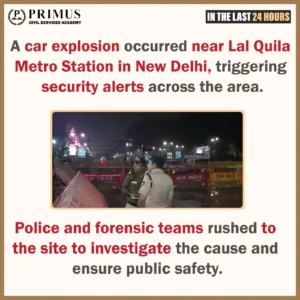
Car Blast Near Lal Quila Metro in New Delhi
Relevance to UPSC
GS Paper III: Internal Security, Disaster Management & Infrastructure
- Demonstrates the importance of urban disaster preparedness and capacity building of fire and emergency services.
- Calls for technological integration such as AI-enabled surveillance and real-time monitoring for public safety.
- Highlights the need for critical infrastructure protection in crowded areas like metro stations and heritage sites.
More About the News
- A vehicle exploded near Lal Quila Metro Station in New Delhi at about 6:52 PM, causing nearby cars to catch fire and cause multiple casualties.
- The Delhi Police confirmed on-site deployment of senior officials and several injured persons have been admitted to Lok Nayak Jai Prakash (NLNJ) Hospital for treatment.
- The Delhi Fire Service dispatched seven fire-tender units, controlled the blaze by 7:29 PM and remained on high alert at the scene.
Red Fort
The Red Fort, a UNESCO World Heritage Site in Delhi, stands as a magnificent symbol of Mughal grandeur, architectural excellence, and India’s enduring journey from imperial rule to sovereign nationhood.
When and by Whom It Was Built?
- Constructed between 1638 and 1648 CE by Mughal Emperor Shah Jahan, after shifting the Mughal capital from Agra to Shahjahanabad (Delhi).
- Designed by Ustad Ahmad Lahori, the principal architect of the Taj Mahal.
Why Was It Built?
- Built as the main residence of the Mughal emperors and the center of administration and power for nearly 200 years.
- Intended to represent imperial authority and cultural prosperity, showcasing the strength of the Mughal Empire.
- Also served as a defensive fortification, strategically located along the Yamuna River.
Significance
- Served as the political nerve centre of the Mughal Empire until 1857.
- Symbolizes India’s freedom and sovereignty — from the site where the British captured Bahadur Shah Zafar (1857) to where the Prime Minister hoists the National Flag annually.
- Represents the fusion of Persian, Timurid, and Indian architectural traditions, reflecting India’s syncretic heritage.
Architectural Highlights
- Built from red sandstone, giving it the name Lal Qila.
- Layout follows the Mughal charbagh (four-part garden) pattern.
- Important structures within the fort:
- Lahori Gate – main ceremonial entrance.
- Diwan-i-Aam – hall of public audience.
- Diwan-i-Khas – hall of private audience, once housed the Peacock Throne.
- Moti Masjid and Rang Mahal – reflect Mughal aesthetics.
- Example of Mughal military architecture blended with artistic ornamentation – arches, domes, marble inlay, and calligraphy.
Impact on India’s Culture and Tourism
- A major cultural and historical landmark, attracting millions of tourists annually.
- Hosts the Sound and Light Show, narrating India’s history.
- Promotes heritage conservation and cultural tourism, contributing to local economy and global cultural diplomacy.
- A site for national celebrations, reinforcing patriotic sentiments.
Relevance to India Till Date
- Since India’s Independence in 1947, the Prime Minister delivers the Independence Day address from the ramparts of the Red Fort every year.
- Serves as a symbol of national pride, freedom, and unity.
- Venue for cultural events, military parades, and international visits, integrating history with modern identity.
- Managed by the Archaeological Survey of India (ASI) under heritage preservation efforts.
As India progresses into the future, the Red Fort remains a timeless emblem of resilience and unity, bridging the nation’s glorious past with its dynamic aspirations for cultural and democratic excellence.
Prelims MCQ
Q. With reference to the cultural history of India, consider the following statements: (PYQ 2018)
1. White marble was used in making Buland Darwaza and Khankah at Fatehpur Sikri.
2. Red sandstone and marble were used in making Bara Imambara and Rumi Darwaza at Lucknow.
Which of the statements given above is/are correct?
A. 1 only
B. 2 only
C. Both 1 and 2
D. Neither 1 nor 2
Correct Answer: (d) Neither 1 nor 2
Explanation:
- Statement 1 – Incorrect: The Buland Darwaza at Fatehpur Sikri was built by Akbar in 1601 to commemorate his victory over Gujarat. It is made primarily of red sandstone with marble inlays, not white marble.
- Statement 2 – Incorrect: The Bara Imambara and Rumi Darwaza in Lucknow (built by Nawab Asaf-ud-Daula in the 18th century) were constructed using brick and lime plaster, not red sandstone or marble.
Hence, both statements are incorrect.
Mains Question
Q. How will you explain that Medieval Indian temple sculptures represent the social life of those days? (PYQ 2022)
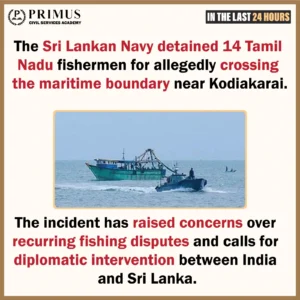
Sri Lankan Navy Arrests 14 Tamil Nadu Fishermen Near Kodiakarai
Relevance to UPSC
GS Paper II: International Relations
- Highlights maritime boundary disputes and bilateral tensions between India and Sri Lanka.
- Impacts regional diplomacy, fisheries agreements, and Indian foreign policy in the Indian Ocean region.
- Raises concerns about Indian citizens’ rights abroad and the need for effective consular and diplomatic safeguards.
GS Paper III: Internal Security
- Reflects on the security of India’s maritime zones and protection of coastal livelihoods.
- Brings into focus governance of the informal sector (fisherfolk), maritime surveillance and enforcement infra.
- Affects sustainable livelihood frameworks and linkages between marine economy and national security.
More About the News
- Fourteen fishermen from Tamil Nadu were arrested by the Sri Lankan Navy while fishing near Kodiakarai, and their boat was seized.
- Twelve of them belonged to Vanakiryai village and the remaining two from Cuddalore and Tharangambadi districts of Tamil Nadu.
- They were taken to the Kankesanthurai naval camp and then handed over to Sri Lanka’s fisheries department at Jaffna for further action.
India-Sri Lanka Relations
Components | Data |
Evolution of Ties | • 1948: Sri Lanka (then Ceylon) gained independence; India established diplomatic relations. • 1954: India signed Trade and Friendship agreements with Ceylon. • 1983–2009: India was involved in the Sri Lankan Civil War (IPKF 1987–1990). • 2000s: Focus shifted to trade, investment, and maritime cooperation. • 2015 onwards: Strengthened economic, defense, and maritime ties; India helped post-flood & tsunami reconstruction. • 2021–2025: Close cooperation in infrastructure, ports, renewable energy, and cultural ties. |
Trends & Important Data Sets | • Trade (2025): ~$3.67 billion; India’s exports: petroleum, vehicles, machinery, pharmaceuticals. • Imports from Sri Lanka: tea, spices, garments, coconut products. • India is Sri Lanka’s largest trade partner. • Tourism & people-to-people exchanges: over 1 million Indian tourists annually pre-pandemic. • Indian investment in Sri Lanka: ports (Trincomalee), renewable energy & infrastructure projects. |
Major Issues | • Past ethnic conflict in Sri Lanka & India’s involvement (IPKF). • Fisheries disputes in Palk Strait (Tamil Nadu fishermen vs Sri Lanka Navy). • Debt concerns from Chinese-funded infrastructure projects (Hambantota Port). • Strategic influence in Indian Ocean amidst China’s presence.. |
Border Issues & Length | • No land border; maritime boundary defined by Palk Strait & Gulf of Mannar (~100 km width at closest point). • Indian states closest to Sri Lanka: Tamil Nadu, Kerala. • Issues: fishing rights, illegal migration & smuggling in maritime zones. |
Trade Ties | • Bilateral trade (2023): ~$5.4 billion. • India exports petroleum, vehicles, machinery, pharmaceuticals. • Sri Lanka exports tea, spices, garments, coconut products. • Connectivity via maritime routes and air freight; focus on increasing investments. |
Defence Deals / Agreements | • Maritime security cooperation: joint naval exercises, patrols in the Palk Strait & the Bay of Bengal. • Training of Sri Lankan defense personnel in India. • India provides coastal radar and surveillance equipment. • Counter-terrorism & counter-piracy collaboration. |
Strengths in Ties | • Historic, cultural, and religious linkages (Hindu & Buddhist heritage). • Strong economic & trade relationship. • Close maritime security cooperation. • India is a preferred partner for infrastructure, education, and development assistance. |
Weaknesses in Ties | • Fisheries disputes remain unresolved. • Growing Chinese influence in ports and strategic infrastructure. • Occasional political sensitivity over the Tamil issue. • Heavy dependence of Sri Lanka on external debt funding. |
Challenges Faced | • Managing maritime boundary conflicts (Palk Strait, Gulf of Mannar). • Balancing China’s growing role in Indian Ocean. • Ensuring smooth trade & investment amid Sri Lanka’s economic instability. • Handling ethnic & domestic political concerns. |
Potential of Ties | • Expand maritime trade & port connectivity (East Coast ports, Colombo). • Strengthen renewable energy cooperation (solar, wind). • Promote tourism, education, and cultural exchanges. • Enhance India’s strategic influence in Indian Ocean & Indo-Pacific region. |
Common Groupings & Initiatives | • SAARC, BIMSTEC, IORA. • Trilateral initiatives with Maldives for Indian Ocean security. • Joint participation in Indian Ocean naval exercises (MILAN). |
Way Forward | • Resolve fisheries disputes via joint mechanisms. • Increase investments in ports, infrastructure, and renewable energy. • Strengthen maritime security & surveillance cooperation. • Promote people-to-people, cultural, and educational exchanges. • Counterbalance China’s Indian Ocean presence with strategic engagement. |
Prelims MCQ
Q. Elephant Pass, sometimes seen in the news, is mentioned in the context of the affairs of which one of the following? (PYQ 2009)
A. Bangladesh
B. India
C. Nepal
D. Sri Lanka
Correct Answer: (d) Sri Lanka
Explanation:
- Elephant Pass is a strategic narrow land strip in northern Sri Lanka connecting the Jaffna Peninsula to the mainland.
- It has been the site of several major battles between the Sri Lankan Army and the LTTE during the Sri Lankan Civil War.
- Control of Elephant Pass is crucial for military and transport access to the northern region of Sri Lanka.
Mains Question
Q. India is an age-old friend of Sri Lanka. Discuss India’s role in the recent crisis in Sri Lanka in the light of the preceding statement. (PYQ 2022)
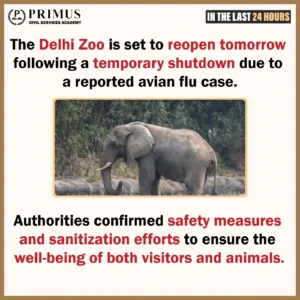
Delhi Zoo to Reopen Tomorrow After Temporary Closure Over Avian Flu Case
Relevance to UPSC
GS Paper III: Environment & Ecology
- Highlights the risk and management of zoonotic outbreaks like avian influenza in urban wildlife facilities.
- Underlines the role of biosafety protocols, surveillance and contingency planning in public-health ecosystems.
- Demonstrates the governance of animal-human interface zones under frameworks like the Action Plan for Preparedness, Control and Containment of Avian Influenza.
- Touches upon wildlife conservation, urban green spaces and their safe reopening in the wake of biological emergencies.
More about the News
- The National Zoological Park, Delhi will reopen from 8 November after closure since 30 August due to a confirmed avian influenza case in its waterbird aviary.
- Extensive disinfection, repeated sampling and biosafety measures under the ministry’s guidelines cleared the facility for reopening.
- The reopening signals resumed visitor access, but health and safety protocols (including surveillance) will continue to be strictly enforced.
Avian Influenza (H5N1 Bird Flu)
Avian Influenza (H5N1), commonly known as bird flu, is a highly contagious viral disease affecting birds and occasionally humans, posing serious threats to global health, food security, and biodiversity.
Background
- Caused by: Influenza Type A virus (H5N1 strain).
- First identified: In geese in China in 1996; first human infection in Hong Kong in 1997.
- Transmission: Mainly spreads among domestic poultry through direct contact or contaminated environments; occasional zoonotic spillover to humans.
- Classification: A notifiable disease under the World Organisation for Animal Health (WOAH) guidelines.
Impact on Animals
- Causes high mortality among domestic poultry (ducks, chickens, turkeys).
- Leads to mass culling to prevent spread — resulting in economic losses for farmers.
- Wild migratory birds act as natural reservoirs, aiding long-distance transmission.
- Affects poultry trade, food supply chains, and livelihoods dependent on animal husbandry.
Impact on Humans
- Human infections are rare but often fatal, with a high case fatality rate (~50%).
- Transmitted through direct contact with infected birds, secretions, or contaminated surfaces.
- Symptoms: Fever, cough, sore throat, pneumonia, respiratory distress.
- No sustained human-to-human transmission yet, but risk of mutation into a pandemic strain remains.
WHO Assessment
- WHO classifies H5N1 as a “public health concern” due to its pandemic potential.
- Monitors global outbreaks through Global Influenza Surveillance and Response System (GISRS).
- Recommends early detection, rapid containment, and global cooperation to limit spread.
- Advocates a One Health approach, integrating animal, human, and environmental health systems.
Preventive Measures
- Culling infected or exposed birds in affected zones.
- Surveillance and monitoring of migratory bird populations.
- Disinfection of poultry farms, markets, and equipment.
- Ban on poultry transport from affected areas.
- Use of protective gear by poultry handlers.
- Public awareness campaigns on hygiene and safe handling of poultry.
- Development of avian influenza vaccines for birds and humans.
Challenges in Prevention
- Rapid mutation of the H5N1 virus complicates vaccine effectiveness.
- Poor biosecurity measures in backyard poultry farms.
- Underreporting and delayed detection in rural regions.
- Cross-border spread via migratory birds.
- Limited coordination between veterinary and public health departments.
- Public panic and misinformation during outbreaks hinder control efforts.
Government Initiatives
- Implementation of the National Action Plan for Prevention, Control, and Containment of Avian Influenza (2021).
- Department of Animal Husbandry and Dairying (DAHD) oversees active surveillance and response.
- ICAR-NIHSAD, Bhopal functions as the national reference lab for avian influenza testing.
- Ban on import of live birds and poultry products from affected countries.
- Awareness and compensation schemes for farmers affected by culling.
- Coordination with WHO and FAO under the One Health framework.
Way Forward
- Strengthen One Health surveillance integrating human, animal, and environmental data.
- Promote biosecure poultry farming and regular vaccination drives.
- Invest in rapid diagnostic tools and mutant strain tracking.
- Enhance international data sharing and scientific collaboration.
- Educate communities on safe animal handling practices and hygiene.
- Build pandemic preparedness infrastructure through R&D and health system strengthening.
Combating Avian Influenza demands sustained One Health cooperation, technological innovation, and community awareness to safeguard global health, ensure food security, and build resilient systems against future zoonotic pandemics.
Prelims MCQ
Q. H1N1 virus is sometimes mentioned in the news with reference to which one of the following diseases? (PYQ 2015)
A. AIDS
B. Bird flu
C. Dengue
D. Swine flu
Correct Answer: (d) Swine flu
Explanation:
- The H1N1 virus is a subtype of the Influenza A virus that causes Swine Flu — a contagious respiratory disease originating in pigs.
- It spreads among humans through respiratory droplets and produces symptoms similar to seasonal influenza.
- The 2009 H1N1 pandemic led to global public health measures, emphasizing vaccination and zoonotic disease surveillance.
Mains Question
Q. India’s animal husbandry and livestock sector holds immense potential for rural income diversification, yet it faces persistent challenges of disease control, infrastructure gaps, and sustainability. Critically analyse the role of government policies and technological interventions in ensuring sustainable livestock development and animal health protection in India.
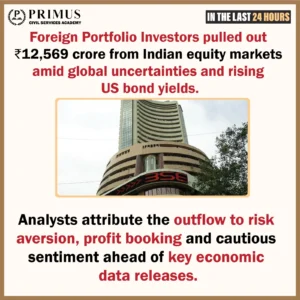
FPIs Withdraw ₹12,569 Cr from Indian Equity Markets
Relevance to UPSC
GS Paper III: Indian Economy, Foreign Direct Investments & External Borrowings
- Reflects on foreign portfolio investor (FPI) flows as a key indicator of capital market health and external investment dynamics.
- Highlights how global risk-off sentiment impacts India’s balance of payments and financial stability.
- Raises questions on the resilience of Indian equity markets and the macroeconomic implications of sustained outflows.
More about the News
- Foreign portfolio investors withdrew a net ₹12,569 crore from Indian equity markets in early November amid global risk-off and weak cues.
- This pull back follows a small inflow of ₹14,610 crore in October and precedes earlier large-scale outflows in August and September.
- Analysts note FPIs appear to favour tech-driven markets abroad and view India as an “AI-underperformer”, affecting fund allocation decisions.
Foreign Direct Investments (FPI) & Foreign Portfolio Investments (FPI)
Foreign investments such as FDI and FPI have become key drivers of India’s economic globalization, facilitating capital inflow, technology transfer, and integration with global financial and production networks.
What is it?
- FDI (Foreign Direct Investment): Investment by a foreign entity in an Indian company involving ownership, control, or management participation.
- FPI (Foreign Portfolio Investment): Investment in financial assets such as stocks or bonds without management control — purely for returns.
Objectives
- To supplement domestic capital formation.
- To promote industrial growth, employment, and infrastructure.
- To enhance global competitiveness and productivity.
- To integrate India with global financial markets.
- To stabilize the rupee and improve the balance of payments.
Significance
- Economic growth: Boosts capital inflow and industrial capacity.
- Technology transfer: Brings advanced management and production practices.
- Employment generation: Creates direct and indirect jobs.
- Export promotion: Helps develop global value chains.
- Market confidence: Strengthens investor trust in India’s regulatory environment.
Arguments in Favour
- Increases forex reserves and macroeconomic stability.
- Encourages innovation and knowledge spillovers.
- Bridges savings-investment gap.
- Promotes infrastructure and service sector expansion.
Arguments Against
- Risk of profit repatriation leading to forex outflow.
- Volatility of FPI can destabilize financial markets.
- Can lead to foreign dominance in key sectors.
- Risk of asset bubbles and speculative trading.
Challenges Faced
- Regulatory complexities and delays in clearances.
- Policy inconsistency and taxation issues.
- Geopolitical uncertainties affecting investor sentiment.
- Currency fluctuations reducing return predictability.
- Inadequate infrastructure and ease-of-doing-business gaps.
Difference Between FDI and FPI
Basis | FDI (Foreign Direct Investment) | FPI (Foreign Portfolio Investment) |
Nature of Investment | Long-term, involves ownership/control | Short-term, involves financial assets only |
Objective | To gain management control and business interest | To earn quick returns from markets |
Control | Investor has management influence | No management control |
Volatility | Stable and long-term | Highly volatile and speculative |
Sectoral Cap | Varies by sector as per FDI policy | Limited by SEBI and RBI norms |
Entry Route | Automatic or government approval route | Through stock exchanges |
Example | Toyota setting up a car plant in India | Foreign funds buying Infosys shares |
A balanced framework ensuring regulatory transparency, sectoral liberalization, and investor confidence will enable India to harness FDI and FPI as engines of inclusive, sustainable economic transformation.
Prelims MCQ
Q. With reference to Foreign Direct Investment in India, which one of the following is considered its major characteristic? (PYQ 2020)
A. It is the investment through capital instruments essentially in a listed company.
B. It is a largely non-debt creating capital flow.
C. It is an investment which involves debt-servicing.
D. It is the investment made by foreign institutional investors in Government securities.
Correct Answer: (b) It is a largely non-debt creating capital flow
Explanation:
- Foreign Direct Investment (FDI) represents long-term capital inflows by foreign entities into domestic businesses.
- FDI is non-debt creating because it does not require repayment or interest obligations, unlike external borrowings or loans.
- It contributes to technology transfer, employment generation, and increased production capacity.
- FDI differs from Foreign Portfolio Investment (FPI), which involves short-term capital in securities markets.
Mains Question
Q. Justify the need for FDI for the development of the Indian economy. Why is there a gap between MOUs signed and actual FDIs? Suggest remedial steps to be taken for increasing actual FDIs in India. (PYQ 2016)
Related
Discover more from Primus Civil Services Academy
Subscribe to get the latest posts sent to your email.